News / Blog
Announcing: The Maynard Institute is partnering with BlueLena.
Watch this space for more information on how to manage YOUR donor portal with BlueLena and FundraiseUp!


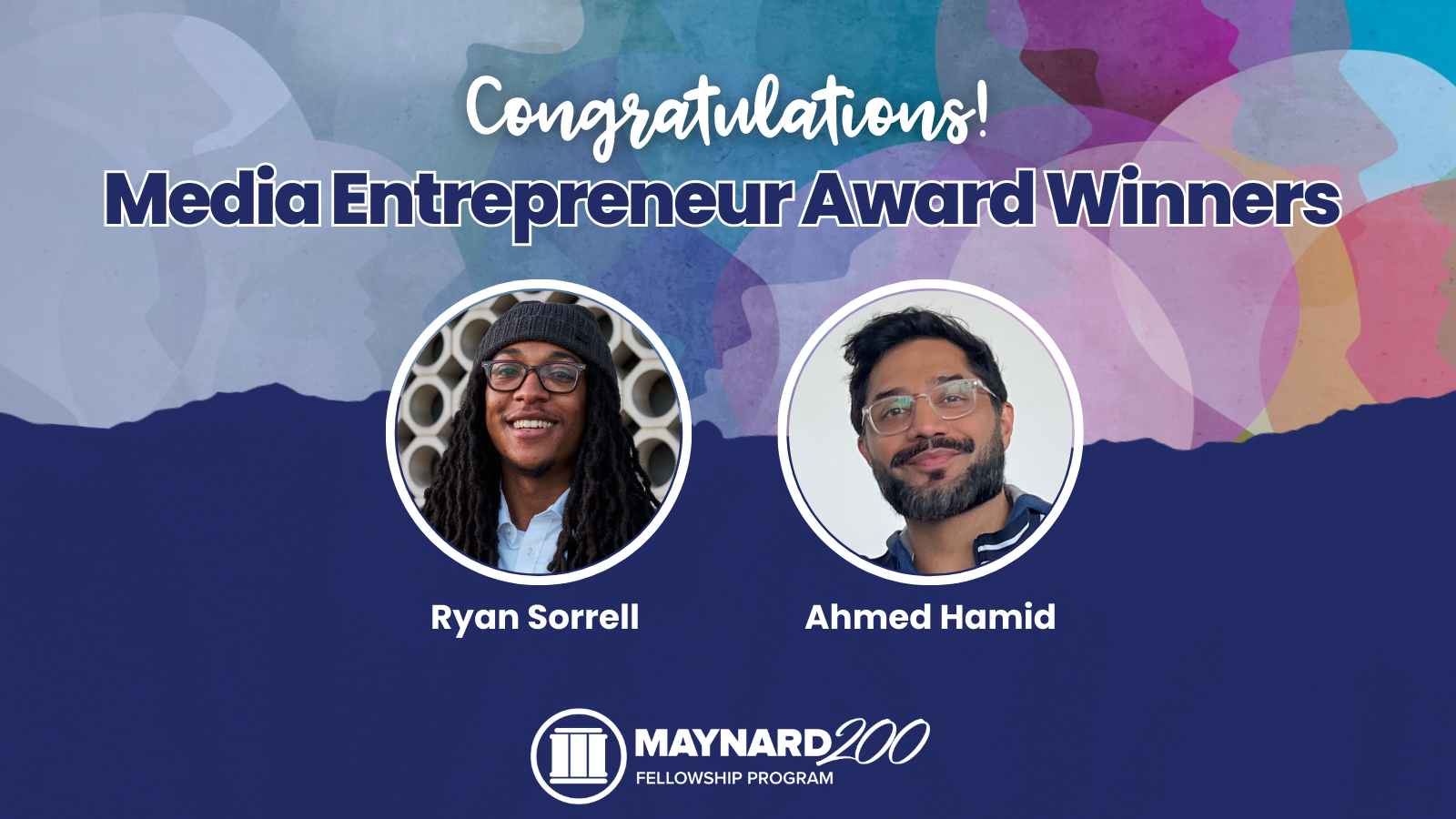
One of the Maynard Institute’s core programs, the Maynard 200 Fellowship is designed to advance the careers of investigative storytellers, executive leaders, frontline editors and media entrepreneurs of diverse backgrounds. In 2023, Executive-in-Residence Dickson Louie continued the media entrepreneurship award program originally launched in 2021. Based on the scores from a panel of media business experts, faculty, and Maynard 200 alumni, two fellows, Ryan Sorrell and Ahmed Hamid, have been recognized for their outstanding media venture pitches.
This award program would not be possible without the esteemed panel of judges. Our special thanks go to this year’s judges: Nancy Flores, Jon Funabiki, Michelle Garcia, Waylae Gregorie, Ned Hawley, Bruce Koon, Peter Lamb, Cathy Eckstein, Marla Jones-Newman, Professor Michael Sherrod, and Linda Lloyd da Silva.
Ryan Sorrell is the recipient of this year’s Dori J. Maynard Media Entrepreneurship Award for his start-up, The Kansas City Defender. This award is given to the Fellow with the top overall score from the judges. The award honors the late Dori J. Maynard, the long-time president of the Maynard Institute and the daughter of Robert C. Maynard, our Institute co-founder. The amount of this award, which is funded by Louie each year, is $1,000 and for the operating expenses of the winning start-up.
“From our in-person conversations, to your feedback and guidance, this has been a truly transformative experience that has helped me grow in my confidence and vision,” Sorrell said in thanks.
Ahmed Hamid is the recipient of this year’s Quentin Hope Metrics Award for his start-up, Refound, which verifies news images in this era of AI. The award honors Quentin Hope, who was instrumental in defining metrics in the News Table Stakes program that Institute co-executive directors, Evelyn Hsu and Martin Reynolds, had participated in. The amount of this award, which is funded by the Institute, is also $1,000.
“The camaraderie in the Maynard 200 cohort was a special part of the learning experience,” Hamid said in response to receiving the award. “It has been a special joy to meet the kind hearted and hardworking colleagues and teachers at Maynard. Thank you for guiding us all on this awesome entrepreneurial journey and adventure and for the phenomenal roster of mentors and coaches you curated throughout our learnings.”
Ryan is an artist, organizer, digital strategy consultant and media entrepreneur with a diverse background. His career includes consulting for globally-leading brands such as Meta, Samsung, Amazon, Harvard University and Google.
Ryan’s commitment to social justice began in Chicago amid the emergence of the Black Lives Matter movement. He learned from, and is inspired by, radical Black queer women in organizations such as The Black Youth Project and Assata’s Daughters. He has dedicated his career to creating change – specifically abolition of carceral institutions – through intentional community and world building.
As COVID-19 swept worldwide in 2020, Ryan worked at his corporate job in Chicago. When protests of George Floyd’s deaths began in May that year, he moved to Kansas City, Mo., to become a full-time community organizer. With his parents’ support, he lived at home and built the city’s largest direct action and mutual aid organization as protests swelled.
Frustration with how local news reported the protests and the Floyd racial reckoning led Ryan, with no background or experience in journalism, to found the most influential Black digital news outlet in Missouri and Kansas.
Under his leadership, The Kansas City Defender has broken over 10 national news stories, reached over 50 million people, grown a social media following of over 50,000 across platforms and shifted conversations regarding objectivity and traditional journalistic values in news.
Ryan’s commitment to social justice also led him to give public talks at institutions such as University of the Arts London, NPR, PBS and Kansas City Art Institute. He is strongly inspired by the tradition of the Black press and believes it a necessity to philosophically reconceptualize the role and function of news in society.
A big fan of the outdoors, Ahmed climbed Mount Kilimanjaro with his brother, a triumph that helped him realize that anything you put your mind to is possible. He is involved in using blockchain and Web 3 to enhance journalism with Refound Journalism, a startup he cofounded.
In December 2022, Refound won first place at the NEAR MetaBuild Ill hackathon. He has cultivated his passion to develop technological means to help creativity flourish and shed light on the urgent need for veracity in reporting. Hailing from Michigan, Ahmed has lived around the world including in the Maldives, Pakistan and China.
His travels from Lake Michigan to the Indian Ocean have exposed him to the tremendous diversity of thought in our world and the fragility of our free speech rights. He is very familiar with challenges and opportunities for progress in helping to keep lines of communication open for true reporting. He hopes to bring toolkits to make that easier for journalists working with Refound.
Read more about all the 2023 Maynard 200 Fellows and check out past blogs featuring award winners from 2022 and 2021.
The Maynard 200 fellowship program advances the Maynard Institute’s efforts to expand the diversity pipeline in news media and dismantle structural racism in its newsrooms. It is designed for and serves the next generation of media leaders, storytellers, editors and entrepreneurs, in order to advance their career growth and leadership power in newsrooms and organizations. The professional development program provides customized training courses, resources and 1:1 mentorship by industry professionals, to fellows who have represented a wide spectrum of racial, gender and geographic backgrounds. Maynard 200 has been supported by Craig Newmark Philanthropies, Google News Initiative and The Hearthland Foundation.
For more information about the Maynard 200 Fellowship, please reach out to:
Maynard 200 Director, Odette Alcazaren-Keeley at okeeley@mije.org.
Watch this space for more information on how to manage YOUR donor portal with BlueLena and FundraiseUp!
On Tuesday, May 19, 2026 the Maynard Institute was honored to receive the Lorraine Branham Award from Syracuse…
“Our contributions to journalism will outlast ourselves if we do it right — I’m really encouraged that there’s…
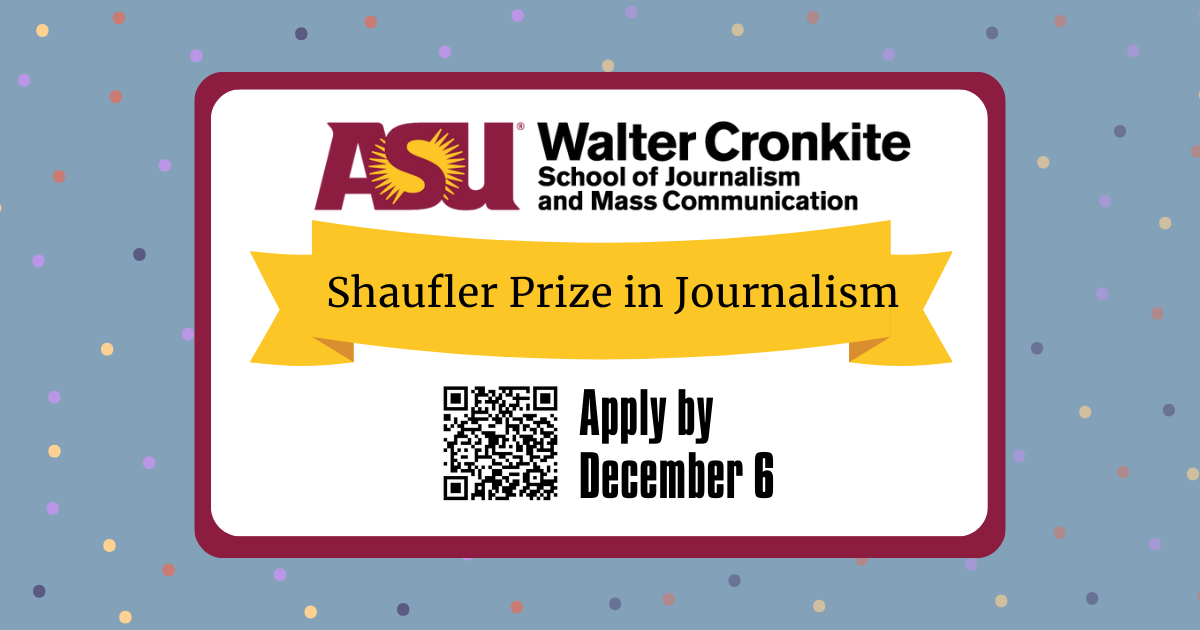
Arizona State University’s Walter Cronkite School of Journalism and Mass Communication is calling for submissions for the Shaufler Prize in Journalism. Now in its third year, the prize is awarded to the best journalism in the country that advances the understanding of stories and issues related to underserved people in society. This can include communities of color, the LGBTQIA+ community, immigrants, the disabled community, and more. The deadline to enter is December 6, 2023. There is no entrance fee, and winners will be announced in early 2024.
With great storytelling in a print, digital, audio or television platform, the best entry by a student could receive a $5,000 prize. In the professional category, the awards are $10,000 for first prize, $3,000 for second place, and $2,000 for third place.
The Shaufler Prize was established by Paul B. Anderson, the principal & CEO of Workhouse Media in Seattle, Washington to honor his late friend, Ed Shaufler, who died in late 2020. Shaufler cared deeply about promoting understanding of underrepresented people. The prize recognizes America’s best journalism advancing the understanding of stories and issues related to underserved people in society, such as communities of color, immigrants and LGBTQ+.
In previous years, the winning entries have focused on environmental racism, the life and murder of George Floyd and more. Momo Chang, the Maynard Institute’s Oakland Voices Co-Director, participated on the panel of judges for the 2nd annual prize. Winners in the professional and student categories were honored in an awards ceremony at the Cronkite School. Read more about past winners.
We’re partnering with the Kansas City Defender for Black Philanthropy Month! August is Black Philanthropy Month! Founded in…
The inaugural cohort of Fire Up Fellows represent the power and potential of diverse news in the State…
Fire Up is made possible by a budget allocation from the State of California and is part of…
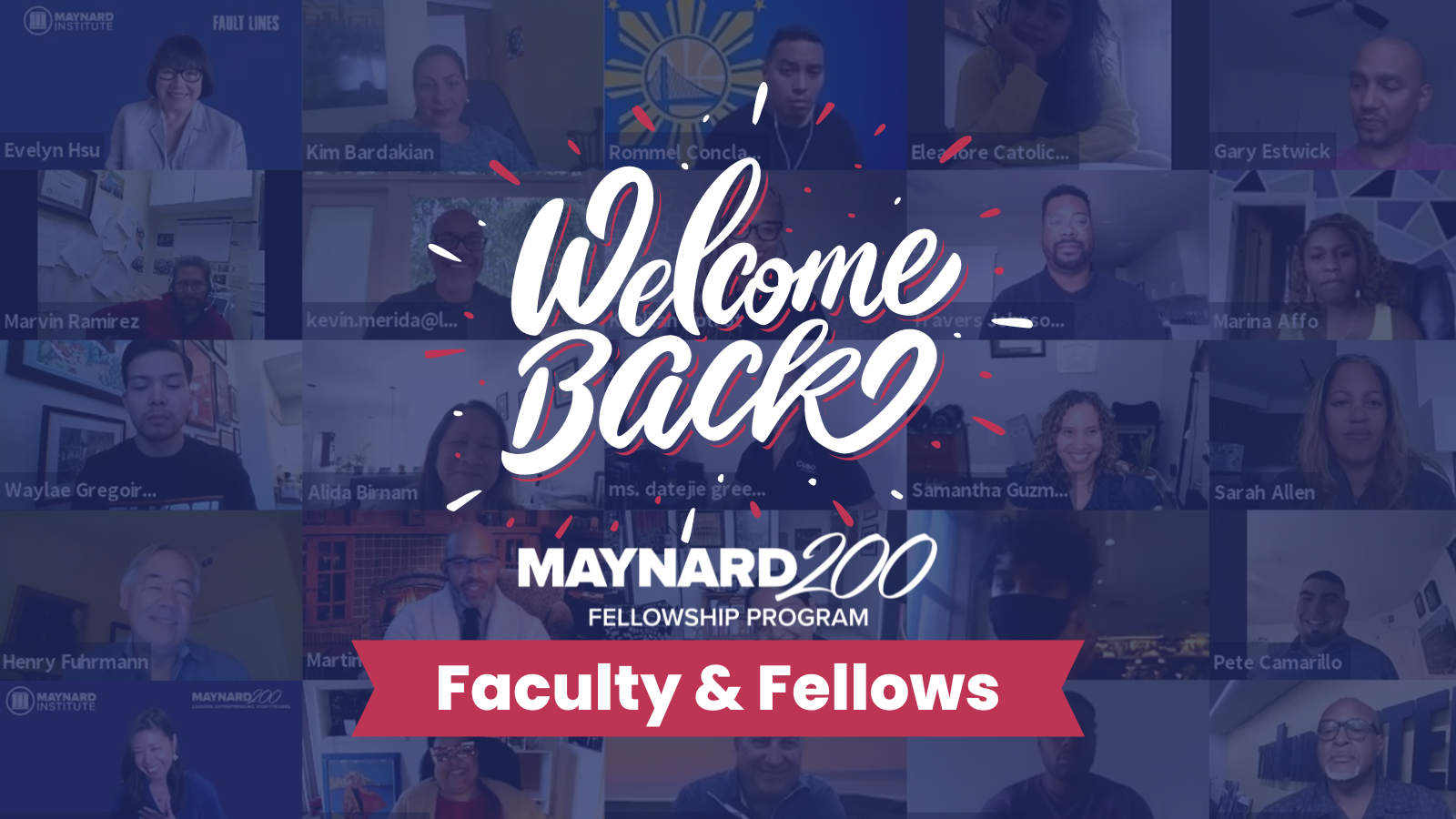
On October 23 the Maynard 200 Fellowship cohort of 2023 will reconvene for the final week of virtual programming presented by industry-leading faculty. The Maynard Institute’s cornerstone program, the Maynard 200 Fellowship promotes career growth and supports the future of inclusive and equitable journalism by providing training courses, resources, and mentorship by distinguished media professionals. The program kicked off in person at TCU Bob Schieffer College of Communication in June and will culminate this October after a final week of virtual sessions on professional development topics ranging from effective leadership and negotiation strategies to investigating large corporations and raising entrepreneurial capital.
The Maynard 200 Fellowship operates in four disciplines: Investigative Storytellers, Executive Leaders, Frontline Managers and Editors and Media Entrepreneurs and Product Developers, Executive Leaders, Frontline Managers and Editors and Investigative Storytellers. Each track is led by accomplished industry veterans such as Peabody award-winning journalist Aaron Glantz for investigative storytelling, former newsroom C-suite executive Virgil Smith for the leadership track, and retired senior editor John X. Miller for frontline editors and managers, and media strategist Dickson Louie for media entrepreneurs and product developers. This month’s virtual programming is tailored to each discipline with some overlap in areas that benefit multiple tracks.
Investigative Storytellers will benefit from a career advice session from Ron Nixon, Vice President of News and Head of Investigations, Enterprise, Partnerships and Grants at the Associated Press. In addition, two-time Pulitzer Gold Medalist and International Investigations Editor for the Associated Press Mary Rajkumar will lead a deep dive session on mounting and mannaging a major investigative project. Later, Investigative Storytellers will explore “Investigations that Make an Impact” with two-time Peabody Award-winner and Pulitzer Prize finalist Aaron Glantz, this discipline track’s executive-in-residence. Investigative Storytellers will also learn what’s involved in Taking on Large Corporations from Ziva Branstetter, senior editor at ProPublica, and Tekendra Parmar, Insider’s Tech Features Editor and an alum of the Maynard 200 Fellowship Program.
The Executive Leaders track is led by Virgil Smith, Principal of Smith Edwards Group, LLC and author of The Keys to Effective Leadership. In addition to professional networking and financial management sessions, fellows in the Executive Leaders curriculum track will also learn about “Managing Your LinkedIn Profile” from Senior Contributor to Forbes and Founder of Dream Career Club, Caroline Ceniza-Levine.
Led by executive-in-residence John X. Miller, veteran journalist and former Senior Editor for Sports, Business and Features at The Dallas Morning News, Frontline Managers and Editors will learn about “Getting to the Heart of the Story” from Tom Huang, Assistant Managing Editor for Journalism Initiatives at The Dallas Morning News. Frontline Managers and Editors will also explore the Keys to Effective Leadership in a session led by Virgil Smith before receiving tips for a successful presentation from Tom Nixon. Finally, from John X. Miller, the fellows will receive Hands on Editing and Management Coaching.
The Media Entrepreneurs and Product Developers track is led by track executive-in-residence Dickson Louie, principal of a Bay Area consultancy providing strategic planning, competitive analysis and executive development services. Session highlights include “Polishing a Pitch” from presentation designer and coach Tom Nixon, “Writing a Grant” from Jill M. Kunishima and “Raising Entrepreneurial Capital with Term Sheets” from Professor Michael Sherrod, the William M. Dickey Entrepreneur in Residence at TCU’s Neeley School of Business. Each entreprenuer and product developer will also participate in a Shark Tank-like session, pitching their proposals to a panel of judges.
Some plenary sessions benefiting all tracks include discussions on “Listening to Your Authentic Voice” with Tonya Mosley of NPR’s Fresh Air and founder and host of podcast Truth Be Told, and Ayesha Rascoe, host of NPR’s Weekend Edition Sunday, as well as “Leveraging Your Strenghts and Seizing Opportunities in a Time of Transition, Innovation and Upheaval” with Jean Marie Brown, associate professor of professional practice in the Department of Journalism at TCU Bob Schieffer College of Communication.
The business case study provides Maynard 200 Fellows with a unique opportunity to learn real-world application of evolving best practices in the industry. Participating fellows are briefed on challenges facing a present-day media organization. Team work will focus on market research and the development of proposed solutions to create a presentation to share with the news organization’s leadership at the October Maynard 200 gathering.
When first announced last year, the project was a case study of the Los Angeles Times business strategy and culminated in fellows presenting their findings and recommendations to LA Times executives. This year, the Business Case Study Challenge has expanded to include partners Mother Jones and the Dallas Morning News.
We often refer to the extended network of our program alumni as the Maynard Family. One of the main benefits of the Maynard 200 Fellowship program is access to Maynard Family mentors in the industry. The Maynard 200 Fellowship program’s unique one-on-one mentorship component continues well into 2024. After the formal training curriculum concludes in October 2023, Maynard 200 fellows are paired with a veteran media professional or issue expert who has committed to mentoring the fellow for a full year. Successful fellows meet with their assigned mentors at least once per month for conversational consults as schedules permit.
The Maynard 200 fellowship program advances the Maynard Institute’s efforts to expand the diversity pipeline in news media and dismantle structural racism in its newsrooms. It is designed for and serves the next generation of media leaders, storytellers, editors and entrepreneurs, in order to advance their career growth and leadership power in newsrooms and organizations. The professional development program provides customized training courses, resources and 1:1 mentorship by industry professionals, to fellows who have represented a wide spectrum of racial, gender and geographic backgrounds. Maynard 200 has been supported by Craig Newmark Philanthropies, Google News Initiative and The Hearthland Foundation.
For more information about the Maynard 200 Fellowship, please reach out to:
Maynard 200 Director, Odette Alcazaren-Keeley at okeeley@mije.org.
Watch this space for more information on how to manage YOUR donor portal with BlueLena and FundraiseUp!
We’re partnering with the Kansas City Defender for Black Philanthropy Month! August is Black Philanthropy Month! Founded in…
The inaugural cohort of Fire Up Fellows represent the power and potential of diverse news in the State…
This article was originally published on the Oakland Voices website.
Oakland Voices launched its 2024 Community Journalism Academy to amplify the voices of Oakland residents and change the narrative about the Town.
“This is a resilient group of people that want to tell compelling stories about Oakland,” said Rasheed Shabazz, co-director of Oakland Voices.
Shabazz developed the curriculum, building on the work of former program coordinator Brenda Payton. The academy includes training on journalism ethics, the Maynard Institute’s Fault Lines framework, news reporting, interviews, health and civic reporting, and opinion/column writing.
Working journalists support the program by leading workshops and sharing their experiences in the field and the newsroom. This year’s faculty has included Niema Jordan, Azucena Rasilla, and Spence Whitney. Grover Wehman-Brown with the housing narrative lab also led a workshop focused on writing about unhoused communities. Most training takes place at Oakland Public Libraries.
“I’m really excited about their creativity and commitment to telling stories about the people of Oakland,” Shabazz said.
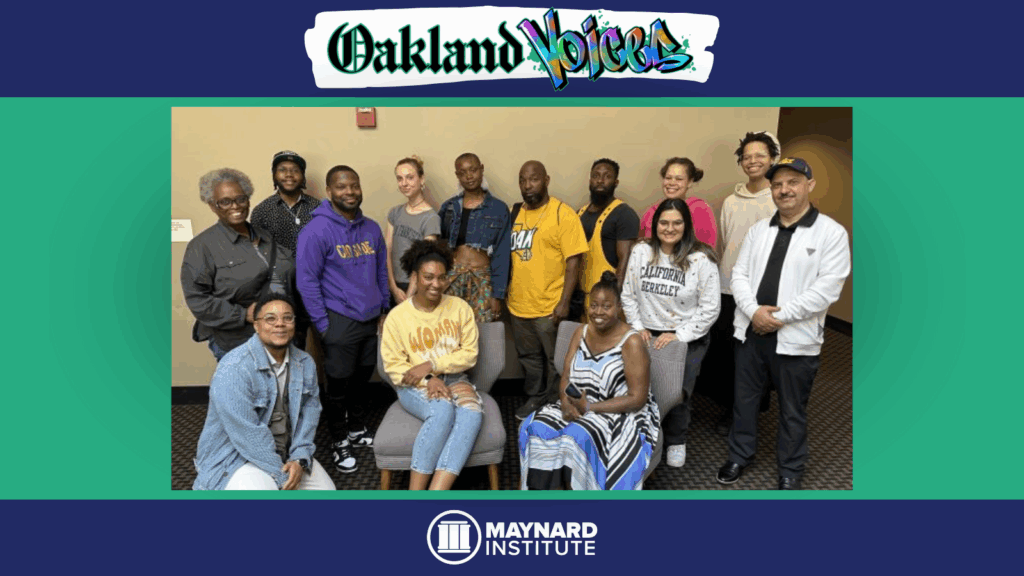
This year, nine dedicated Oakland residents are participating in the six-month program. Participants are halfway through the program. So far, they’ve learned interviewing skills through the Talk of the Town series, asking Oakland residents their opinions on different issues, and leading in-depth question and answer interviews. Correspondents are currently completing news and health feature stories.
Participants learn essential journalism ethics, practices, and storytelling skills while contributing impactful stories to the Oakland Voices website (oaklandvoices.us). This year’s program launched in May.
When correspondents complete the program, they will develop a portfolio of stories and be eligible to join Oakland Voices’ alumni program. Program alumni receive payment for contributing stories to the website along with support with publishing in other outlets.
The majority of content of the Oakland Voices site is contributed by program alum.
Since 2010, Oakland Voices has trained over 75 community storytellers to tell stories about their communities in print and online platforms, as well as radio broadcasts and live shows in partnership with KALW.
Oakland Voices emerged from a partnership between the Maynard Institute for Journalism Education and the Oakland Tribune newspaper and continues to evolve as a unique, independent, community news and information source focused on media literacy and journalism education.
By 2030, Oakland Voices hopes to train 100 Oakland community storytellers to help address the gap that has emerged from the loss of local news outlets.
Oakland Voices is a program of the Maynard Institute for Journalism Education. Oakland Voices has been supported by the California Endowment and the Akonadi Foundation.
For more than 45 years, the Maynard Institute has fought to push back against the systemic lack of diversity in the news industry through training, collaborations and convenings. Founded by Robert C. Maynard, the Institute promotes diversity and antiracism in the news media through improved coverage, hiring and business practices. We support efforts to change the narrative about Oakland by providing journalism training and a platform to amplify the voices of Oakland residents.
Watch this space for more information on how to manage YOUR donor portal with BlueLena and FundraiseUp!
On Tuesday, May 19, 2026 the Maynard Institute was honored to receive the Lorraine Branham Award from Syracuse…
“Our contributions to journalism will outlast ourselves if we do it right — I’m really encouraged that there’s…
For a print-friendly version of the open letter access the PDF file format.
For those of us who work in journalism, there is not a day that passes that we don’t see vividly how newsrooms are shrinking and how local news deserts are negatively impacting people.
So when a group of foundation leaders and heads of philanthropic organizations announced the Press Forward initiative to raise hundreds of millions of dollars to support local news, those of us who work in the field didn’t hesitate to applaud. After all, we need many more funders to understand that local news is vital to the health and sustainability of our democracy. A growing number of people are vulnerable to becoming victims of disinformation and misinformation masquerading as credible local and national news.
As the much-anticipated initiative to fortify local news ecosystems rolls out, we think it’s important to remember just what is “local news” and who are the people who have long been providing it.
The organizations that have signed this open letter represent, support, train and serve many of the journalists, leaders and founders of color who are essential to the sustainability of healthy, equitable and trustworthy local news ecosystems.
Philanthropy has a responsibility to be inclusive, intentional and transparent about how funding from this initiative is distributed. It is no secret that BIPOC-led organizations are awarded less grant money and are less trusted with how to spend that money when compared to white-led institutions. A recent Lenfest Institute/National Trust for Local News study of 103 publishers of color and outlets serving “racial, ethnic, or linguistic communities” revealed that 53 percent of them will be out of business in less than five years if current revenue trends persist.” In effect, that would undermine the stated objectives of the Press Forward initiative.
Our organizations have come together to advocate on behalf of Asian, Black, Hispanic, Indigenous and other people of color who have historically been neglected, misrepresented or tokenized. Engaging our people and our communities in Press Forward will be vital to its success and credibility. In many of the country’s most populous regions and cities, communities of color account for the majority demographic.
We are pleased to see that the funding priorities of the Press Forward initiative include “improving diversity of experience and thought.” As this initiative unfolds and decisions are made about where support is directed, we want to be clear: Racial and ethnic diversity, equity and belonging must be among the pillars of its foundation. An equitable distribution of resources and opportunities ensures that underrepresented voices are heard and elevated by journalists, leaders and publishers who know them best.
What we mean by this is:
Racial and ethnic diversity fosters trust between media outlets and underrepresented communities. When people see themselves and their experiences reflected in the news, they are more likely to engage with it and view journalism as a credible and valuable resource. We know from research done by the Trust Project that one of the indicators of trustworthiness on the part of news consumers is the inclusion of diverse voices.
If philanthropy is not intentional about addressing historical funding inequities and the processes by which they persist, it is complicit in the harm they inflict. At a time when we are seeing intentional and structural attacks on marginalized communities gain momentum in our society, this would be unacceptable.
Significant investment in the people, publications, and organizations that serve an increasingly diverse society must be made with clear-eyed intention. We commend the support many of the foundations that are part of this initiative have contributed to news ecosystems. We stand ready to help this effort any way we can; we are watching it with enthusiasm, with vigilance and concern.
As philanthropic stakeholders dedicated to supporting the growth and sustainability of local news, your commitment to these values can help shape not only the future of journalism, but also the broader fabric of our society.
Thank you.
Signed,
For media inquiries: andrews@aaja.org, jmedina@naja.com, press@nabj.org, asherry@nahj.org, mreynolds@mije.org, karolle@journalists.org, info@opennews.org
Since joining with other journalism affinity organizations and sending this open letter to Press Forward, our collective efforts to ensure equity in news funding have been covered in journalism industry news across a multitude of platforms.
For more than 45 years, the Maynard Institute has fought to push back against the systemic lack of diversity in the news industry through training, collaborations and convenings. Founded by Robert C. Maynard, the Institute promotes diversity and antiracism in the news media through improved coverage, hiring and business practices. We are creating better representation in U.S. newsrooms through our programs , which gives media professionals of color the tools to become skilled storytellers, empowered executives and inspired entrepreneurs. Donate to support our programs.
We’re partnering with the Kansas City Defender for Black Philanthropy Month! August is Black Philanthropy Month! Founded in…
The inaugural cohort of Fire Up Fellows represent the power and potential of diverse news in the State…
Fire Up is made possible by a budget allocation from the State of California and is part of…

Photo: Oakland Voices correspondents Randy Cross, Manar Harb, Patricia Morrow, Joy Quilatan, Tanna Simone, Nani Smith, Daniel Swafford, Ansel Troy, Vanessa Velasco, and Dera R. Williams.
This article was originally published on the Oakland Voices website.
Oakland Voices, a community-driven initiative, has launched its highly anticipated 2023 Community Journalism Academy, aiming to amplify the voices of Oakland residents and redefine the narrative about the town. This year, ten dedicated Oakland residents will participate in the program, acquiring essential journalism ethics, practices, and storytelling skills while contributing impactful stories to the Oakland Voices website.
This year’s program launched in May. The program curriculum includes training on journalism ethics, the Maynard Institute’s Fault Lines framework, news reporting, interviews, health- and arts & culture- reporting, and opinion/column writing.
Oakland Voices co-director Rasheed Shabazz developed the curriculum, building on the work of former program coordinator Brenda Payton. Working journalists support the program by leading workshops and sharing their experiences in the field and the newsroom. Most training takes place at Oakland Public Libraries.
“We have an amazing group this year,” exclaimed Shabazz, expressing his admiration for the passionate participants who deeply care about their communities, neighborhoods, and the issues affecting their loved ones. The program celebrates their dedication and seeks to empower them as they continue to hone their unique voices, effectively representing the diverse perspectives within Oakland.
“They are passionate about their communities, their neighborhoods, and the issues that matter to them and their loved ones,” Shabazz added. “I am grateful to work with them as they continue to develop their voices.”
When correspondents complete the program, they will develop a portfolio of stories and be eligible to join Oakland Voices’ alumni program, led by program co-director Momo Chang. Program alumni receive payment for contributing stories to the website along with support with publishing in other outlets.
Participants also earn up to $1,000 while in the academy.
With the decline in traditional newspapers and the struggle to adapt to the digital age, many local news outlets like the Oakland Tribune have ceased daily operations. As a result, residents have experienced a dearth of reliable, in-depth reporting on local events, issues, and government activities. This loss has had serious implications for civic engagement, community awareness, and accountability, as crucial stories and voices have been left untold and unheard in Oakland.
Oakland Voices has a remarkable history of helping fill this information gap since its inception in 2010. The program has trained over 70 community storytellers. These empowered voices have artfully conveyed the stories of their communities through print and online platforms, as well as radio broadcasts and live shows in partnership with KALW. The initiative’s roots in a collaboration with the Oakland Tribune newspaper have fostered its evolution as a unique, independent, and indispensable community news and information source.
Looking ahead, the program plans to launch a podcast series in 2024, expanding its reach and enhancing storytelling opportunities. By 2030, Oakland Voices envisions training 100 Oakland community storytellers, aiming to bridge the gap caused by the loss of local news outlets and to continue serving as a powerful voice for the community.
2023 Community Journalism Academy:
-Randi Cross
-Manar Harb
-Patricia Morrow
-Joy Quilatan
-Tanna Simone
-Nani Smith
-Daniel Swafford
-Ansel Troy
-Vanessa Velasco
-Dera R. Williams
Oakland Voices is a program of the Maynard Institute for Journalism Education. The program has been supported by the California Endowment, Google News Initiative, and the Akonadi Foundation.
For more than 45 years, the Maynard Institute has fought to push back against the systemic lack of diversity in the news industry through training, collaborations and convenings. Founded by Robert C. Maynard, the Institute promotes diversity and antiracism in the news media through improved coverage, hiring and business practices. We support efforts to change the narrative about Oakland by providing journalism training and a platform to amplify the voices of Oakland residents.
Watch this space for more information on how to manage YOUR donor portal with BlueLena and FundraiseUp!
We’re partnering with the Kansas City Defender for Black Philanthropy Month! August is Black Philanthropy Month! Founded in…
The inaugural cohort of Fire Up Fellows represent the power and potential of diverse news in the State…
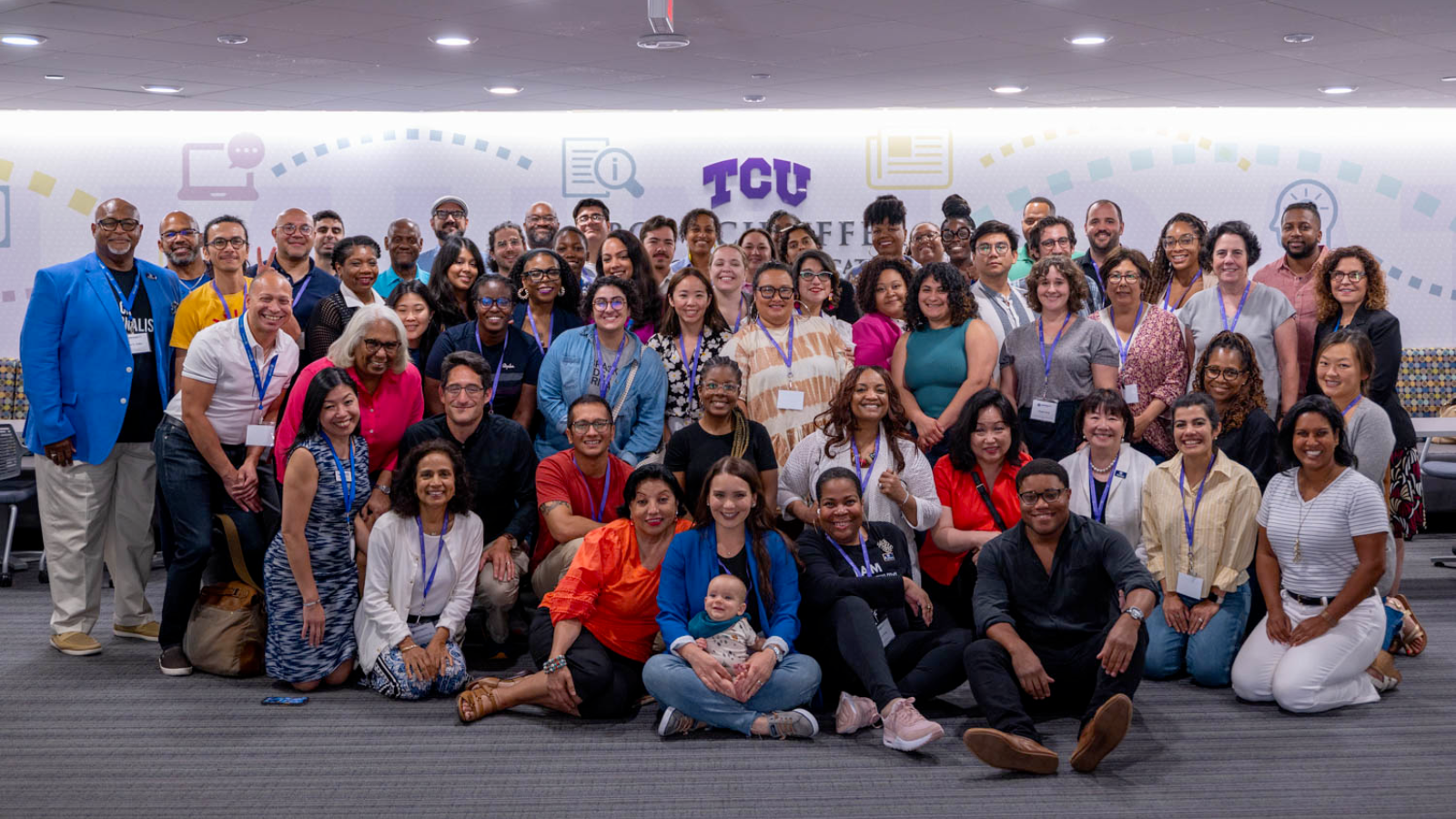
Photo credit: Bob Schieffer College of Communication
The Maynard 200 Fellowship kicked off the program with its first training week grounded in the Maynard Institute’s core DEI and Belonging framework focused on dismantling structural racism in America’s newsrooms. The 49 fellows of 2023, coming from a range of media platforms including print, broadcast, multimedia and online arrived in Fort Worth, Texas in late June, ready to work toward change and with a dedication to transforming their newsrooms for equity.
Hosted by the program’s university partner – the Bob Schieffer College of Communication at Texas Christian University (TCU) – media leaders representing diverse geographic, racial and ethnic backgrounds bonded not only in the swelter of a Texas heatwave, but also in the responsibility to bring the power of diversity, equity and belonging back to their newsrooms.
Since its inception in 2018, the Maynard 200 Fellowship has bolstered fellows’ leadership power and has contributed to the journalism industry’s impact by providing advanced training to mid-career media professionals. The curriculum is customized across learning tracks designed for investigative storytellers, frontline editors and managers, executive leaders and media entrepreneurs and product developers.
The tuition-free program’s in-person week of education and connection gave the media fellows an opportunity to participate in powerful discussions and collaborative projects that transform their work in the media world and shape their professional growth.
Fellows in three cohorts – frontline editors and managers, executive leaders and media entrepreneurs – also kicked off group projects with leading news organizations Mother Jones and Dallas News to create meaningful change in those newsrooms.
Incoming fellows are affiliated with a range of nationally recognized publications, community-powered media and emergent ventures including the New York Times, Oaklandside, KQED, Kansas City Defender and the Maynard Institute’s own community journalism training program Oakland Voices.
The fellows were collectively led through over 60 engaging training sessions delivered by 45 faculty members, some of whom were in previous Maynard 200 Fellowship cohorts. Breakout sessions were divided by the cohort tracks to share in the knowledge and skills of fellows on topics including investigative story-pitching, hands-on editing, media disruption, product strategies, financial leadership, talent recruitment and techniques for building resilience while reporting on traumatic events.
Before the in-person sessions, fellows were asked to complete the Gallup StrengthsFinder assessment. Jean Marie Brown, TCU’s Associate Professor of Professional Practice, held one-on-one sessions explaining to the fellows how to position their strengths in their work using their Gallup results.
The plenary large-group learning sessions included all fellows to foster learning from each other’s expertise and multi-layered perspectives. The goal of these sessions was to embrace each of the participants’ diverse backgrounds and life experiences.
In one session, consultant Adriana Lacy led the cohorts through a product development workshop demonstrating user interface interactions and customer experience.
Every year, the Fault Lines® session is foundational to the Maynard 200 Fellowship curriculum. The Maynard Institute’s Fault Lines® DEI training methodology explains race, gender, sexual orientation, generation, geography and class, as they apply to journalists, newsroom collaboration and coverage. Co-led with TCU faculty Jean Marie Brown and the Maynard Institute’s Co-Executive Director Martin G. Reynolds, the training is based on addressing personal bias and asks the fundamental question: How can you be a dismantler of systemic racism in your organization?
During the Fault Lines® plenary session, just as Reynolds changed the slide to read “Are you ready to get uncomfortable?” faculty and fellows learned of the U.S. Supreme Court ruling declaring affirmative action as unlawful, gutting race-conscious admissions at Harvard University and University of North Carolina with repercussions across the nation’s colleges and universities.
The news sparked an emotionally-charged and raw discussion surfacing lessons, personal experiences and remembrances of previous Supreme Court decisions impacting the daily lives of everyone in the room.
Maynard Institute Board Chair and Maynard 200 Fellowship faculty member and mentor, John X. Miller delivered an empowering speech reminding the editors, media entrepreneurs and journalists of their call to action and to use the decision as fuel for their newsrooms for change and equity. “Take that anger that you have…and turn it into action” he said.
“We recognize that we are in the position to be the change that we want to see in the world,” said Miller. “Feel as though you are empowered to make that change.”
The Maynard 200 program adheres to an all-teach, all-learn framework where not only faculty members provide training, but all participants learn from each other’s expertise and multi-layered perspectives. It embraces each of the participants’ diverse backgrounds and life experiences.
A second and final training week will be held virtually in October 2023, when the storytellers, leaders, frontline editors and entrepreneurs will finalize their business case study projects, sharing their research and lessons learned during their time in the program.
Then, the Maynard 200 Fellowship program’s unique one-on-one mentorship component continues well into 2024. After the formal training curriculum concludes in October 2023, each Maynard 200 fellow is paired with a veteran media professional or issue expert who has committed to mentoring the fellow for a full year.
Maynard 200 is the cornerstone fellowship program advancing the Maynard Institute’s efforts to expand the diversity pipeline in news media and dismantle structural racism in its newsrooms. It is designed for and serves the next generation of media leaders, storytellers, editors and entrepreneurs, in order to advance their career growth and leadership power in newsrooms and organizations. The professional development program provides customized training courses, resources and 1:1 mentorship by industry professionals, to fellows who have represented a wide spectrum of racial, gender and geographic backgrounds. Maynard 200 has been supported by Craig Newmark Philanthropies, Google News Initiative and The Hearthland Foundation.
For more information about the Maynard 200 Fellowship, please reach out to:
Maynard 200 Director, Odette Alcazaren-Keeley at okeeley@mije.org.
Watch this space for more information on how to manage YOUR donor portal with BlueLena and FundraiseUp!
We’re partnering with the Kansas City Defender for Black Philanthropy Month! August is Black Philanthropy Month! Founded in…
The inaugural cohort of Fire Up Fellows represent the power and potential of diverse news in the State…
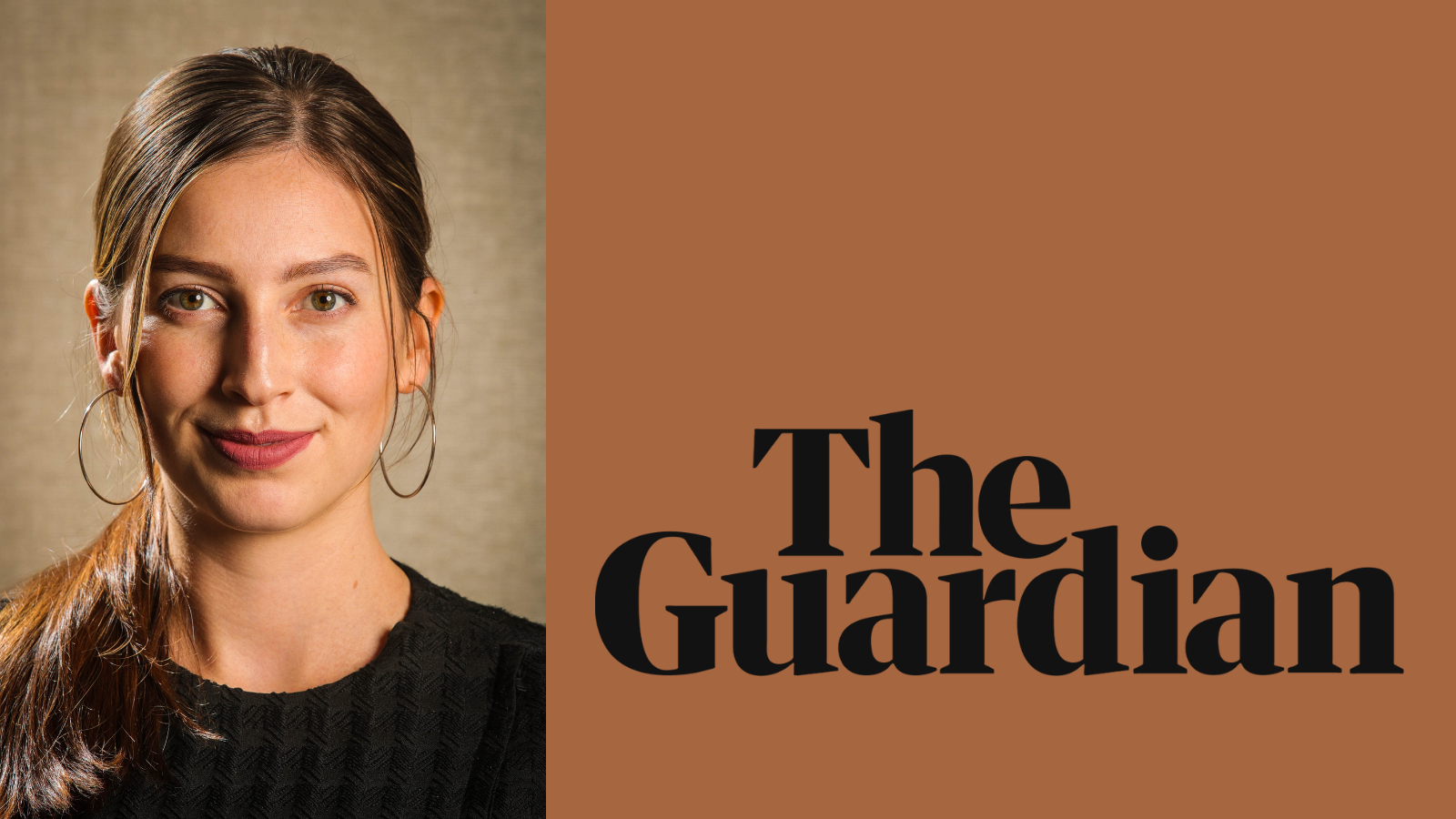
The Maynard Institute congratulates Community Engagement Manager Ava M. Macha on her new role as Audience Engagement Editor – Underrepresented Communities at The Guardian US. Macha joined the Maynard Institute in December 2019 a few months before the onset of the COVID-19 pandemic. She quickly adapted to the social climate by building the institute’s digital presence and increasing the visibility of the organization during the civil rights protests of 2020. She helped produce the popular Belonging in the News webinar series, which featured guest speakers such as Nikole Hannah-Jones, Maria Hinojosa, Wesley Lowery, Versha Sharma and more.
When sharing the news of her new role, Macha expressed gratitude for the opportunity to be part of the team and to contribute to the history of the Maynard Institute. “This amazing organization will continue to be so special to me, and has truly shaped my career trajectory,” said Macha.
Currently based in Brooklyn, New York, Macha holds a B.A. in Journalism from the University of Southern California, but she remains loyal to the Northwest and her home state of Idaho. Prior to working with the Maynard Institute, Macha was the Visual Design Fellow for Santa Barbara-based social justice magazine, Pacific Standard. She also worked as the Audience Coordinator for Los Angeles-based data journalism website, Crosstown LA. In her role, she developed relationships with South LA neighborhood council leaders to understand their community’s crime reporting needs and presented them with monthly crime statistics.
When Macha joined the Maynard Institute team in late 2019, no one could have predicted the tumultuous year ahead. The skills and experience Macha gained at the institute helped her realize that what she loved most about journalism was audience engagement work. As a mission-driven organization dedicated to diversifying the media industry and helping journalists of color advance their careers, everyone at the Maynard Institute celebrates the next step in Macha’s journey with the Guardian US, where she will remain committed to bettering coverage and engagement with traditionally underserved communities.
Macha quickly grew her position beyond coordinating individual donors and alumni communications. She took on projects large and small. For her first 2 years at the institute, Macha served as the sole driver of the organization’s online presence. In 2020, she managed a website redesign project while growing our social media presence and establishing a bi-monthly email newsletter.
She continued to manage all the fundraising appeals, successfully growing the institute’s individual and recurring donor community. Macha also used her industry knowledge to leverage larger-scale funder relationships to strategically execute match challenges for greater impact.
Macha also represented the Maynard Institute in key stakeholder relationships such as the Maynard Institute’s partnership with OpenNews and the Online News Association, Vision25: Building Equity in Newsrooms. She was instrumental in creating a series of live webcasts on the topics of diversity, equity, inclusion and belonging that featured industry thought leaders. More recently, Macha contributed to the Maynard Institute’s partnership with Politico by participating on the screening committee for the annual Politico Journalism Institute.
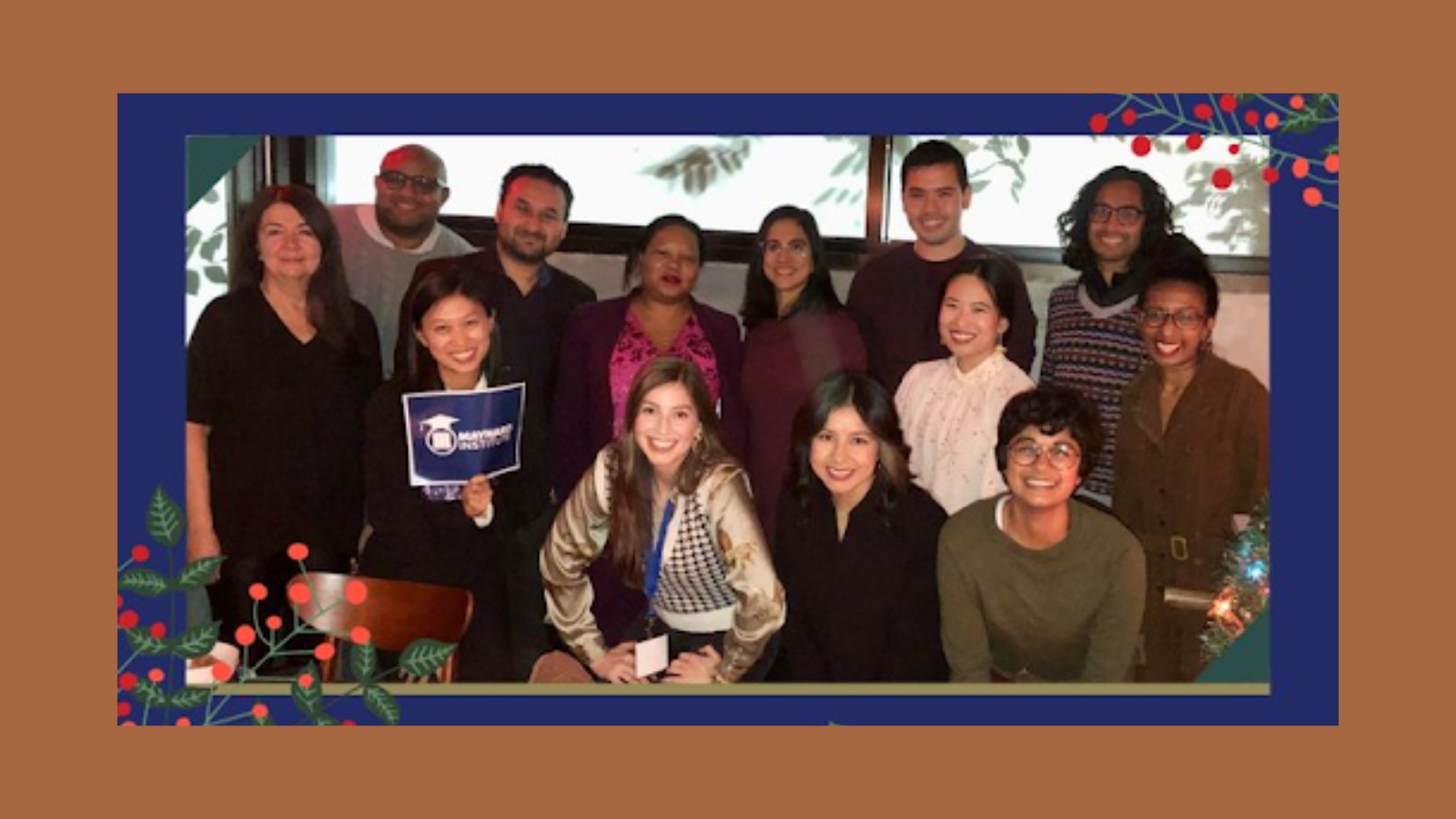
Photo: December 2022 Maynard Institute holiday happy hour mixer. Front row left to right: Jess Chou, Ava Macha, Thalía Juárez, Corinne Chin, Beena Raghavendran, Meena Ganesan. Back row left to right: Yasmin Namini, Manuel Smith, Anuz Thapa, Patricia Peart, Neena Satija, Stefanos Chen, Tekendra Parmar.
In 2022, as pandemic restrictions loosened and in-person convenings were re-established, Macha helped the institute produce successful networking receptions at key conventions. The Maynard Institute hosted popular happy hours at the Asian American Journalists Association (AAJA) convention in Los Angeles and the joint National Association of Black Journalists (NABJ) and National Association of Hispanic Journalists(NAHJ) convention in Las Vegas. Transitioning the Institute from virtual to in-person events was a huge lift, but Macha was up to the task.
In her new role at the Guardian US, Macha will focus on increasing audience diversity, both culturally and geographically, to increase the reach and engagement among underrepresented communities in the US. Her work at the Guardian is in some ways a continuation of her work at the Maynard Institute which supports wider newsroom efforts to create journalism that is more accurately representative of the US.
Maynard Institute professional development programs have the goal of fueling the pipeline of journalists of color into the newsrooms of America. One of the Maynard Institute’s core programs, the Maynard 200 Fellowship provides advanced training and mentorship to mid-career journalists of color for promoting their career growth and expanded leadership roles.
Watch this space for more information on how to manage YOUR donor portal with BlueLena and FundraiseUp!
On Tuesday, May 19, 2026 the Maynard Institute was honored to receive the Lorraine Branham Award from Syracuse…
“Our contributions to journalism will outlast ourselves if we do it right — I’m really encouraged that there’s…

The 2023 Maynard 200 Fellowship launches on June 26 at the program’s university partner, the Bob Schieffer College of Communication at Texas Christian University (TCU) in Fort Worth, Texas. Forty-five faculty members will lead over 60 engaging training sessions on professional development topics ranging from investigative story-pitching, hands-on editing, media disruption and product strategies to financial leadership, talent recruitment and techniques for building resilience while reporting on traumatic events. With this new class of 49 fellows, the Maynard Institute is on course to surpass its goal of cultivating 200 media leaders dedicated to advancing diversity, equity, inclusion and belonging in journalism, in 2024.
This year’s program is made possible thanks to the generous partnership of Bob Schieffer College of Communication at TCU. The reception on Monday, June 26 will include a welcome address by Chair of the Journalism Department, Dr. Uche Onyebadi. The first full training day on Tuesday, June 27, will kick off with opening remarks by the Dean of TCU’s Bob Schieffer College of Communication, Dr. Kristie Bunton.
Long-standing TCU faculty member, Associate Professor of Professional Practice and Director of Student Media Journalism, Jean Marie Brown has also been instrumental in welcoming the Maynard 200 Fellowship. Brown is an expert in the Maynard Institute’s Fault Lines® training methodology that promotes diversity, equity and inclusion (DEI) in newsrooms. Under Brown’s tutelage, the Fault Lines® methodology has also been applied to in-depth community reporting by students at TCU 360, the official, student-produced journalism of the Journalism Department in the Bob Schieffer College of Communication.
“Hosting the Maynard 200 professional development training program further demonstrates our profound commitment toward upholding the principles of diversity, equity and inclusion,” said Dr. Uche Onyebadi, Chair of the Journalism Department.
“As a core value in our college, all of us in the journalism department strive to instill these principles in our students in and outside of classrooms. We believe that this program will reinforce the centrality of DEI in modern journalism practice and hope that all participants will use what they have learned to enhance the quality of their work in furtherance of the growth and relevance of the profession in our society.”
In addition to providing training session facility space, TCU is hosting both the welcome reception and a happy hour mixer at Lot 12, the rooftop bar of the Hyatt Place – TCU hotel. One of the lasting benefits of the Maynard 200 Fellowship is connecting with a network of journalists of colors and their allies. This community of peers and mentors can serve fellows throughout their careers.
Last year, the Maynard 200 Fellowship piloted a new team project across multiple tracks under the direction of Executive-in-Residence, Dickson Louie. The project was a case study of the Los Angeles Times business strategy and culminated in fellows presenting their findings and recommendations to executives at the Los Angeles Times. The Maynard Institute is thrilled to announce that in 2023, the business case study challenge has expanded to include partners Mother Jones and the Dallas Morning News.
The business case study provides Maynard 200 Fellows with a unique opportunity to learn real-world application of evolving best practices in the industry. Participating fellows are briefed on challenges facing a present-day media organization. Team work will focus on market research and the development of proposed solutions to create a presentation to share with the news organization’s leadership at the October Maynard 200 gathering.
The Maynard 200 program is grateful to all members of the 2023 faculty and mentors. Each track is led by accomplished industry veterans such as Peabody award-winning journalist Aaron Glantz for investigative storytelling, former newsroom C-suite executive Virgil Smith for the leadership track, and retired senior editor John X. Miller for frontline editors and managers, and media strategist Dickson Louie for media entrepreneurs and product developers.
The full list of 2023 Maynard 200 faculty (alphabetized by first name) includes:
To learn more about the Maynard 200 Faculty, read their bios (PDF)
Interested in learning more this year’s faculty? Get to know the 45 media leaders joining the fellowship in 2023.
Maynard 200 is the cornerstone fellowship program advancing the Maynard Institute’s efforts to expand the diversity pipeline in news media and dismantle structural racism in its newsrooms. It is designed for and serves the next generation of media leaders, storytellers, editors and entrepreneurs, in order to advance their career growth and leadership power in newsrooms and organizations. The professional development program provides customized training courses, resources and 1:1 mentorship by industry professionals, to fellows who have represented a wide spectrum of racial, gender and geographic backgrounds. Maynard 200 has been supported by Craig Newmark Philanthropies, Google News Initiative and The Hearthland Foundation.
For more information about the Maynard 200 Fellowship, please reach out to:
Maynard 200 Director, Odette Alcazaren-Keeley at okeeley@mije.org.
Watch this space for more information on how to manage YOUR donor portal with BlueLena and FundraiseUp!
We’re partnering with the Kansas City Defender for Black Philanthropy Month! August is Black Philanthropy Month! Founded in…
The inaugural cohort of Fire Up Fellows represent the power and potential of diverse news in the State…

The 2023 Maynard 200 Fellows (clockwise from top left) Investigative Storytellers: Natalia Alamdari, Dorine Bethea, Janet Cho, Sheila Dang, Angela Dennis, Rachel Hinton, Troy Johnson, Michael Lyle, Josh McGhee, Jaisal Noor, Kaila Philo, Farida Jhabvala Romero, Helina Selemon, and Kristoffer Tigue; Frontline Editors and Managers: Diego Barahona, Scott Bell, April Bethea, Momo Chang, Melinda Coleau, Nia Decaille, Karim Doumar, Christine Hendricks, Yihyun Jeong, Alejandro Martinez-Cabrera, Daniel Moattar, Angelica Obioha, Rheaa Rao, and Walter Smith Randolph; Executive Leaders: Eva-Marie Ayala, Cynthia Benjamin, Khary Brown, Tercius Tarcisius Serrano Bufete, Rachel James-Terry, Nina Martin, Nicole Ortiz, Megha Satyanarayana, Jacob Simas, Ashley M. Slayton, Matthew Tinoco, and Michelle Zenarosa; Media Entrepreneurs and Product Developers: Priya David Clemens, Brandy Collins, Jazmin Goodwin, Ahmed Hamid, Caron LeNoir, Alicia Ramirez, Karina Ramos Villalobos, Ryan Sorrel, and Wendy Todd.
OAKLAND, CA (June 1, 2023): The Robert C. Maynard Institute for Journalism Education, a nonprofit dedicated to expanding diversity in the news media and dismantling structural racism in newsrooms, announced today the recipients of its 2023 Maynard 200 Fellowship. Since the program’s inception in 2018, more than 140 storytellers, editors, managers, leaders, and media entrepreneurs of diverse backgrounds have been trained and mentored. With its latest class of 49 fellows, the Maynard Institute is on course to surpass its goal of cultivating 200 media leaders dedicated to advancing diversity, equity, inclusion and belonging in journalism, in 2024.
The 2023 in-person program will open June 26th, hosted by the program’s university partner this year, the Bob Schieffer College of Communication at Texas Christian University (TCU) in Fort Worth, Texas.
A second week of training will be held virtually from October 23-27, when fellows will be paired with industry veterans and experts for ongoing, one-to-one mentorship.
“This year’s Maynard 200 fellows join a community of journalists who have ascended into executive-level roles; received awards for coverage; led diversity initiatives that have shifted newsroom cultures; and launched innovative entrepreneurial ventures, many of which bolster local journalism,” said Odette Alcazaren-Keeley, Maynard 200 Director.
“We welcome another impressive class of 49 media leaders, representing diverse gender, geographic, racial and ethnic backgrounds; and are affiliated with legacy, ethnic, community-powered media and emergent ventures. They join the community of peers that we build every year, propelling a mini-movement to dismantle systemic inequity in American media. Our fellows contribute to a program that an industry ally has referred to as one of the most powerful incubators for journalists of color.” Alcazaren-Keeley added.
“Our graduates are reshaping American journalism,” said Maynard Institute co-executive director Evelyn Hsu. “This program is part of the Maynard Institute’s long record of service to a craft that is critical to the health of a functioning democracy.”
The 2023 Maynard 200 cohort includes:

Investigative Storytelling Fellows pictured (clockwise from top left) include Natalia Alamdari, Dorine Bethea, Janet Cho, Sheila Dang, Angela Dennis, Rachel Hinton, Troy Johnson, Michael Lyle, Josh McGhee, Jaisal Noor, Kaila Philo, Farida Jhabvala Romero, Helina Selemon, and Kristoffer Tigue.

Editors and Managers Fellows pictured (clockwise from top left) include Diego Barahona, Scott Bell, April Bethea, Momo Chang, Melinda Coleau, Nia Decaille, Karim Doumar, Christine Hendricks, Yihyun Jeong, Alejandro Martinez-Cabrera, Daniel Moattar, Angelica Obioha, Rheaa Rao, and Walter Smith Randolph.

Executive Leadership Fellows pictured (clockwise from top left) include Eva-Marie Ayala, Cynthia Benjamin, Khary Brown, Tercius Tarcisius Serrano Bufete, Rachel James-Terry, Nina Martin, Nicole Ortiz, Megha Satyanarayana, Jacob Simas, Ashley M. Slayton, Matthew Tinoco, and Michelle Zenarosa.

Media Entrepreneurs and Product Developers Fellows pictured (clockwise from top left) include Priya David Clemens, Brandy Collins, Jazmin Goodwin, Ahmed Hamid, Caron LeNoir, Alicia Ramirez, Karina Ramos Villalobos, Ryan Sorrel, and Wendy Todd.
Read the bios for the 2023 Maynard 200 Fellows(PDF)
Maynard 200 has been supported by Craig Newmark Philanthropies, Google News Initiative and The Hearthland Foundation.
Interested in learning more this year’s fellows? Get to know the 49 media leaders joining the fellowship in 2023.
For more than 45 years, the Maynard Institute has fought to push back against the systemic lack of diversity in the news industry through training, collaborations and convenings. Founded by Robert C. Maynard, the Institute promotes diversity and antiracism in the news media through improved coverage, hiring and business practices. We are creating better representation in America’s newsrooms through our Maynard 200 fellowship program, which gives media professionals of color the tools to become skilled storytellers, empowered executives and inspired entrepreneurs.
Maynard 200 is the cornerstone fellowship program advancing the Maynard Institute’s efforts to expand the diversity pipeline in news media and dismantle structural racism in its newsrooms. It is designed for and serves the next generation of media leaders, storytellers, editors and entrepreneurs, in order to advance their career growth and leadership power in newsrooms and organizations. The professional development program provides customized training courses, resources and 1:1 mentorship by industry professionals, to fellows who have represented a wide spectrum of racial, gender and geographic backgrounds.
Visit PR Newswire press release.
For more information about the Maynard 200 Fellowship, please reach out to:
Maynard 200 Director, Odette Alcazaren-Keeley at okeeley@mije.org.
Watch this space for more information on how to manage YOUR donor portal with BlueLena and FundraiseUp!
We’re partnering with the Kansas City Defender for Black Philanthropy Month! August is Black Philanthropy Month! Founded in…
The inaugural cohort of Fire Up Fellows represent the power and potential of diverse news in the State…