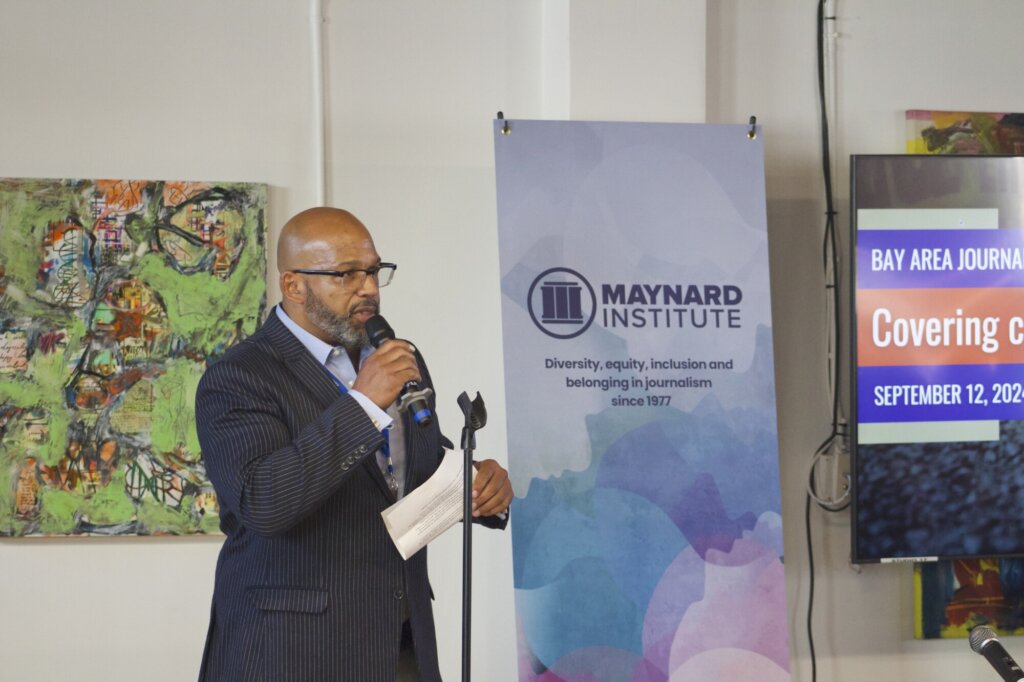
“A calling:” Interviews with Maynard Regional Training Faculty

Post Header Decoration Image

For Maynard Regional Training faculty and participants, journalism leadership is “more than a profession”

by Alice Finno, Maynard Institute reporting intern

This post contains promotional material for the Maynard Regional Training Series in Chicago.

The Maynard Institute will host a free training for entry- and mid-level editors and managers in Chicago, Illinois, on June 4 through 5, as part of its regional training series.

In partnership with Northwestern University’s Medill School of Journalism, Media and Integrated Marketing Communications, the training will provide coaching and mentoring to help editors and managers working in print, broadcast and digital platforms navigate the complexities of newsroom leadership. Northwestern will cover the standard registration fee on behalf of registrants. Two meals will be provided each day, and limited discounted hotel rooms will be available.

Anyone from the Chicago regional area is invited to attend the training. Registration is open until Tuesday, May 26. Anyone with questions can contact Maynard Regional Training Series Director Odette Alcazaren-Keeley. 

Award-winning journalists and Medill professors will lead workshops and discussions together with Maynard Institute faculty.

Empathy

Martin Reynolds, co-executive director at the Maynard Institute, said that people often start managerial positions without receiving any training, especially when transitioning from a reporter role to a manager or editor position. 

However, Reynolds said, only one in ten people have the skills to be a successful manager, according to Gallup, a research and polling organization. During the Chicago training, Reynolds will hold a session about “The Manager’s Mindset” and core aspects of leadership roles, including authority, influence and empathy.  

“Having empathy and compassion for your people is really one of the elements that I think is essential,” Reynolds said. “If you don’t have that, it’s very difficult to be an effective manager, a good manager, where your colleagues will thrive under your leadership.”

Integrity

Mei-Ling Hopgood, journalism professor at Northwestern, will hold a session on using AI with integrity, where participants will discuss newsrooms’ standards and practices when using large language models, such as ChatGPT and Gemini.

“They’re going to be part of newsrooms, they’re going to be part of our workflow, but to be able to say aloud  — or to have in writing  — this is my philosophy, these are the values that are guiding my use, is very important,” Hopgood said, adding that she hopes people will leave the session having a sense of the guiding principles they want to follow when using AI.

Complexity

Deborah Douglas, director of the Medill Solutions Journalism Hub, will hold a session called “Complicating the Narrative,” where she will teach people a deep listening technique used in interviewing developed by journalist Amanda Ripley, who currently partners with Maynard alum Hélène Biandudi Hoffer at Good Conflict, guiding and facilitating communication by reimagining conflict “to help people listen and be heard in times of profound disagreement.”

“In a time of deep polarization and shrinking trust, I want to introduce a deep listening technique that models deep listening so that people feel heard and so that they feel safe enough to open up and give us the real answer, not just the surface level answers that people tend to give,” she said.

Trust

At the training, Mackenzie Warren, interim executive director of the Medill Local News Initiative, will also present the findings of a study about how Chicago gets its news. The researchers surveyed 1,101 adults in the Chicago metropolitan area and examined consumer behavior, obtaining insights about audiences’ evolving habits and interests.

Warren said the survey focused on 14 counties and included urban, suburban and rural communities in proportions roughly mirroring the United States’ population while also taking race, class and socio-economic status into account to have a representative index. 

“I feel somewhat confident in using it as a directional information about how the United States as a whole is getting local news,” he added.

Warren also shared that the Medill Local News Initiative is designed to help the local news ecosystem thrive and highlighted the correlation between positive performance in local news and in democratic norms. 

“Without trusted local journalism, it’s not as possible for ordinary people to make good decisions in their lives,” he said.

Perspective

Doris Truong, deputy director of the Fire Up Entrepreneurship Program at the Maynard Institute, will lead a session on listening and identifying personal values. Truong will talk about interviewing people you disagree with without expressing judgement. 

“When you’re talking to sources, it’s really important for them to understand that you’re just trying to understand them, not trying to change their minds,” she said. “You may end up having to interview somebody that you can say ‘I don’t agree with this, but I really want to help my audience understand your perspective.’”

Felecia Henderson, senior director of strategic initiatives at the Maynard Institute, will hold a session about navigating difficult conversations, providing useful steps managers can follow and then role-playing scenarios.

“When you’re a manager, you really have to find a way to strike the right tone, the right setting, the right approach. And a lot of people don’t know what that is,” Henderson said.

Henderson added that when people finish a regional training, they become part of the Maynard Communities of Practice, a program that connects people working in the same field and provides continuous training across different curriculum tracks.

Community

Odette Alcazaren-Keeley, director of the Maynard Regional Training and Communities of Practice Programs, shared that the training will include a roundtable with news leaders from the region to talk about the state of the media in the region.

Alcazaren-Keeley said what participants always appreciate about the programs is sharing the room with other journalists who face the same challenges and be able to learn from each other. 

“What we hope is that when they leave, they feel they are not alone, that they have us, and they have each other, and they grow the community with us: they become part of the Maynard family that endures,” she said.

Jasmine Barnes, program manager at the Maynard Institute, said she enjoys creating the vision for a Maynard training and thinking about all the details that will enhance the participants’ experience.

“I’m really hoping that the Chicago training can be a really good opportunity for Northwestern’s network and broader community, as well as some Maynard alumni and some folks who haven’t really been involved with either of those institutions to meet and to really talk about the region and the unique challenges and opportunities that are present in Chicago,” she said.

Calling

Mackenzie Warren expressed his excitement for having frontline editors and leaders in journalism come together for the training. 

“There’s going be a room full of people who have signed on to this mission and dedicated themselves to this profession that’s more than a profession, it’s a calling,” Warren said.

“Our contributions to journalism will outlast ourselves if we do it right — I’m really encouraged that there’s a room full of people, the next generation of people, who see themselves that way and see this as not just their job, but their mission, and are invested in themselves to get better at their craft.”

The Business Case for DEIB Training in Journalism

Post Header Decoration Image

The Business Case for DEIB Training in Journalism

By Celeste Barker Bright for Nonprofit Megaphone

In an era when public trust in news is both more fragile and more essential than ever, how stories are told matters just as much as the stories themselves. For journalism employers, investing in diversity, equity, inclusion, and belonging (DEIB) training is a powerful way to strengthen reporting, build audience trust, and create newsrooms where every voice contributes to more accurate and impactful storytelling. 

What DEI Training Means and Why Belonging Matters

Diversity, equity, and inclusion training, or DEI training, helps organizations build workplaces where people of all identities and backgrounds are fairly represented, treated, and supported in contributing fully. DEI training programs focus on improving awareness around the experiences of nonwhite and noncisgender male workers. This helps to reduce both conscious and unconscious bias and create systems that ensure equitable access to workplace opportunities and resources.

Many organizations now emphasize DEIB, which adds a critical fourth pillar of social equity: belonging. Belonging goes beyond representation and fairness. It reflects whether employees actually feel accepted, valued, and psychologically safe enough to contribute authentically. Without belonging, even diverse and equitable workplaces may struggle with disengagement or high turnover when employees don’t truly feel included.

In other words, DEI creates access and opportunity, while belonging ensures people feel connected and empowered once they are there. For news media organizations and the American public media as a whole, where storytelling depends on authentic voices and perspectives, that distinction is especially important.

The Real-World Benefits of DEIB Training for Media Employers

DEIB training isn’t just a nice-to-have workplace initiative. Diversity in the media directly influences the quality, accuracy, and impact of reporting. Research and industry guidance consistently show that inclusive representation in media outlets produces stronger journalism and more sustainable organizations.

Stronger, More Accurate Reporting

A diverse and inclusive newsroom is better equipped to cover stories that concern all American communities and the challenges they face. When journalists reflect a broader range of lived experiences, coverage becomes more representative and less likely to overlook or misinterpret marginalized perspectives.

Inclusive practices help journalists ask better questions, build trust with sources, and avoid harmful stereotypes. DEIB training equips staff with the tools to recognize bias in sourcing, framing, and language, leading to more accurate and nuanced reporting.

Increased Audience Trust and Engagement

Trust is a core currency in journalism, and DEIB training plays a significant role in strengthening it. When audiences see themselves reflected fairly in coverage, they are more likely to engage with and trust a news outlet. That translates to positive company reputations and ratings in very real ways.

Inclusive journalism fosters stronger relationships with communities, particularly those historically underrepresented or misrepresented in media. By improving cultural competency and awareness, DEIB training helps newsrooms build credibility and deepen audience connections.

More Innovative and Resilient Newsrooms

Organizations that invest in DEIB often benefit from greater creativity and innovation. Forbes explains that diverse teams bring a wider range of ideas, perspectives, and problem-solving approaches, which can lead to better decision-making and more innovative content strategies.

In the fast-changing media landscape, adaptability is essential. DEIB training encourages open dialogue, collaboration, and inclusive leadership practices that help teams respond more effectively to new challenges and opportunities.

Improved Employee Engagement and Retention

Employees who feel valued and included are more likely to stay and contribute at a high level. DEIB-focused environments improve morale, job satisfaction, and overall performance.

For journalism employers, this translates into lower turnover and a more stable workforce. Given the demanding nature of newsroom work, fostering a sense of belonging can help prevent burnout and ensure that talented journalists remain engaged and committed.

Reduced Bias and Ethical Risk

Bias in journalism can lead not only to misinformation but also to reputational damage and loss of public trust. DEIB training helps staff identify unconscious biases and understand how they may influence reporting decisions. Structured DEI workshops provide practical tools for addressing bias, improving communication, and fostering accountability. This is especially important in journalism, where ethical standards require fairness, accuracy, and sensitivity.

Stronger Leadership and Organizational Culture

DEIB training also shapes leadership practices. Inclusive leaders are better equipped to manage diverse teams, support equitable advancement, and create transparent decision-making processes. Organizations that prioritize DEIB develop healthier workplace cultures characterized by trust, collaboration, and shared purpose. In newsrooms, this can lead to stronger editorial alignment and a more cohesive mission.

Why News Organizations Should Partner With DEIB Training Experts

While internal efforts are valuable, many news organizations stand to gain the most from working with third-party DEIB specialists who bring expertise, structure, and objectivity to the process.

Specialized Industry Expertise

Organizations such as the Maynard Institute for Journalism Education provide tailored training specifically designed for media professionals. Their programs address the unique challenges of journalism, such as inclusive sourcing, equitable storytelling, and newsroom culture. External partners bring proven frameworks and up-to-date best practices that may not exist internally. 

Objective Assessment and Accountability

Third-party consultants can offer an unbiased perspective on workplace culture and practices. External experts can identify gaps, measure progress, and recommend data-driven strategies for improvement. This objectivity is particularly valuable in journalism organizations, where internal dynamics and hierarchies may make it difficult to address sensitive issues openly.

Customized, Scalable Training Programs

External partners can design training programs that align with an organization’s size, goals, and audience. Partnering with experts can strengthen broader diversity and inclusion strategies, including hiring and retention efforts. For news organizations with multiple teams or locations, scalable training ensures consistency while allowing for customization based on local needs.

Long-Term Strategy and Sustainable Impact

DEIB is not a one-time initiative. It requires ongoing commitment and continuous improvement. External consultants can help organizations move beyond one-off workshops to develop long-term strategies that embed DEIB principles into daily operations. Outsourcing enables companies to build sustainable programs with clear goals, metrics, and accountability structures — all without guesswork or strain on company staff.

For journalism employers, this means creating a newsroom culture where inclusive practices aren’t just passively or abstractly encouraged, but actively and concretely integrated into every aspect of reporting, editing, and leadership. By investing in DEIB training and partnering with experienced organizations, news media employers can strengthen both their workplace culture and the quality of their journalism.

Get Expert DEIB Training for Your Media Organization With the Maynard Institute

The Maynard Institute inspires and powers the national, collaborative drive for DEIB in news media. Our antiracism training programs have helped create decades of news industry trailblazers, all of whom belong to the “Maynard Family”: a community of deep caring and intergenerational support for journalists of color. Programs by the Maynard Institute are open to all applicants, and the Maynard Institute is committed to addressing the under-representation of people of color and other historically disadvantaged groups in media-related professions.

The Maynard Institute’s Fault Lines® Culture Shift Program gives media professionals the tools to recognize and address biases that shape news coverage. Rooted in the Fault Lines® framework, our program helps organizations move far beyond performative DEI efforts. 

Instead, we use intentional DEI practices — built on nearly 50 years of DEI training in media spaces — that are proven to create inclusive workplaces that connect with diverse communities. Fill out our interest form to Register to bring Maynard’s Fault Lines® training to your company today!

Newsrooms rethink source protection and journalist safety in immigration coverage

Post Header Decoration Image
Department of Homeland Security (DHS) Secretary Kristi Noem participates in U.S. Immigration and Customs Enforcement (ICE) Enforcement and Removal Operations (ERO) in Los Angeles, California, June 12, 2025. (DHS photo by Tia Dufour)

Journalists balance transparency, safety in the wake of ICE escalation

By Alice Finno, Reporting Intern

As Immigration and Customs Enforcement increased activity in recent months, journalists across newsrooms began having difficult conversations about balancing transparency in coverage with protecting their sources.

In January 2025, El Tímpano, a Bay Area newsroom that reports on Latino and Mayan immigrants, published guidelines to better protect immigrant sources and the communities it covers, focusing on three key areas: ensuring informed consent, limiting identifying details, and increasing in-person engagement. The policies seek to balance the dangers of exposing immigrants’ stories with the benefits journalism provides. 

For instance, Miriam Jordan, an immigration reporter for the New York Times, revealed in 2018 that President Trump employed undocumented workers in his properties, identifying two immigrant women with their full names and photographing them. One of them, Victorina Morales, made numerous media appearances after the story was published, applied for asylum, and received a work permit, but months later, she found out her case had been referred to a court for removal proceedings, as reported by the Columbia Journalism Review. 

During the first Trump administration, immigration reporters told CJR they were more inclined to grant anonymity to undocumented sources and explain the potential consequences of being quoted in a story.

Educating sources

El Tímpano’s guidelines recommend that reporters make greater efforts to explain the risks of participating in stories and how content may be shared, so immigrant sources can make fully informed decisions. This includes telling sources about the risks of speaking with journalists, which could include being identified and contacted by ICE, Customs and Border Protection, the Department of Homeland Security or other law enforcement.

Drawing from material by Define American and PublicSource.org, El Tímpano also tells sources that when reporters reach out for a story, they should clearly state what news outlet they work for, what story they are working on, ask whether the source is willing to speak, answer any questions they might have and clarify at the beginning of the interview if the conversation is on the record, on background, off the record or anonymous. El Tímpano explains to sources where and how the story will appear online.

Sources can decide how much of their name and identifying information is included in the piece. At the same time, El Tímpano has chosen to reduce the amount of identifying information it uses, selecting from details such as first and last name, initials, age, city of residence, job, country of origin, and other information, avoiding the use of more than three identifiers.

If sources ask for additional protection, the outlet says it will honor their request by using only their initials or a pseudonym. It will only ask for last names and citizenship status when this information is essential and store information with robust security measures.

El Tímpano notes that its journalism is rooted in a close connection with the community and prioritizes maintaining trust with the community, ensuring its reporting is neither extractive nor harmful. The outlet’s journalists also avoid including the names of sources’ family members, especially if they have a different legal status, and filming or taking photos at locations that might reveal the source’s home or work location.

The publication also emphasizes more face-to-face reporting and an increased presence in the East Bay, while avoiding publicizing the locations of these interactions to protect participants. Overall, El Tímpano argues that journalism can counter dehumanization and bridge social divides, reminding readers that undocumented people are entitled to respect.

The Los Angeles Public Press also published strategies to navigate media interviews during ICE raids last July amid an increase in ICE operations in Los Angeles. The publication tells immigrant sources that sharing their story can amplify their voice and highlight critical issues, but it can also put them at risk.

With the increased press attention on immigrant communities due to immigration enforcement, the outlet highlights that many people are speaking to journalists for the first time without knowing how to protect themselves. It advises individuals to verify reporters’ identities, ask questions about the story, and set boundaries before agreeing to interviews, including deciding how much identifying information they want to share.

Sources can decline questions that feel uncomfortable and be as specific or vague as they like when sharing information, with the understanding that anything they disclose could potentially become public. The LA Public Press guidelines emphasize that sources may end the conversation at any time, as well as decline to have the interview recorded or photos taken, unless they are in a public space or during a protest, in which case people can wear masks, sunglasses, or hats if they want to conceal their identity.

The guide also warns against reporters who use leading questions or push a narrative, highlighting that sources can voice their concerns if they see that happening and assert their own point of view. They can also ask clarifying questions or information about how the article is going to be used to make sure the reporters will handle the story and their community with care.

Journalist safety and self-care

Brenda Verano, a journalist who has been covering social justice and immigration at CALÓ News, said that even her newsroom had conversations about how to keep sources safe when immigration raids and protests started happening in Los Angeles. 

For example, Verano said that the newsroom decided not to publish photos of street vendors during protests or to blur faces to avoid exposing people’s identity in case they didn’t have a legal status. In other instances, she said sources who weren’t used to speaking with the press mentioned during an interview that they were undocumented, so she talked with them about it to make sure they were okay with that information becoming public and discussing what she would include in the article.

“We also made that agreement of if people say that they don’t want to be on record, or if they don’t want to use their full name, that is totally okay, and we will respect that,” Verano said. She would also try to meet people in person and make sure sources felt safe, she said, interviewing them in Spanish and explaining what she was working on.

Verano attended the Maynard Institute’s Propel Regional Training in San Luis Obispo at the end of April and said she was still thinking about some of the sessions, such as A.C. Thompson’s session on investigative journalism and Andrés Cediel’s session on immigration coverage and imperiled civil rights. Verano said Cediel’s session also made her realize it’s okay to consider taking a break from covering immigration. As someone from a mixed-status household, Verano said the topics she has been reporting on feel very personal.

“It takes a lot of mental and emotional strain on you, but I think that’s also what helps you connect with the fewer sources to a greater extent,” she said.

Verano said she has also taken measures to protect herself as a journalist, such as letting people know where she is when covering a protest, making her social media private, and using Signal to communicate with sources and other journalists.

Michelle Zenarosa, former editor-in-chief at LA Public Press, wrote about the impact that covering immigration has had on reporters and how the newsroom had to rethink how to protect its journalists due to the increased risks they faced, from personal threats to rubber bullets and arrests. They quickly realized the need for safety training and started to collaborate with reporters across different newsrooms.

“When local journalists can’t safely document what’s happening in your community, you lose the ability to hold power accountable. And right now, that’s the calculation we’re all making,” wrote Zenarosa.

An attack on Civil Rights

Andrés Cediel, visiting professor at Arizona State University and one of the speakers at the Propel training, said that journalists need to be careful about protecting themselves and sources at the same time. Today, journalists are frequently facing attacks by the government, he added. One of them is Mario Guevara, a Salvadoran journalist who was covering a “No Kings” rally last June when he was arrested and detained by ICE for livestreaming their activity.

Guevara was in the country legally with a path to receiving a green card through his son, who is a U.S.-citizen, but he was still deported to El Salvador.

 “Whenever, as a journalist, you’re doing reporting that involves some level of trauma or vulnerability, it’s really important to be paying attention to how that’s affecting you personally, and sometimes doing reporting that is too close to your own trauma can be especially difficult,” Cediel said in an interview.

Cediel also highlighted the critical role journalists play in documenting what is happening during a period of crisis and how their reporting and the evidence collected could eventually lead to more accountability.

“When this administration is no longer in power, at that time, there will be an opportunity to hold those actors responsible for any potential crimes they committed,” Cediel said. “For that to happen, we need to be documenting those abuses now.”

Cediel said he hopes the Propel training inspired journalists to recommit to the mission of documenting what happens in their communities. “All this work is building towards a higher mission and goal,” he said.

*This article references Maynard Institute programming and interviews Maynard Institute training participants and faculty, including Brenda Verano, who works at CALÓ News. CALÓ News is a central initiative of the Latino Media Collaborative, a Propel Partner of the Maynard Institute.

What My Fault Lines Taught Me

Post Header Decoration Image

What My Fault Lines Taught Me

A Maynard Institute training helped me understand my perspective — and the responsibility that comes with it

By Jeremy Garza, Managing Editor, Mustang Media Group, California Polytechnic State University.

Photos by Jennifer Shaevitz, SLO Media Creations.

SAN LUIS OBISPO, Calif. – “The phone rang. It was my mom telling me my brother died.”

That’s how Joe Lambert, founder of StoryCenter, said he would start a story about his brother. By jumping right into it, I was immediately itching to hear his next word. I felt tears welling in my eyes, imagining my own mother calling me to tell me about a tragic loss.

I went up to him after his presentation at the Maynard Institute’s Propel Regional Training in San Luis Obispo, held April 24-25. I wanted to thank him for changing the way I see storytelling and sharing personal stories — to which he just said, “Of course, and a little emotional manipulation never hurts.”

As an involved journalism student, I’ve found myself at a lot of conferences. I’ve sat through professionals talking about their glory days and college students rehearsing for their glory days more times than I can count. After Lambert’s kickoff session, I knew Maynard was going to push me to think differently about storytelling — including how I will tackle stories after I graduate from my college sandbox.

Over the course of two days, I heard frank presentations about immigration reporting and investigative work. In partnership with Cal Poly Journalism, Maynard took a page out of Cal Poly’s playbook and had participants “Learn by Doing.” Peers workshopped current stories and tackled personal biases. 

Co‑executive director of the Maynard Institute Martin G. Reynolds, while teaching about the
Fault Lines® framework, tasked us to write down six people we trusted, beyond relatives. Then, based on the six fault lines — race, gender, generation, class, sexual orientation and geography — we placed check marks next to each person if we shared the same identity. 

Fault Lines® taught me how to analyze spaces. Not only for myself, but for my peers and for sources. Where do more people need to be heard?

Most of my names, ranging from childhood friends to current roommates, had three to four check marks. A subconscious truth came forward: I often surround myself with people who are eerily similar to me. This can’t be the case in a newsroom, and I hope that I am able to foster belonging in more spaces that I join. 

All of my trusted individuals lacked the check mark that represents sexual orientation. Not many people in my life are queer, and even fewer are gay men. I often find myself in gray areas — too gay for masculine spaces, but still too “man” for female spaces. I’m often perceived as white, but my last name and my grandfather’s immigration from Mexico shape experiences that don’t always align with that perception.

Fault Lines® taught me how to analyze spaces. Not only for myself, but for my peers and for sources. Where do more people need to be heard? When does my privilege need to stand up for others? And when does it need to sit and listen? This perspective will now shape my coverage as I search for a place in the industry.

“Belonging in newsrooms is the essential outcome of deliberately confronting bias.”

Our Cal Poly Journalism Department chair, Professor Brady Teufel, moderated a panel of community-oriented newsrooms, including representatives from ethnic media organizations, such as Latino Media Collaborative and India Currents. These small, but mighty organizations are cracking open fault lines and making room for those who do not see themselves in traditional coverage.

This conversation was taking place in a town that looks different than many in California and hosted by a state university unlike any other — predominantly white. This training was an important reminder in 2026, very eloquently stated by Reynolds.

“Belonging in newsrooms is the essential outcome of deliberately confronting bias,” Reynolds said. “When we name and dismantle the identity‑based biases that shape our coverage and culture, we create spaces where journalists of all backgrounds can bring their full selves to their work.”

During the campus tour, I showed a group of attendees around KCPR 91.3 FM, Cal Poly’s student-run radio station. The station’s motto is “Where Different Matters.” The station is developing into a space for belonging, internally and externally, from the “boys club” it once was in the ’70s. 

“Harnessing the power of journalists’ diverse lived experiences is the cornerstone of genuine belonging, and our humanity.”

I was proud to show my station off to attendees and speak of how we are able to serve our audiences. I was especially proud, and a little nervous, to show Ernesto Aguilar. As executive director of radio programming and content innovation initiatives at KQED Public Media, Aguilar taught us not only technique and style tips, but also encouraged us to have hope for the future.

Aguilar, kind with his words, told me to keep pushing, and my path will work out. This represents the best part about Maynard. The connections I formed with innovators and daily grinders inspire me as I’m leaving my college bubble. The Maynard Institute showed me that the journalism industry is alive and well, just as I needed the reminder that I belong in this space.

“Harnessing the power of journalists’ diverse lived experiences is the cornerstone of genuine belonging, and our humanity,” said Odette Alcazaren-Keeley, director of the Maynard Regional Training Program.

The Propel Regional Training Series – San Luis Obispo

A writing exercise

Roundtable discussion of news leaders

Odette Alcazaren-Keeley addresses participants

Mustangs Jeremy Garza and Carly Hertzel

Martin G. Reynolds teaches Fault Lines®

Joe Lambert teaches storytelling

Joe Lambert asks what story changed participants’ lives

Inside KCPR Radio

Listening and learning at the Propel Regional Training

About Jeremy Garza

Jeremy Garza is a journalism and political science student at California Polytechnic State University in San Luis Obispo, where he serves as managing editor of Mustang Media Group and was previously a CalMatters fellow. His work has been republished by the Associated Press and earned two California College Media Association first-place awards. 

About Mustang Media Group

Mustang Media Group (MMG) is an award-winning, multi-platform news organization based at California Polytechnic State University in San Luis Obispo. Covering digital, print, radio and social media, the student-run organization works to tell campus and community stories accurately and equitably.

Black Beyond Borders: How Black journalists built the room Perugia needed

Post Header Decoration Image
Photos and video by Sara Lemlem.

Black Beyond Borders: How Black journalists built the room Perugia needed

At the International Journalism Festival, Black journalists and allies created a space rooted in Black diasporic experience — and opened a wider conversation about belonging, solidarity and journalism’s global blind spots.

By Martin G. Reynolds, photos and video by Sara Lemlem, founder, dotzmedia.com.

PERUGIA, Italy — Journalism gatherings often claim to wrestle with the future of the field. But too often, the people most practiced at seeing power clearly — Black journalists, Black media leaders and other journalists of color — remain peripheral to the rooms where that future is being imagined.

That tension was at the heart of Black Beyond Borders: A Global Town Hall on Journalism, Identity, and Resistance, convened by URL Media and the Robert C. Maynard Institute for Journalism Education during the International Journalism Festival in Perugia, Italy April 15-18.

At a moment when Black journalists, Black media and Black communities are facing intensifying attacks on multiple fronts, Black Beyond Borders created something both urgent and restorative: a space for candor, connection and collective imagination across the African diaspora.

The town hall brought together journalists, media leaders, scholars and others from across countries and cultures to ask a set of questions that felt both immediate and enduring: What does it mean to be a Black journalist in this moment? How are race, identity, belonging and truth being challenged or weaponized globally? And what becomes possible when we build stronger relationships, sharper analysis and deeper solidarity across borders?

The gathering was rooted in Black diasporic experience, but it was not insular. The room included colleagues from across journalism and philanthropy, as well as people who did not identify as part of the Black diaspora. The design was intentional: center Black journalists and Black experience, while welcoming a broader mix of voices committed to understanding, connection and the possibility of something more for all of us.

Why the room was needed

The roots of the idea trace back to last year’s festival, when Sara Lomax of WURD Radio and URL Media, film festival curator Karen McMullen, and I joined a panel titled “Am I Black Enough For You,” moderated by Coda Story CEO and Editor-in-Chief Natalia Antelava. The conversation raised important questions about Black American identity and experience, but it also prompted audience concerns about framing, power and racial dynamics. As Lomax later put it, the critique was blunt — and fair.

In the months that followed, conversations continued with Press Forward Canada Executive Director Vicky Mochama, – no affiliation with Press Forward in the United States – URL Media and others about how to create a more intentional space at this year’s festival. A larger gathering for Black women journalism leaders required more time and funding, and a proposed follow-up panel was not selected. Meanwhile, conversations in the Black Perugia Dinner WhatsApp Group made clear that other pitches from Black journalists had also been declined.

Taken together, those absences raised a larger question: How can journalism conferences, convenings and festivals claim to wrestle with the future of journalism while still too often treating Black expertise and experience as peripheral?

What began as a smaller idea evolved into a broader side event, developed with Mochama, URL Media and the Maynard Institute, centering Black voices from across the diaspora.

Held at Il Birraio in Perugia, Black Beyond Borders was intentionally designed not as a traditional panel, but as a town hall. Though unable to attend, Lomax offered a reflection I read at the start of the event, grounding the gathering in urgency and shared purpose.

Video by journalist Sara Lemlem.

A town hall, not a panel

The setting mattered.

Perugia, with its tight streets and sweeping views of Umbria’s rolling green hills, surrounds your senses with history. Nestled between Rome and Florence in the landlocked but lushly adorned landscape of Central Italy, the city is Umbria’s capital. It is a vivacious hill town of universities and artists, home to the Eurochocolate Festival, with stunning architecture and centuries-old travertine limestone underfoot. Its uneven cobblestones require an easeful pace — the kind reflected in a mother and daughter strolling arm in arm down Corso Vannucci, the wide pedestrian street at the heart of the city.

The evening opened with a scene-setting exchange featuring Garry Pierre-Pierre, director of partnerships at URL Media and founder of The Haitian Times; Seada Nourhussen, editor-in-chief of OneWorld Magazine in Amsterdam; and Mochama of Press Forward Canada — each bringing perspectives shaped by distinct national and professional realities.

From there, the conversation opened to the room.

Attendees sipped wine and compared notes across regions. They reflected on how anti-Blackness and exclusion take shape in different media systems and explored what stronger alliances might look like editorially, relationally and economically.

Many spoke from the experience of being the only person of color in their newsroom or institution, navigating both hypervisibility and isolation. Nourhussen, for example, spoke from the experience of being the only top Black editor in the Netherlands. Her presence underscored both the power of representation and the isolation that can come with being the only one.

The openness of the town hall, the range of voices in the room, and the willingness to move between personal experience and structural critique created something more expansive: a space not only for conversation, but for recognition, alignment and possibility.

What Black struggle makes visible

It also became clear that frustrations about exclusion from the festival were not limited to Black journalists. Others shared similar experiences of rejected pitches, reinforcing the need for spaces where those who are structurally sidelined can come together honestly, without flattening their realities.

One attendee, a journalist from outside the United States, put it plainly: he and others in his circle had also been frustrated by pitches and perspectives that had not found a place in the formal festival program. But, he said, it was the Black journalists from the United States who decided to do something about it.

I found that observation deeply affirming, especially in a moment when Black people and other communities of color in the U.S. are facing renewed attacks through policy, politics and public rhetoric. To hear global colleagues say that the Black struggle in the United States continues to inspire marginalized people fighting for visibility in their own countries was both humbling and energizing.

It reminded me that the struggle our ancestors carried — and the one we continue to carry — has never stopped at national borders. The fight to be seen, heard and fully recognized matters not only for us, but for others searching for language, courage and strategy in their own struggles for visibility.

What emerged was not a single narrative, but a layered exchange about shared struggle, difference and possibility — and a living example of the Maynard Institute’s commitment to reaching across Fault Lines® of race, class, gender, generation, geography and other elements of identity. That commitment traces back to Robert C. Maynard, one of the Institute’s nine founders, who believed journalism could connect people across difference.

Toward a global Black media network

The idea of connection across difference was not abstract. It was voiced directly by the people in the room.

“Black people are too sparse in media, which means our experiences often have to be tied to a diasporic understanding to carry weight,” Nourhussen said. “At the same time, Black American media professionals can deepen their understanding of global Blackness by working with European, African and Latin American colleagues. That’s where BBB can become a global Black media network.”

Mochama connected the moment to a longer history.

“Mary Ann Shadd Cary, the first woman editor of a newspaper in North America, was a Black American who founded her paper in Canada,” she said. “Our experiences are connected, even if our realities vary. The scale of our ambitions is matched only by the depth of our challenges, but we can take them on together.”

Pierre-Pierre offered this perspective after the event about the energy in the room.

“It sparked a much-needed conversation for journalists who often find themselves as the only person of color in their spaces, navigating isolation,” he said. “We easily could have continued for another hour.”

Among those in the room was Jaldeep Katwala, director of the Sir Lenny Henry Centre for Media Diversity at Birmingham City University in the United Kingdom.

“The power of this gathering was that it happened both despite and because of the International Journalism Festival,” Katwala said. “It was a conversation that deserved a larger stage. I found my people at this event.”

That sense of finding one another — across geography, identity and experience — lingered with me. While Black Beyond Borders was shaped in part by what didn’t happen, it ultimately became something that likely could not have taken shape within the confines of the festival’s regular format.

Even the music spoke to that sense of connection. Curated by Nadia Campbell-Mitchell, Maynard’s development director, sounds of the Black diaspora floated through the venue, past distressed-style chairs and a spiral staircase that led to a lower level where other groups were holding conversations of their own.

Our gathering became an opportunity to build something more connected and more responsive to the realities people were carrying with them into the room — across countries, across systems and across different experiences of exclusion and belonging.

Belonging beyond borders

This was one of the most uplifting experiences of my professional life. What happened that night felt like the continuation of something that began modestly — a dinner last year, then a WhatsApp group — and is now evolving into something more intentional and ambitious.

As people joined the Black Beyond Borders community that night, it began to take shape as a growing network rooted in Black experience and sustained by solidarity.

Nourhussen mentioned that after coming to the festival numerous times, she would often see clusters of attendees of color gathered together, frustrated by what she described as a lack of inclusion and a sense that who they were was not fully seen or represented.

Not this time, Nourhussen said. When she passed people on the street who had attended our town hall, she was greeted with smiles and thank-yous for a space to connect, to tell their own stories and to be seen.

That is belonging beyond borders.

We are now exploring what it might look like to take Black Beyond Borders to other countries and communities, not as a one-time gathering, but as an evolving network of journalists in conversation across borders. So if this speaks to you, reach out. Let’s have a conversation.

Because what Perugia made clear is that when we gather with intention, we don’t just respond to the moment; we expand what becomes possible. We show what happens when Black people hold space for ourselves and, in doing so, open space for us all.

About the Author:

Martin G. Reynolds is co-executive director of the Robert C. Maynard Institute for Journalism Education. A former editor-in-chief of The Oakland Tribune, he co-founded Oakland Voices and was among the editorial leaders of the Chauncey Bailey Project. He is also a professional lyricist whose work includes a live album recorded in Havana, Cuba, with Mingus Amungus.

About the Institute:

The Robert C. Maynard Institute for Journalism Education works to advance diversity, equity, and belonging in news media through training, leadership development, and innovative programs that support journalists of color and strengthen inclusive storytelling across the industry.

Meet our new Program Manager, Jasmine Barnes

Post Header Decoration Image
A photo of Jasmine Barnes, a Black woman with tight curly hair parted n the middle. She wears a black short sleeved shirt and smiles broadly. Behind her is the ocean.

Jasmine Barnes

Jasmine Barnes (she/her) is a community builder, writer and program manager based on Potawatomi land on the South Side of Chicago. For many years, Jasmine served as the Community Engagement Director of an education non-profit, helping adults nationwide develop their relationship-building and collaborative communication skills. She applied similar strategies to the organization’s internal culture, co-leading its inaugural strategic DEI initiatives and developing foundational workplace culture practices. Jasmine has also worked as a consultant providing workplace culture training, facilitation, and program development services to values-driven organizations. 

With a degree in sociology and journalism from the University of Texas at Austin, Jasmine brings a human-centered approach to her work, helping organizations and individuals better understand themselves and others. She specializes in creating and facilitating trainings and programs grounded in a trauma-informed, healing-centered framework. Her greatest joy is creating supportive and inclusive environments that encourage people to take risks and grow.

Jasmine expands upon this relational work by amplifying and archiving everyday stories as a freelance journalist contributing to South Side Weekly, City Bureau, the Chicago Reader and other publications. 

Remembering Diana R. Fuentes, executive director of IRE and steward of journalism

Post Header Decoration Image
A photograph of Diana R. Fuentes, late Executive Director of Investigative Reporters and Editors (IRE). She has curly hair that borders on frizzy, mostly dark brown with some graying at the top. She wears round glasses, gold hoop earrings, a thin gold chain necklace over a black shirt, and a bright red blazer. She has intense brown eyes and a smile that is more like a smirk. Even in the photo, you can tell she's quite small. Behind her, a blurred background of a brick building with thick climbing ivy.
Diana R. Fuentes (IRE).

Remembering Diana R. Fuentes

After passing away suddenly in Washington, D.C. on March 20, Diana R. Fuentes is being remembered across the nation as an indomitable journalist, a dedicated editor and educator, a steadfast mentor and a fierce advocate for journalists and journalism.

Executive Director of Investigative Reporters and Editors (IRE), Fuentes began her more than 35-year-long career in journalism in her hometown of Laredo, Texas, where she served as editor of the Laredo Morning Times.

“Whether she was representing IRE at events across the country or engaging with our international and student members, her dedication to our mission was clear. She worked tirelessly to make investigative training accessible and was also a passionate defender of press freedom and journalist safety,” IRE Board President Josh Hinkle said in a statement released March 20.

“In light of the challenges we face today, she reminded us that ‘we have a constitutionally protected right — and deep responsibility — to keep the people informed, and we will not stop.’ Those words from Diana — shared in a recent statement of support for journalists arrested for their protest coverage — resonate now more than ever.”

Many in the journalism community and her home state of Texas expressed shock at her unexpected passing, as well as the deep loss of a friend and teacher so integral to the journalism community.

“We are saddened to share the passing of a giant in our industry. One of our leaders, mentors and dear friends, Diana ‘DeeDee’ Fuentes has passed away. It is a shock to many of us and we are processing it just as you are,” San Antonio Association of Hispanic Journalists stated in a Facebook post.

IRE will be closed Friday, March 27 as the staff takes time off to attend her funeral.

“Texas journalism — and the national investigative journalism community — has lost a giant. Whether she was fighting for open records, coaching a young reporter, or leading a national journalism organization dedicated to accountability, she did so with a rare combination of tenacity, grace, and unwavering integrity. She taught us that the story matters, but the people behind the stories matter more,” Texas Managing Editors posted to Facebook.

Oakland Voices director and Maynard alum Rasheed Shabazz expressed gratitude to Fuentes as well as sorrow at her passing in an emailed statement.

“I finally met Diana Fuentes in real life last year at the NABJ Conference during an investigative journalism panel. It was an honor to share a stage with her. I am grateful for all the work she did to support young and emerging investigative journalists and I wish I had more time to learn from her. Thank you, Diana,” Shabazz said.

IRE has posthumously nominated Fuentes to be inducted into its Ring of Honor at this year’s IRE Conference, taking place June 18-21. The Ring of Honor is a “new initiative celebrating members who have made a significant contribution to the organization and to investigative journalism.” Those who wish to do so can donate to the campaign in Fuentes’ honor.

Simplified Summary

Diana R. Fuentes died last week, this post is about her work in journalism and those who miss her.

Meet Doris Truong, Deputy Director of the Maynard Institute’s Fire Up Training program

Post Header Decoration Image

Doris Truong, Deputy Director of the Maynard Institute’s Fire Up Training Program

Photos of the 50th Class of Knight-Wallace Fellows at the University of Michigan on November, 4, 2023 in Ann Arbor, MI. © Jarrad Henderson, 2023.

Doris Truong is deputy director of the Maynard Institute’s Fire Up training program for journalism entrepreneurs. She is an inclusion expert and facilitator who led teaching and diversity strategies for the Poynter Institute.

She has two decades of daily news experience from The Washington Post and The Dallas Morning News. She served as national president of the Asian American Journalists Association, vice president of UNITY: Journalists for Diversity and a board member on the Fund for Investigative Journalism.

She was a Knight-Wallace Fellow at the University of Michigan, researching ways journalists can mitigate their own unconscious bias. And she is a graduate of the Missouri School of Journalism. Find her on most social platforms @doristruong.

The Maynard Institute to be recognized with Lorraine Branham Award during Newhouse School’s Mirror Awards ceremony in May

Post Header Decoration Image

Award honors the Maynard Institute’s impact

The Syracuse University Newhouse School of Public Communications announced March 12 plans to recognize the Maynard Institute with the Lorraine Branham Award during Newhouse School’s Mirror Awards ceremony in May.

Established in 2021, the award honors late Newhouse Dean Emerita Lorraine Branham, and recognizes a media organization that has worked to promote inclusion, diversity, equity and accessibility in the news.

Previous Branham Award recipients include ICT, the 19th NewsMLK50 and Amplifier.

Lorraine Branham’s legacy, and ours

“Lorraine Branham was a 1977 graduate of the Summer Program for Minority Journalists, an early training initiative founded by a diverse group of journalists, including the late Robert C. Maynard,” said Evelyn Hsu, co-executive director of the Maynard Institute. “That program stood at the forefront of efforts to desegregate America’s newsrooms. We are deeply honored to receive an award bearing Lorraine’s name, and it will inspire our continued work.”

“Lorraine Branham’s legacy reminds us that expanding opportunity in journalism has always required intention—and courage,” said Martin G. Reynolds, Maynard Institute co-executive director. 

“At a time when some are questioning the value of that work, this recognition affirms that inclusive, representative journalism is foundational to a just, equitable, and informed society.

It also honors the most meaningful outcome of our mission—the journalists of color and those of diverse backgrounds at the center of our programs, alongside others we support to stay and thrive in this field. History will look back on this moment and remember who stood firm in their values—and we will be among them.”

“The Maynard Institute doesn’t just identify the problem—they develop the solutions,” the selection committee said. “Their commitment to building a more inclusive and representative media landscape has transformed journalism and set the standard for how organizations can champion equity and authentic storytelling.” 

About the Mirror Awards

Established by the Newhouse School in 2006, the Mirror Awards are the preeminent competition in the field of media industry reporting. Prizes are awarded in four juried categories, recognizing the reporters, editors and writers who hold a mirror to their own industry for the public’s benefit.

Dateline NBC host and NBC News journalist Lester Holt will receive The Fred Dressler Leadership Award at the 2026 Mirror Awards ceremony May 19 in New York City.

The Dressler Award is named after the late Fred Dressler, an influential figure in the cable broadcasting industry. The award honors individuals or organizations that have made distinct and consistent contributions to the public’s understanding of the media.

Simplified Summary

The Maynard Institute is receiving an award.

The  Maynard Institute condemns arrests of Georgia Fort and Don Lemon for reporting on Cities Church in St. Paul, Minnesota

Post Header Decoration Image

The arrests of journalists Georgia Fort and Don Lemon for reporting on a protest set a dangerous precedent for press freedom. Bearing witness is not a crime. Reporting at moments of civic tension — especially where government power and community response intersect — is core to journalism’s role in a democracy, and the First Amendment exists to protect precisely this work.

Through our Fault Lines® framework, we know the risk is not evenly shared. Journalists working at the intersections of race, immigration, power, and community — often independent or community-based reporters — are the first to feel the chilling effect when newsgathering is criminalized.

If they are pushed out, the voices and communities journalism has worked to include are pushed out too. We stand with the National Association of Black Journalists and the wider journalism community in condemning these arrests and calling for the protection of journalists’ constitutionally protected rights.