
Dorothy Bland
Board Member



The third round of the Maynard Regional Training Series – hosted by the Bob Schieffer College of Communication at Texas Christian University (TCU) in Fort Worth – brought a powerful close to the inaugural program, after dynamic convenings of media professionals in Detroit and Chapel Hill, North Carolina.
At each training site, Maynard faculty sought to give frontline editors and mid-level managers tools they could immediately use to manage teams and coverage in a rapidly evolving landscape that’s shaped by industry upheaval and accelerating AI evolution.
The bespoke curriculum provided eight sessions and coaching from a distinguished faculty of news executives and academics, covering topics such as:
Participating in the two-day workshop were two TCU students and 18 full-time journalists who work in a variety of editing roles representing the Fort Worth Report, The Dallas Morning News, Fort Worth Star-Telegram, La Prensa de Houston, The Associated Press, Bloomberg Industry Group, The Oklahoman Media Company, Gannett and USA Today Network, TCU-Schieffer College and TCU 360 Media.
“I’m really thankful to have participated in this year’s Maynard Regional Training in Texas,” wrote Maya Earls, deputy team lead/environment and energy at Bloomberg Law
(Bloomberg Industry Group), in a LinkedIn post. “This program included great sessions on how to be a better manager and editor, and provided space to ask the big questions about AI and how we as journalists evolve for the moment.”
Maynard Regional Training and Communities of Practice Director Odette Alcazaren-Keeley opened the training, saluting the long-standing relationship with TCU Bob Schieffer College of Communication’s Dean Kristie Bunton, Ph.D; Jean Marie Brown, associate professor of professional practice and student media director; and John Tisdale, Ph.D., associate professor and chair of the journalism department.
“As a college named for an award-winning, longtime journalist, our TCU Bob Schieffer College of Communication is happy to provide a regional home for the Maynard Regional Training Series,” Dean Bunton said. “Our democracy needs well-trained journalists to lead newsrooms effectively and ethically in reporting news that is vital to citizens.”
Alcazaren-Keeley welcomed the participants, citing their impactful work and acknowledging their organizations’ investment in their career growth.
“We were invigorated by the latest outstanding journalists in the Maynard Regional Training – members of the next generation of news leaders who reflected the diversity of the Texas media ecosystem and beyond.They expressed appreciation for the skills they gained, coaching and conversations they engaged in, and affirmed they are applying these toolkits to their work,” said Alcazaren-Keeley.
Felecia D. Henderson, Maynard senior director of strategic initiatives, echoed that sentiment, reflecting on the impact across all three training programs.
“At each regional training, we saw mid-level editors and managers embrace new strategies for leadership, learn to conduct tough conversations, and explore how AI is reshaping journalism,” Henderson said. “These sessions weren’t just about skills; they were about building confidence and community. It was inspiring to see participants leave ready to lead with clarity and purpose.”

Professor Jean Marie Brown kicked off the training with “Leaning Into Your Fault Lines®,” focused on Maynard’s signature Fault Lines® framework, which helps editors understand how their biases – unconscious and conscious – inform the ways they manage news coverage. She also facilitated the workshop “Managing Time while Building Genuine Relationships.”
One participant wrote when surveyed: “I appreciated the candid discussion about Fault Lines. It made me step back and consider all the different fault lines that exist in my life and how those show up daily as a manager.”
The Manager’s Mindset: Stepping into your Leadership Role
Martin G. Reynolds, Maynard Institute Co-Executive Director
Maynard Co-Executive Director Martin G. Reynolds led the session “The Manager’s Mindset”, focused on what editors and managers need to consider when stepping into leadership roles.
“It’s exciting to provide management training to editors — many of whom have had limited access to the kind of sustained support that helps them grow as leaders,” said Martin G. Reynolds, Maynard Institute co-executive director, who leads the Manager’s Mindset session for each Regional Training cohort. “Managing is about helping others thrive and fueling the success of the whole organization. In a moment of transformation and uncertainty for journalism, the quality of managers often determines whether innovation thrives or fades — and whether morale improves or erodes. Our program helps editors build the awareness, tools, and community they need to lead with care and confidence.”
“I loved learning about the different manager archetypes because I noticed pieces of myself in each of them. I consider myself a bridge builder more than anything else, but I could benefit from being more of a disruptor.”
Regional Training Series Participant


Coach and consultant Maria Carrillo led two workshops: Ethical Editorial Decision Making and Coaching for Story and Building Trust.
In “Ethical Editorial Decision-Making,” Carrillo led discussions with trainees highlighting real-world news coverage ethical dilemmas. She said this session showed that our moral code can help us to make decisions when we are faced with tough calls, which happens often in any newsroom.
“My hope is that the editors in these classes walk away feeling empowered to make tough decisions and to execute more powerful stories,” Carillo said.
Carrillo also facilitated the workshop “Coaching for Story & Building Trust” where she shared lessons about developing relationships and trust with reporters as well as best practices for vetting ideas and executing stronger stories.
“This was another session where I learned a lot about being both an effective leader and editor. I’ve already used Maria’s suggestion to edit side-by-side with members of my team. When I can’t do that, I’m being better about following up with them about major edits I’ve made to their projects. Before this session, I’d often edit without providing much feedback – but I now see that my team can’t learn to grow and develop confidence if I don’t show them how they can improve.”
Regional Training Series Participant

Tom Huang centered this workshop on story focus, introducing five questions that will help editors and reporters focus their stories and identify underlying themes. He used the movie Titanic to illustrate how stories can have a central theme and secondary themes. An interactive exercise helped participants understand how stories can often have strong emotions lying beneath the surface.
“I hope the editors in the class took away the idea that they can and should coach their reporters and discuss what their stories are truly about. Most stories should just be told simply and in a straightforward way. But some stories deserve a little more time in exploring themes and meaning. That’s the fun part of storytelling,” Huang said.
“I love Tom. He’s incredibly passionate about journalism and storytelling, and he only wants to make our industry better. I realize that’s true of all the speakers and panelists, but Tom’s session made us pause and take a step back, something that doesn’t often happen in the fast-paced environment of a newsroom.”
Regional Training Series Participant
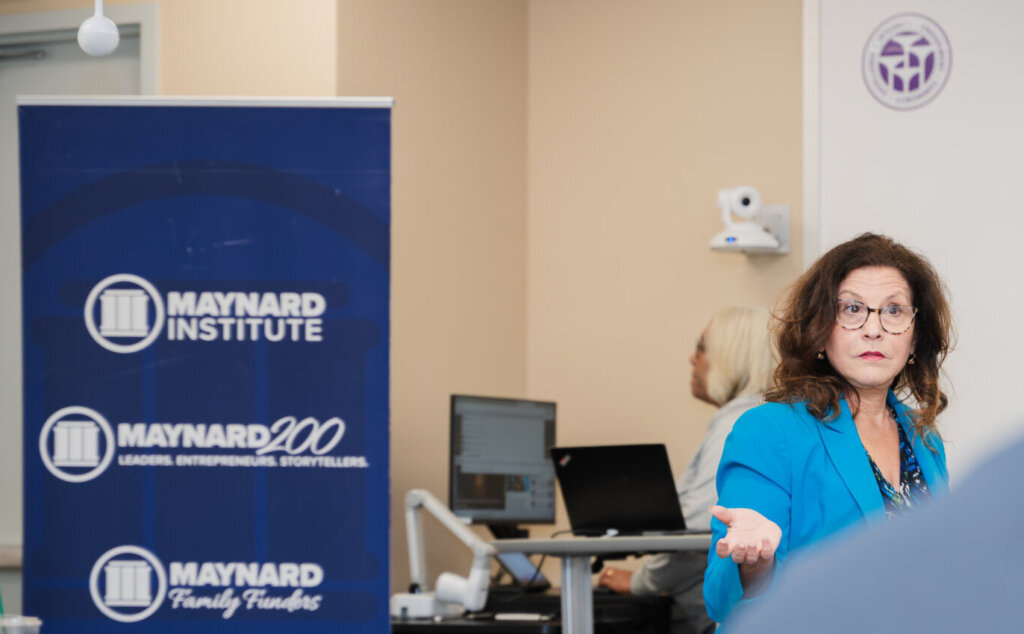
In the workshop “AI: Best Practices and Ethics,” Professor Marisa Porto explored how AI is transforming newsrooms, focusing on ethics and innovation. Participants discussed real-world examples and practical ways to use AI that is grounded in journalistic values.
“I hope participants left ready to use AI in their news organizations with purpose and transparency, guided by a commitment to public trust,” Porto said.
“It was interesting (and a bit concerning) to see how some newsrooms around the world use AI. I also appreciated the questions she encouraged us to ask about purpose, disclosure, oversight, review and impact. This will benefit me in my role as we explore more ways to utilize AI tools in our newsroom.”
Regional Training Series Participant

This workshop led by audience engagement consultant and newsroom management expert P. Kim Bui was centered on her observation that newsrooms are now multi-generational and each generation has its own working style. In this interactive workshop, she examined how today’s managers and leaders cross generational differences to lead more empathetic and valuable newsrooms.
“It is always such a joy to work with others in the Maynard family to create better workplaces for us all in turbulent times,” Bui said. “Attendees always approach tough problems with deep solutions as well as humor and hope.”
“Kim’s presentation gave me insight into how to be a more collaborative and effective leader beyond my team. As soon as I left Maynard, I created my own version of Kim’s employee Q&A to give to my direct reports and a recent new hire. I’m excited to see how it helps me be a better manager.”
Regional Training Series Participant

The regional roundtable of news leaders highlighted the state of Texas media and each editors’ perspectives on building a culture of courage and integrity in newsrooms in defense of democracy. Executives of legacy, nonprofit, ethnic and local media discussed challenges that news organizations are facing, including in covering federal and state policies impacting their audiences.
They shared innovations and approaches that are crucial in this era of political division. The panel was moderated by professor, author and Maynard board member Dr. Dorothy Bland.
Panelist Evelyn Castro of La Prensa de Houston, who also participated in the training, shared with her LinkedIn network that “The Maynard Institute for Journalism Education continues to set the standard for leadership, collaboration, and integrity in journalism. [I am] grateful for the opportunity to learn, share, and connect with so many passionate newsroom leaders committed to truth and community.”
Participants in the regional training programs are automatically eligible to access the benefits of the peer-to-peer learning and coaching hub, the Maynard Communities of Practice.
Program director Alcazaren-Keeley said the insights shared by trainees during session conversations and office hours consultations drive the impact of each training.
They value the space to be seen, heard and supported, and give that support to each other.
She sees the training programs embodying hope as the industry forges forward.
“The program is vital in helping journalists unlock their full leadership potential, to navigate this inflection point in our history and the tide of AI disruption. Our newest journalism cohort carries the professional advancement and movement-building legacy of the Maynard Institute. Together we bring our collective mission of integrity and courage to the future,” Alcazaren-Keeley said.

Board Member

Director Maynard Regional Training Series and Maynard Communities of Practice
okeeley@mije.org
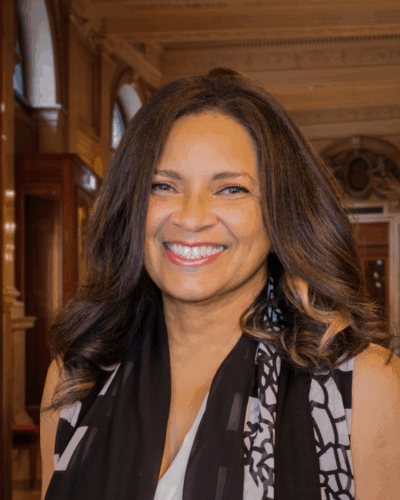
Senior Director of Strategic Initiatives
fhenderson@mije.org
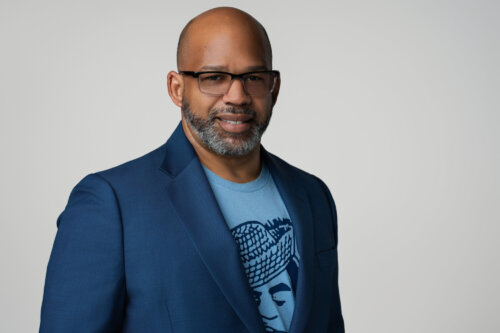
Co-Executive Director, Revenue and External Affairs
mreynolds@mije.org

Associate professor of professional practice, Department of Journalism at TCU Bob Schieffer College of Communication

Consultant / Coach

Assistant Managing Editor, The Dallas Morning News

Knight Chair in Local News and Sustainability, UNC Chapel Hill Hussman School of Journalism

Media Consultant

Panelist

Panelist

Panelist

Panelist
For more than 45 years, the Maynard Institute has fought to push back against the systemic lack of diversity in the news industry through training, collaborations and convenings. We are creating better representation in U.S. newsrooms through our programs which give media professionals the tools to become skilled storytellers, empowered executives and inspired entrepreneurs.
For more information about the Regional Training Series, please reach out to Odette Alcazaren-Keeley, Maynard Regional Training Series Director at okeeley@mije.org.
The Maynard Regional Training Series is a new training program advancing the Maynard Institute’s efforts to expand the diversity pipeline in news media and dismantle structural racism in its newsrooms. It is designed for and serves the next generation of frontline managers and editors in order to advance their career growth and leadership power in newsrooms and organizations.
Maynard Institute programs are open to all. We are committed to addressing the under-representation of people of color and other historically disadvantaged groups in media-related professions.
This professional development program provides customized training courses, resources and 1:1 mentorship by industry professionals, to fellows who have represented a wide spectrum of racial, gender and geographic backgrounds. The Maynard Institute’s new training programs are supported by the John S. and James L. Knight Foundation, the Ford Foundation, Craig Newmark Philanthropies, and The Hearthland Foundation.
For more information about the Maynard Regional Training Series, please reach out to:
Director of Maynard Regional Training and Communities of Practice, Odette Alcazaren-Keeley at okeeley@mije.org.
Watch this space for more information on how to manage YOUR donor portal with BlueLena and FundraiseUp!
We’re partnering with the Kansas City Defender for Black Philanthropy Month! August is Black Philanthropy Month! Founded in…
The inaugural cohort of Fire Up Fellows represent the power and potential of diverse news in the State…
By Maynard Institute Staff
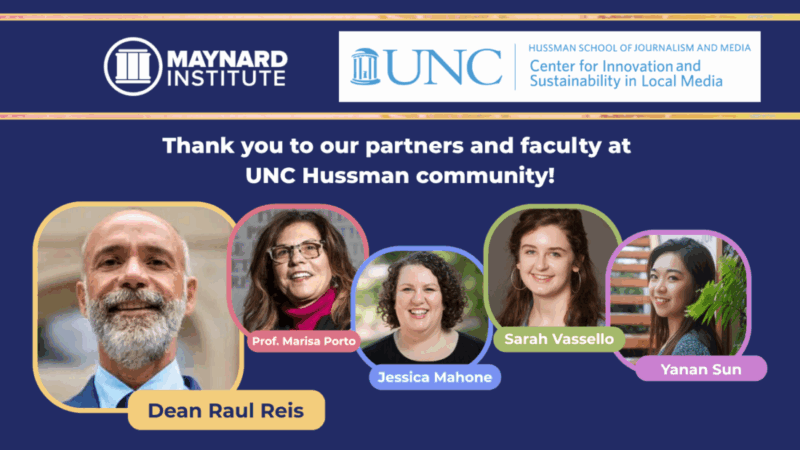
The Maynard Institute’s Regional Training Series will welcome another dynamic cohort of emerging media leaders on July 17 and 18, hosted by UNC Chapel Hill’s Hussman School of Journalism and Media and the Center for Innovation and Sustainability in Local Media (CISLM).
The program will provide customized training from 15 news experts and a community of support for early and mid-career editors and managers in newsrooms as well as nonprofit and/or communications organizations. The first training day will kick off with a welcome from Dr. Raul Reis, dean of the Hussman School.
“The UNC Hussman Community deeply values the transformative work of the Maynard Institute,” Dr. Reis said. “We are proud to support their mission by sharing our space, time and expertise to help cultivate the next generation of leaders in journalism.
We are proud to support their mission by sharing our space, time and expertise to help cultivate the next generation of leaders in journalism.
Dr. Raul Reis, Dean, UNC Hussman School of Journalism and Media
The Maynard Institute’s partnership with the UNC Hussman School and the Center for Innovation and Sustainability in Local Media builds on the allyship of both organizations. Odette Alcazaren-Keeley, director of the Maynard Regional Training Series, said the Institute is grateful for the exceptional support from the university.
“The deep knowledge of regional news and innovative frameworks of the UNC Hussman community’s faculty and specialists will be instrumental in propelling our mission. Alongside the expertise of executive-level Maynard faculty, they will help us continue incubating emerging media leaders who authentically represent our communities and are shaping newsrooms with integrity and courage,” Alcazaren-Keeley said.
“Our second regional training will provide concrete toolkits, cutting-edge frameworks, coaching and the Maynard community of support that will bolster the competency, successful leadership and resilience of frontline editors and managers,” she said. “It is crucial, especially in these adverse times with threats to journalism and vital institutions, to stand with them and their work that defends democracy.
It is crucial, especially in these adverse times with threats to journalism and vital institutions, to stand with them and their work that defends democracy.
Odette Alcazaren-Keeley, Director, Maynard Regional Training Series
Trainees represent a wide range of state, local, hyperlocal, community-powered and ethnic media outlets serving communities in North Carolina, Georgia, Tennessee and Virginia. Their work includes covering neighborhood businesses and the arts with The Carrborean, reporting on public education through EdNC, and sharing stories from Black communities in Gary, Indiana, through Capital B, among others.
Over the two days, attendees will explore leadership development topics ranging from editorial decision-making and finding the heart of the story to managing difficult conversations, a session led by the Institute’s senior director of strategic initiatives, Felecia D. Henderson.
“We have been very intentional about the sessions we are offering in this program,” Henderson said. “As former news leaders, we know the issues emerging news leaders face, such as having difficult conversations with employees. We want to provide frontline editors and managers with the confidence needed to lead with clarity, navigate change, and make a meaningful impact on those they supervise.
We have been very intentional about the sessions we are offering in this program.
Felecia D. Henderson, Senior Director, Strategic Initiatives
Jean Marie Brown, associate professor of professional practice at Texas Christian University’s Bob Scheffer’s College of Communication, will facilitate the Leaning into your Fault Lines® – Managing News Coverage session, which centers the Institute’s signature Fault Lines framework, designed to help editors understand how biases and blindspots inform the way they guide news coverage.
Marisa Porto, UNC’s Knight Chair in Local News and Sustainability, will lead a session on Best Practices & Ethics in Artificial Intelligence, a topic that is impacting news organizations. “AI is going to continue evolving,” Porto said. “To adapt and remain successful, news organizations will need to have a strategic plan in place for how they can use AI to grow their audience, increase efficiencies, and improve their bottom line, while being prepared to adjust along the way.”
Attendees will also engage in a unique, live demonstration and interactive workshop of CISLM’S local news audience assistant – a custom GPT built to compile best practices, Q&As, tip sheets and more from journalism support organizations. The session will be led by CISLM’s Sarah Vassello and Yanan Sun.
The two-day training will conclude with a discussion of news leaders representing organizations across North Carolina, such as the Charlotte Observer, La Noticia, Qcitymetro.com, the Asheville Citizen Times and The Assembly. CISLM interim director Jessica Mahone will moderate the discussion, which will focus on the state of media in North Carolina and the challenges of covering news in the midst of distrust of local and national media and government.
Also joining are Alli Pardue and Daneen Khan, respectively editor-in-chief and community engagement managing editor of The Daily Tar Heel, UNC’s award-winning daily student newspaper.
“At a time when trust in institutions is under strain, our partnership with the Maynard Institute reflects our shared commitment to integrity, empathy and equity in journalism,” Mahone said. “We’re proud to support this program that gives emerging editors and managers the space, tools and community to lead with clarity and purpose and to build newsrooms where truth and a deep sense of responsibility to the public are at the center of decision-making.”
The Maynard Regional Training Series is made possible thanks to the support of our generous funders The Ford Foundation and The John S. and James L. Knight Foundation and donations from individuals who support our mission of diversifying journalism.
For more than 45 years, the Maynard Institute has fought to push back against the systemic lack of diversity in the news industry through training, collaborations and convenings. We are creating better representation in U.S. newsrooms through our programs which give media professionals the tools to become skilled storytellers, empowered executives and inspired entrepreneurs.
For more information about the Regional Training Series, please reach out to:
Odette Alcazaren-Keeley
Maynard Regional Training Series Director.
Watch this space for more information on how to manage YOUR donor portal with BlueLena and FundraiseUp!
We’re partnering with the Kansas City Defender for Black Philanthropy Month! August is Black Philanthropy Month! Founded in…
The inaugural cohort of Fire Up Fellows represent the power and potential of diverse news in the State…