News / Blog
The Business Case for DEIB Training in Journalism
DEIB training isn’t just a nice-to-have workplace initiative. Diversity in the media directly influences the quality, accuracy, and…


by Alice Finno, Maynard Institute reporting intern
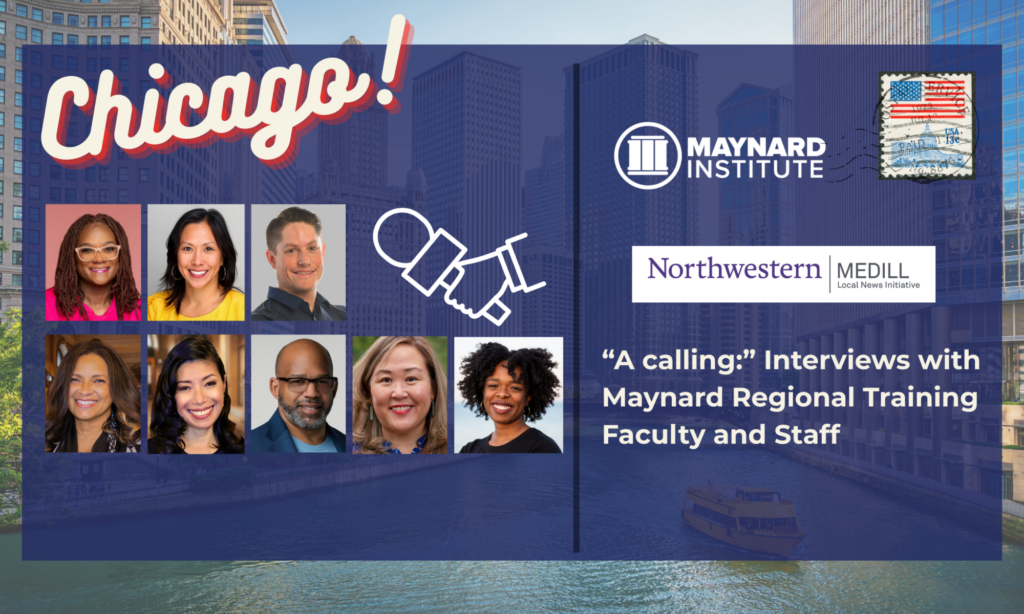
This post contains promotional material for the Maynard Regional Training Series in Chicago.
The Maynard Institute will host a free training for entry- and mid-level editors and managers in Chicago, Illinois, on June 4 through 5, as part of its regional training series.
In partnership with Northwestern University’s Medill School of Journalism, Media and Integrated Marketing Communications, the training will provide coaching and mentoring to help editors and managers working in print, broadcast and digital platforms navigate the complexities of newsroom leadership. Northwestern will cover the standard registration fee on behalf of registrants. Two meals will be provided each day, and limited discounted hotel rooms will be available.
Anyone from the Chicago regional area is invited to attend the training. Registration is open until Tuesday, May 26. Anyone with questions can contact Maynard Regional Training Series Director Odette Alcazaren-Keeley.
Award-winning journalists and Medill professors will lead workshops and discussions together with Maynard Institute faculty.
Martin Reynolds, co-executive director at the Maynard Institute, said that people often start managerial positions without receiving any training, especially when transitioning from a reporter role to a manager or editor position.
However, Reynolds said, only one in ten people have the skills to be a successful manager, according to Gallup, a research and polling organization. During the Chicago training, Reynolds will hold a session about “The Manager’s Mindset” and core aspects of leadership roles, including authority, influence and empathy.
“Having empathy and compassion for your people is really one of the elements that I think is essential,” Reynolds said. “If you don’t have that, it’s very difficult to be an effective manager, a good manager, where your colleagues will thrive under your leadership.”
Mei-Ling Hopgood, journalism professor at Northwestern, will hold a session on using AI with integrity, where participants will discuss newsrooms’ standards and practices when using large language models, such as ChatGPT and Gemini.
“They’re going to be part of newsrooms, they’re going to be part of our workflow, but to be able to say aloud — or to have in writing — this is my philosophy, these are the values that are guiding my use, is very important,” Hopgood said, adding that she hopes people will leave the session having a sense of the guiding principles they want to follow when using AI.
Deborah Douglas, director of the Medill Solutions Journalism Hub, will hold a session called “Complicating the Narrative,” where she will teach people a deep listening technique used in interviewing developed by journalist Amanda Ripley, who currently partners with Maynard alum Hélène Biandudi Hoffer at Good Conflict, guiding and facilitating communication by reimagining conflict “to help people listen and be heard in times of profound disagreement.”
“In a time of deep polarization and shrinking trust, I want to introduce a deep listening technique that models deep listening so that people feel heard and so that they feel safe enough to open up and give us the real answer, not just the surface level answers that people tend to give,” she said.
At the training, Mackenzie Warren, interim executive director of the Medill Local News Initiative, will also present the findings of a study about how Chicago gets its news. The researchers surveyed 1,101 adults in the Chicago metropolitan area and examined consumer behavior, obtaining insights about audiences’ evolving habits and interests.
Warren said the survey focused on 14 counties and included urban, suburban and rural communities in proportions roughly mirroring the United States’ population while also taking race, class and socio-economic status into account to have a representative index.
“I feel somewhat confident in using it as a directional information about how the United States as a whole is getting local news,” he added.
Warren also shared that the Medill Local News Initiative is designed to help the local news ecosystem thrive and highlighted the correlation between positive performance in local news and in democratic norms.
“Without trusted local journalism, it’s not as possible for ordinary people to make good decisions in their lives,” he said.
Doris Truong, deputy director of the Fire Up Entrepreneurship Program at the Maynard Institute, will lead a session on listening and identifying personal values. Truong will talk about interviewing people you disagree with without expressing judgement.
“When you’re talking to sources, it’s really important for them to understand that you’re just trying to understand them, not trying to change their minds,” she said. “You may end up having to interview somebody that you can say ‘I don’t agree with this, but I really want to help my audience understand your perspective.’”
Felecia Henderson, senior director of strategic initiatives at the Maynard Institute, will hold a session about navigating difficult conversations, providing useful steps managers can follow and then role-playing scenarios.
“When you’re a manager, you really have to find a way to strike the right tone, the right setting, the right approach. And a lot of people don’t know what that is,” Henderson said.
Henderson added that when people finish a regional training, they become part of the Maynard Communities of Practice, a program that connects people working in the same field and provides continuous training across different curriculum tracks.
Odette Alcazaren-Keeley, director of the Maynard Regional Training and Communities of Practice Programs, shared that the training will include a roundtable with news leaders from the region to talk about the state of the media in the region.
Alcazaren-Keeley said what participants always appreciate about the programs is sharing the room with other journalists who face the same challenges and be able to learn from each other.
“What we hope is that when they leave, they feel they are not alone, that they have us, and they have each other, and they grow the community with us: they become part of the Maynard family that endures,” she said.
Jasmine Barnes, program manager at the Maynard Institute, said she enjoys creating the vision for a Maynard training and thinking about all the details that will enhance the participants’ experience.
“I’m really hoping that the Chicago training can be a really good opportunity for Northwestern’s network and broader community, as well as some Maynard alumni and some folks who haven’t really been involved with either of those institutions to meet and to really talk about the region and the unique challenges and opportunities that are present in Chicago,” she said.
Mackenzie Warren expressed his excitement for having frontline editors and leaders in journalism come together for the training.
“There’s going be a room full of people who have signed on to this mission and dedicated themselves to this profession that’s more than a profession, it’s a calling,” Warren said.
“Our contributions to journalism will outlast ourselves if we do it right — I’m really encouraged that there’s a room full of people, the next generation of people, who see themselves that way and see this as not just their job, but their mission, and are invested in themselves to get better at their craft.”
DEIB training isn’t just a nice-to-have workplace initiative. Diversity in the media directly influences the quality, accuracy, and…
*This article references Maynard Institute programming and interviews Maynard Institute training participants and faculty, including Brenda Verano, who…
Photos by Jennifer Shaevitz, SLO Media Creations.