News / Blog
Announcing: The Maynard Institute is partnering with BlueLena.
Watch this space for more information on how to manage YOUR donor portal with BlueLena and FundraiseUp!


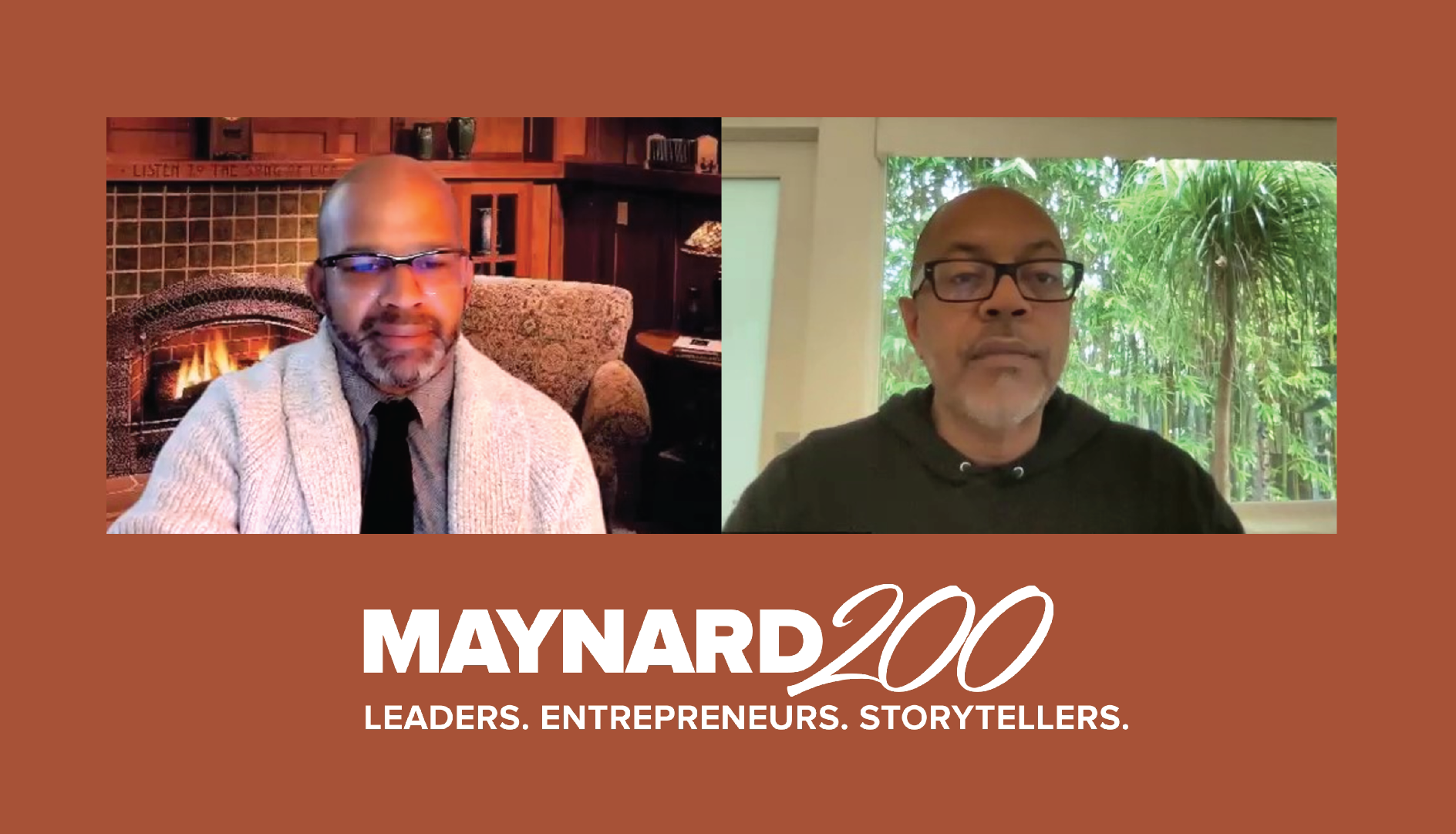
In October, the 2021 cohort of Maynard 200 fellows gathered for week-long intensive training sessions joined by more than 60 executive level faculty and mentors whose caliber mirror back the wide representation of our fellows of diverse heritage and geography affiliation at mainstream and ethnic media outlets across disciplines and expertise. The convening plenary kicked off with a fireside chat featuring Kevin Merida, executive editor of the Los Angeles Times and Maynard Institute board member.
Maynard 200 Program Director, Odette Alcazaren-Keeley, helped set the tone for the keynote session by describing the high stakes facing Maynard 200 fellows today.
“In a climate where local journalism is under threat– in the print sector alone – today half of all daily newspapers in the United States are controlled by financial firms. For example, The Atlantic’s recent cover story points to newsrooms being gutted by hedge fund Alden Global Capital,” she said.
One of the Maynard Institute’s core programs, the Maynard 200 Fellowship provides advanced training to mid-career journalists of color to prime them as candidates for higher leadership roles. As industry leaders, Maynard 200 fellows have the opportunity to change the management culture including hiring practices in institutional and entrepreneurial news organizations.
“We look to our legacy values and groundbreaking work at the Maynard Institute, rooted in trust equity and belonging to change the culture and American media. And all of you, the voices of our fellows resound. We stand together with you in your work in defending the soul of our democracy,” Alcazaren-Keeley added.
Maynard Institute Co-executive director Evelyn Hsu addressed the group, thanking Merida and all the faculty for their support. Detailing the ways the Maynard family survives through the graduates of programs like Maynard 200.
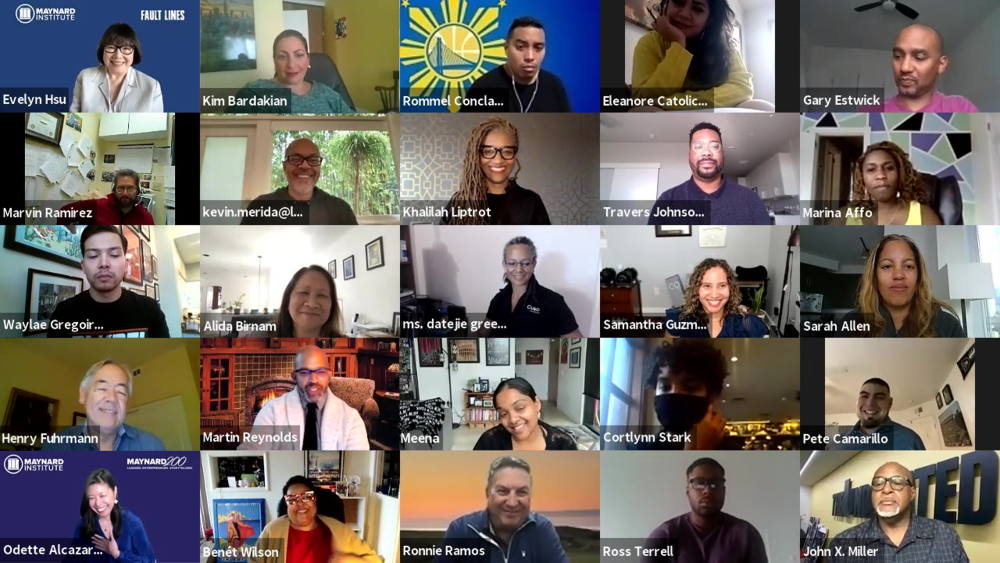
In conversation with Maynard Institute’s co-executive director Martin Reynolds, Merida shared insights from his journalism career, from his earliest days to today as executive editor of the Los Angeles Times, the largest news gathering organization in the Western United States.
“It’s certainly nostalgic just listening to Evelyn talk about the history. Evelyn and I were classmates in the Maynard Instute’s 1979 summer program. And with that pioneering spirit that Bob Maynard had, it’s really important to remember history and how far we’ve come.”
Merida reflected on his journey in relation to Robert C. Maynard’s journey as well.
“This program is why I feel so close to Maynard and this family. It really helped shape my career as one of the most important experiences of my life. We were celebrating our graduation in 1979 from the program but also Bob Maynard’s ascension to be the first African American editor in our country’s history at the Oakland Tribune.”
Merida would later become the first Black managing editor of the Washington Post, before becoming senior vice president at ESPN and editor-in-chief at The Undefeated.
When Reynolds asked for thoughts on trends in journalism, Merida suggested that the digital revolution has evolved to the point where technology is now a major driver in the industry. He explained that journalists fluent in technology have the power to change industry conventions and storytelling as a whole for the better.
“We talk a lot about the digital revolution. I say we’re all digital now, whatever medium you belong to, we’re already in a digital environment. People said content is king and that’s true. But technology is really king among kings because the way in which we are able to reach people and to drive different consumption habits. And in some ways, those consumption habits are driven by technology.”
“So as journalism evolves and people who have grown up in the digital era have fluency that didn’t previously exist they gravitate toward different kinds of storytelling. Even just the way stories are written, every part of our business conventions. We’re disrupting that, so why wouldn’t we disrupt it all?”
“Newsrooms have always had challenges, but now we have challenges in more public ways and I think that is good for our business. It’s going to make us better.”
In response to the question “how do you define culture, and how can the Maynard 200 fellows use culture to their leadership advantage?” Merida said culture can serve newsrooms as a grounding principle for inclusion.
“I always think transparency can’t be underestimated. We have to have a lot more open conversations. As citizens of this workplace, what are we going to stand for? How are we gonna operate? What is the environment of inclusion? What do we do that brings ourselves closer to our community? Culture defines an environment where everybody is welcome, where we can accommodate all kinds of people.”
Merida closed the plenary session with a call to action that echoed the vision of the institute’s founder, Robert C. Maynard who declared in 1978, “We must desegregate this business…Newsrooms have a responsibility to cure the legacy of racism.” The Institute has trained three Maynard 200 cohorts, who are now being promoted in both mainstream and ethnic media newsrooms such as the New York Times, Los Angeles Times, Mother Jones, theGrio, the Associated Press, The Washington Post, the Washington Informer, Mundo Hispanico, Queerency, Univision KDTV Bay Area, Nieman Journalism Lab, among many others. Some of them are also have been awarded grants for entrepreneurial media ventures. As the Maynard Family grows, the journalism industry becomes closer to curing the legacy of racism.
The Maynard 200 program is grateful to Kevin Merida and all members of this year’s faculty who led sessions and all who continue to serve as mentors. This year’s faculty is once again a high-caliber roster of 60+ executives in media and other relevant disciplines. Their expertise and representation mirror that of our fellows – of diverse heritage, geography across the United States and globally, affiliation at mainstream and ethnic media outlets as well as entrepreneurial ventures.
The Maynard 200 program includes three areas of focus: media entrepreneurship, executive leadership and storytelling. Each track is led by accomplished experts, and this year we are privileged to have media strategist Dickson Louie for media entrepreneurship, former newsroom C-suite executive Virgil Smith in executive leadership, and award-winning investigative reporter and author Aaron Glantz for storytelling. Dickson Louie and Virgil Smith serve on the institute’s board of directors as well.
Serving as track deputies this year are Emmanuel Martinez, data reporter at The Markup who was also a session speaker for Storytelling; and Waylae Gregoire, Partner, Head of Business Development at NextShark, for Media Entrepreneurship.
The Maynard Institute’s allies in the field have been instrumental in this year’s recruitment and selection of our stellar 2021 fellows including Investigative Reporters and Editors (IRE), Asian American Journalists Association (AAJA), National Association of Hispanic Journalists (NAHJ), Native American Journalists Association (NAJA), National Association of Black Journalists (NABJ), Poynter Institute, the Craig Newmark Graduate School of Journalism at the City University of New York (CUNY), and Society for Professional Journalists (SPJ). Special thanks to IRE’s support for this year’s mentorship roster, which includes their distinguished board members and network partners.
The 2021 Maynard 200 Journalism Fellowship is supported by Google News Initiative, Craig Newmark Philanthropies, The Hearthland Foundation and the McClatchy Foundation.
Plenary and Track Session Speakers:
Mentors for Storytelling:
Mentors for Executive Leadership:
Mentors for Media Entrepreneurship:
Watch this space for more information on how to manage YOUR donor portal with BlueLena and FundraiseUp!
We’re partnering with the Kansas City Defender for Black Philanthropy Month! August is Black Philanthropy Month! Founded in…
The inaugural cohort of Fire Up Fellows represent the power and potential of diverse news in the State…
The Maynard 200 fellows reconvened virtually for their second week of intensive training, panel discussions, workshops, and mentorship. Due to the COVID-19 pandemic, the 2021 fellows have been unable to gather in-person. To help foster connections in the virtual program, fellows were invited to submit video clips shot from their individual locations and share their thoughts on the Maynard 200 program.
One of the Maynard Institute’s core programs, the Maynard 200 Fellowship provides advanced training to mid-career journalists of color to prime them as candidates for higher leadership roles. The program is designed with three tracks: Storytelling, Media Entrepreneurship, and Executive Leadership. During the week of trainings, daily plenary sessions kicked off with a watch party of these brief compilation videos for all fellows, faculty, and mentors to enjoy together.
Each track is led by accomplished experts, and this year we are lucky to have award-winning investigative reporter and author Aaron Glantz for the storytelling track. Fellows in this track include: Marina Affo, Stephanie Casanova, Angela Chen, Eleanore Catolico, Rommel Conclara, Ruslan Gurzhiy, Estephany Haro Thalia Juarez Sarah Mizes-Tan Herb Pinder Cortlynn Stark Jasmine Vaughn-Hall, Mark Walker, Dalia Hatuqa, and Sameea Kamal.
Fellow Stephanie Casanova, who recently joined The Chicago Tribune as Breaking News and Criminal Justice Reporter, said, “Maynard 200 has helped me be more confident and push aside the imposter syndrome that would have prevented me from applying to this job in the first place.”
Led by former newsroom C-suite executive Virgil Smith, fellows in the executive leadership track include Stephen Angeles, Charmayne Brown , Anica Butler, Tripp J. Crouse, Gary Estwick, Samantha Guzman, Lottie Joiner, Ashton R. Lattimore, Khalilah E. Liptrot, Marian Liu, Michelle Faust Raghavan, Rajeswari Ramanathan, Ross Terrell, Benet J. Wilson, and Tasha Stewart.
“This Maynard experience has really underscored all the ways that journalists of color are too often undervalued in dominant newsrooms. It’s just been incredible to be in a room of people, virtual though it may be, where you really feel like you are seen and you are heard and your contributions are deeply appreciated,” said fellow Khalilah L. Liptrot, Senior Producer of the Black News Channel’s AMplified with Aisha Mills in New York.
Media strategist Dickson Louie leads the media entrepreneurship track for fellows Annie Guo VanDan, Pete Camarillo, Clarisa Strohmeyer, , Jenee Darden, Felicia Purcell, Delonte Harrod, Kevon Paynter, Hannah Kim, Anuz Thapa, Meena Thiruvengadam, Marvin Ramirez, datejie cheko green, Travers Johnson, and Michelle Garcia.
“I’m so thankful for the Maynard 200 because I’m in a space of people who are also innovating in journalism but we’re not doing this alone, we’re doing this together,” said fellow Kevon Paynter, Founder and CEO of Bloc by Block News.
The Maynard Institute has trained two outstanding cohorts so far since 2018, who are now being promoted in both mainstream and ethnic media newsrooms such as the New York Times, Los Angeles Times, Mother Jones, theGrio, the Associated Press, the Washington Informer, Mundo Hispanico, Nieman Journalism Lab, among many others, or earning grants for entrepreneurial media ventures. The continuation of this cornerstone program will be critical to advancing the Maynard Institute’s efforts to expand the diversity pipeline in American media and dismantle structural racism in its newsrooms. These leaders will have the opportunity to change the management culture including hiring practices in institutional and entrepreneurial news organizations.
The program is tuition-free thanks to funding by Google News Initiative, Craig Newmark Philanthropies, The Hearthland Foundation and the McClatchy Foundation.
Watch this space for more information on how to manage YOUR donor portal with BlueLena and FundraiseUp!
We’re partnering with the Kansas City Defender for Black Philanthropy Month! August is Black Philanthropy Month! Founded in…
The inaugural cohort of Fire Up Fellows represent the power and potential of diverse news in the State…
Our opening reception will feature a fireside-style chat between Maynard Institute co-executive director, Martin Reynolds and Kevin Merida, executive editor for the Los Angeles Times. Merida is also a member of the Maynard Institute board of directors and an alumni of the Maynard Institute’s Editing Program.
One of the Maynard Institute’s core programs, the Maynard 200 Fellowship provides advanced training to mid-career journalists of color to prime them as candidates for higher leadership roles.
The program seeks out journalism professionals currently working in three areas of focus: entrepreneurship, executive leadership and storytelling. Each track is led by accomplished experts, and this year we are lucky to have award-winning investigative reporter and author Aaron Glantz for storytelling, media strategist Dickson Louie for media entrepreneurship and former newsroom C-suite executive Virgil Smith in executive leadership.
“The relentless uncertainty of our time made it necessary for us to pivot back to an all-virtual training week to keep all participants safe. But what remains unchanged is our commitment at Maynard 200 to deliver cutting-edge training, diverse frameworks and a year-long 1:1 mentorship, grounded in MIJE’s core values of equity and belonging,” said Odette Alcazaren-Keeley, director of the Maynard 200 program.
“We are again privileged as in previous fellowship years, with the caliber of our faculty and also mentors, matched 1:1 to our 44 fellows. They represent expertise not only from general market and ethnic media, but across various disciplines as well— which align in our mission of advancing the leadership power, change agency and authentic voice of our fellows,” she explained.
“We look forward to strengthening the strong spirit of community that we built together with our M200 cohort since our first training week,” Alcazaren-Keeley added.
The 2021 fellows completed their first week of intensive training in April of this year, where they attended panels and discussions formulated to hone their skills. Our fellows have already made huge strides and career changes with the support of their track chiefs.
The Institute has trained two outstanding cohorts prior to the 2021 class, who are now being promoted in both mainstream and ethnic media newsrooms such as the New York Times, Los Angeles Times, Mother Jones, theGrio, the Associated Press, the Washington Informer, Mundo Hispanico, Nieman Journalism Lab, among many others, or earning grants for entrepreneurial media ventures.
After the formal training, fellows are paired with a high-level journalist who has committed to mentoring the fellow for a year.
The program is tuition-free thanks to funding by Google News Initiative, Craig Newmark Philanthropies, The Hearthland Foundation and the McClatchy Foundation. Learn more about the 2021 Fellows.
Watch this space for more information on how to manage YOUR donor portal with BlueLena and FundraiseUp!
We’re partnering with the Kansas City Defender for Black Philanthropy Month! August is Black Philanthropy Month! Founded in…
The inaugural cohort of Fire Up Fellows represent the power and potential of diverse news in the State…
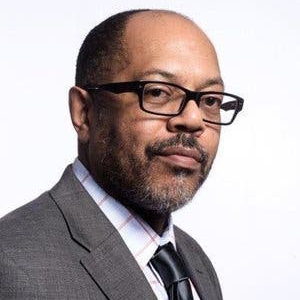
Longtime journalist Kevin Merida, who has served on the board of the Maynard Institute since 2014 and participated in the Maynard Institute Summer Program for Minority Journalists in 1979, was named the executive editor of the Los Angeles Times, one of the largest major metro newspapers in the country.
Merida has served as the editor in chief of ESPN’s The Undefeated since 2015, where he led a division producing content at the intersection of sports, race and culture.
Merida has had the unique opportunity to work in print, broadcast and digital ventures throughout his lengthy career, which was launched by the Maynard Institute’s SPMJ 1979 program, hosted at UC Berkeley. He went on to his first full time reporting job at the Milwaukee Journal and later spent over two decades at the Washington Post, where he rose to managing editor.
Several other alumni of the Maynard Institute’s programs have worked at the LA Times and been instrumental in producing inclusive community reporting, such as Maynard Institute co-founder Frank Sotomayor, who helped lead the LA Times Pulitzer prize-winning series on the Latino community in Los Angeles. That project included the work of Merida’s SPMJ ‘79 classmates, Virginia Escalante and Louis Sahagun.
The current owners of the LA Times, Dr. Patrick and Michele Soon-Shiong, indicated earlier this year that stronger coverage of “Black, Latino, Asian and underrepresented communities” is a priority for the publication.
Merida plans to relocate to Los Angeles with his wife and youngest son. The Maynard Institute sends it’s most heartfelt congratulations to Kevin and family!
Watch this space for more information on how to manage YOUR donor portal with BlueLena and FundraiseUp!
We’re partnering with the Kansas City Defender for Black Philanthropy Month! August is Black Philanthropy Month! Founded in…
The inaugural cohort of Fire Up Fellows represent the power and potential of diverse news in the State…
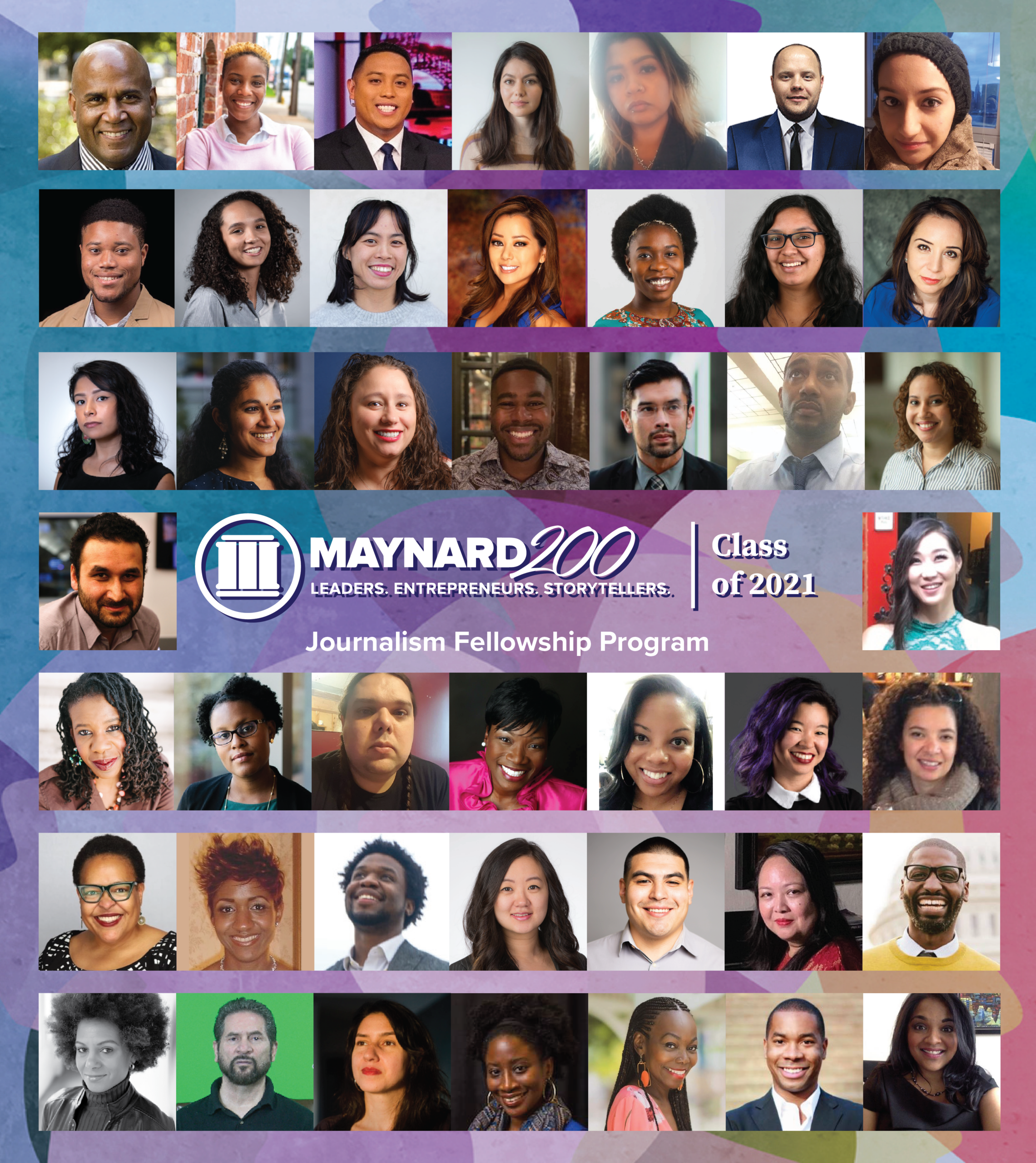
EMERYVILLE, CALIFORNIA (April 8, 2021) —The Robert C. Maynard Institute for Journalism Education [MIJE], a national nonprofit dedicated to making newsrooms look like America and to bring about equity and belonging in media, today welcomes the 44 fellows selected for Maynard 200, the third cohort of its flagship fellowship.
The diverse group of media professionals was selected from a competitive pool of more than 140 applicants. The fellows represent a mix of mainstream, ethnic, local community and niche media, and their entrepreneurial ventures. The Maynard 200 fellowship will provide cutting-edge training and year-long mentorship from top experts.
The goal is to embolden the next generation of storytellers, leaders and media entrepreneurs to transform the nation’s media ecosystem and preserve our democracy by ensuring that the media accurately represents the lives and perspectives of all Americans.
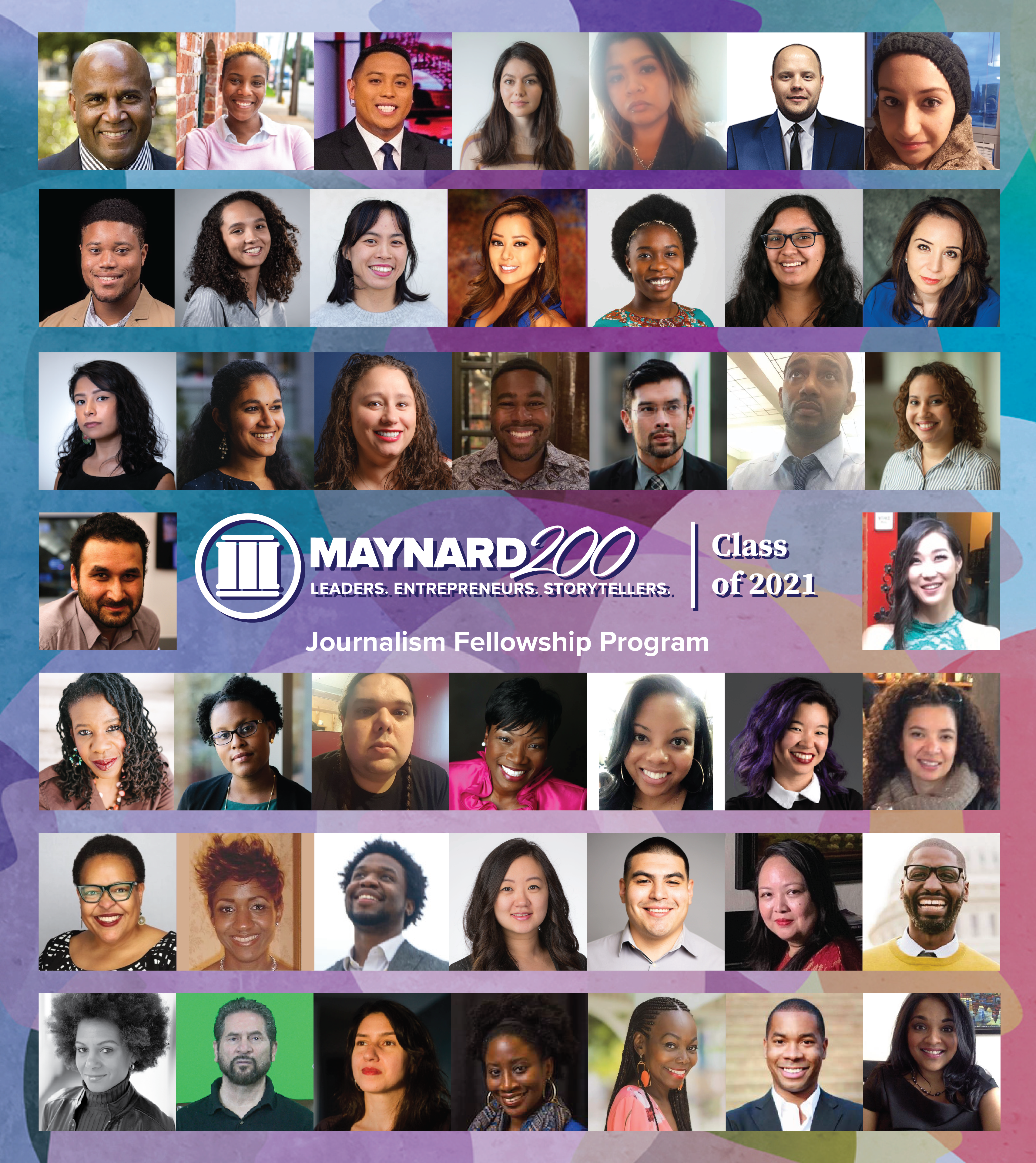
The 2021 class reflects a profound pivot from diversity to belonging. These professionals will provide the energy helping to power the culture shift in America’s newsrooms. Calls by journalists of color for equity and dismantling systemic racism in the news media are profound and will be answered through the work of these fellows.
“We are energized by our fellows’ nuanced coverage, wide spectrum of diverse perspectives, empathetic leadership and innovative entrepreneurial ventures,” said Odette Alcazaren-Keeley, director of Maynard 200. “They will find allyship in and bolster the program’s mission of reinvigorating the media’s diversity pipeline now sharpened by the crises of our time amid our global pandemic recovery and racial justice reckoning.
“Despite our digital pivot for the first training week because of public health protocols for COVID-19, we are committed to deliver the same excellent program this year, aiming to amplify the collective impact of our cohort.”
This year’s Maynard 200 Fellowship will begin with a virtual training week,
April 12-16. The second training round is scheduled in person this November if protocols allow.
Maynard 200’s three-track curriculum delivers a mix of content, expertise and perspectives and includes:
Executive Leadership
Media Entrepreneurship
Storytelling
“We are fortunate to have accomplished leaders in charge of each of our training tracks — award-winning investigative reporter and author Aaron Glantz in Storytelling, media strategist Dickson Louie in Media Entrepreneurship and former newsroom C-suite executive Virgil Smith in Executive Leadership,” said Evelyn Hsu, co-executive director of the Maynard Institute and the architect of Maynard 200. “They are joined by accomplished and devoted professionals who teach and mentor our participants. Our faculty are key to building the next generation of journalists of color.”
“Given the demographics of the nation and the shift to have people pay for the news they use, the need to have media professionals that represent the wide diaspora of lives and cultures isn’t just the right thing to do,” said Martin G. Reynolds, the institute’s co-executive director. “It is imperative if journalism is to be seen as accurate, authentic, trustworthy and credible. It’s not hyperbole to say that the soul of journalism is at stake in this moment and in this time.”
When this third cohort graduates, 93 media professionals will have participated in the Maynard 200 fellowship since its inception in 2018. The program aims to reinvigorate the diversity pipeline in American media by training 200 diverse professionals in its first five years.
The program is tuition-free thanks to funding by Google News Initiative, Craig Newmark Philanthropies, The Hearthland Foundation and the McClatchy Foundation.
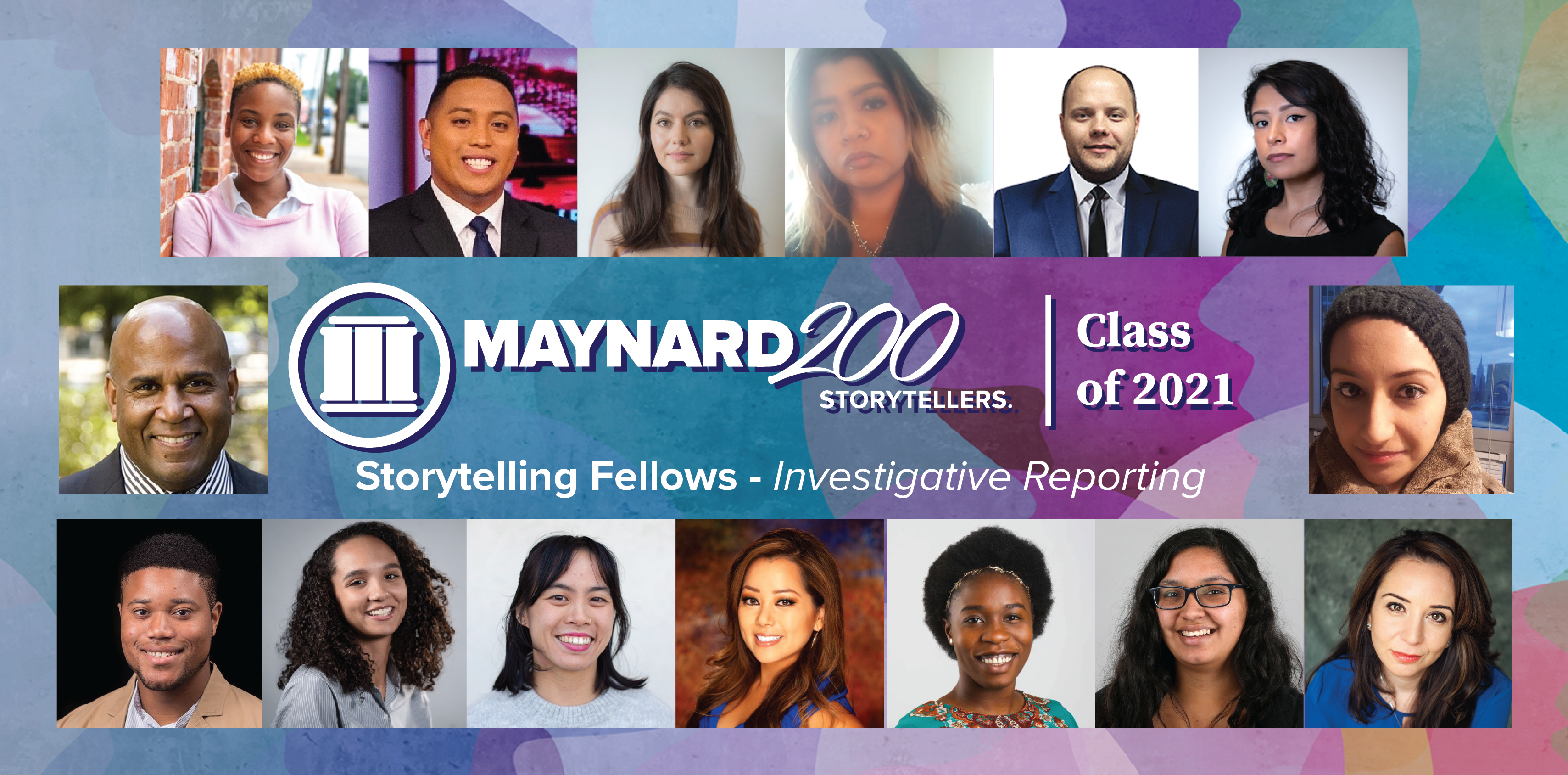
Participating in the Maynard 200 Fellowship – Storytelling track [L-R]:
Jasmine Vaughn-Hall, Rommel Conclara, Estephany Haro, Eleanore Catolico, Ruslan Gurzhiy, Thalia Juarez, Herb Pinder, Sameea A. Kamal, Mark Walker, Cortlynn Stark, Sarah Mizes-Tan, Angela Chen, Marina Affo, Stephanie Casanova, Dalia Hatuqa
STORYTELLING TRACK
Marina Affo, reporter, investigations team, The Philadelphia Inquirer
Stephanie Casanova, reporter and digital producer, Arizona Daily Star
Eleanore Catolico, freelance community journalist/contributor, BridgeDetroit
Angela Chen, morning anchor, KESQ TV- ABC/CBS
Rommel Conclara, Bay Area correspondent, ABS-CBN International-The Filipino Channel
Ruslan Gurzhiy, editor, Slavic Sacramento
Estephany Haro, executive producer, KDTV- Univision 14 Bay Area
Dalia Hatuqa, independent journalist/regular contributor, Foreign Policy
Thalía Juárez, photo editor, The Wall Street Journal / freelance multimedia journalist
Sameea A. Kamal, news desk editor, Los Angeles Times
Sarah Mizes-Tan, race and equity reporter, CapRadio
Herb Pinder, accountability coach, Asbury Park Press / USA Today Network
Cortlynn Stark, breaking news reporter, The Kansas City Star
Jasmine Vaughn-Hall, diversity & inclusion reporter, York Daily Record/USA Today Network
Mark Walker, FOIA coordinator and reporter, The New York Times
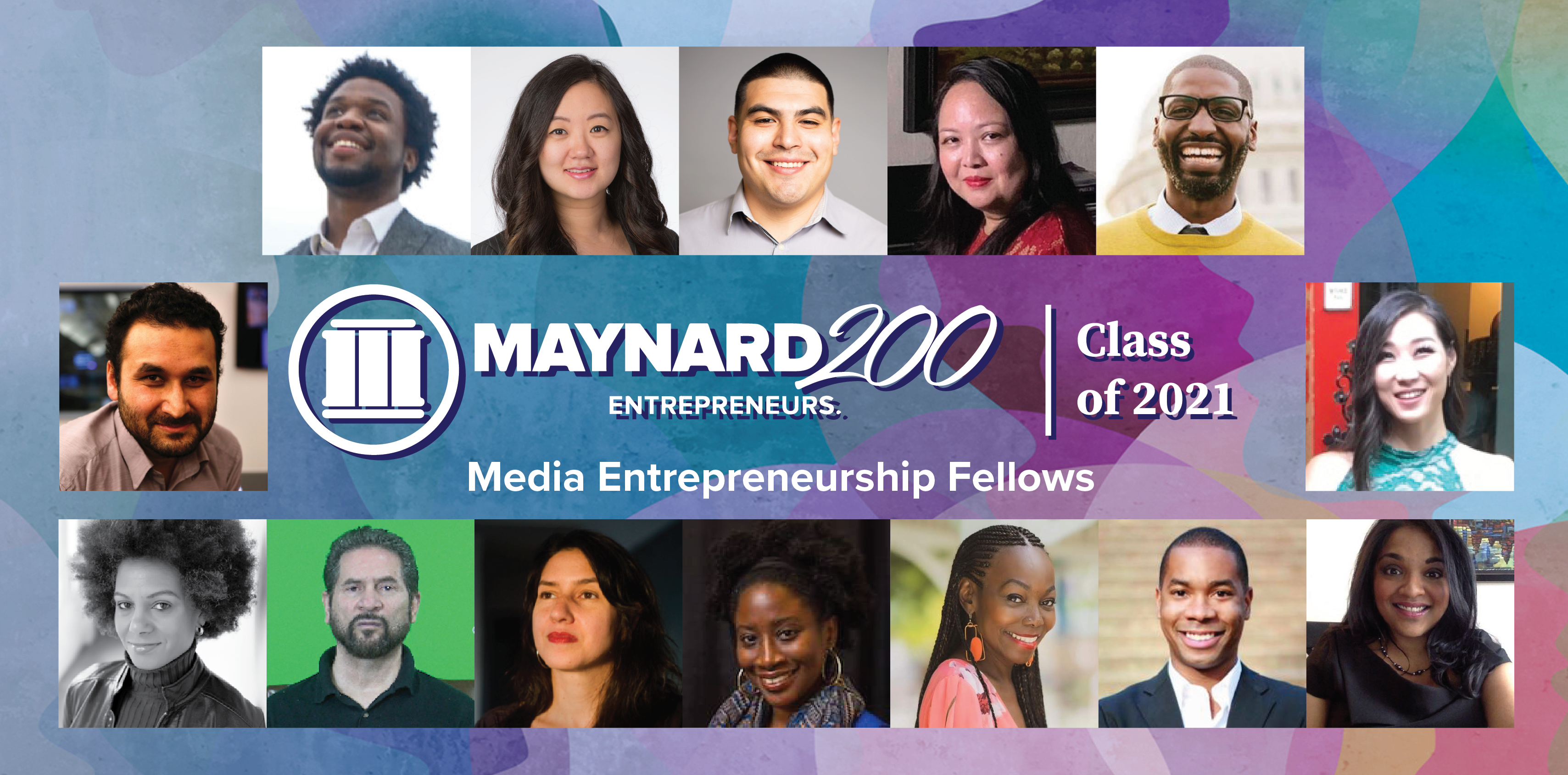
Participating in the Maynard 200 Fellowship – Media Entrepreneurship track [L-R]:
Kevon Paynter, Annie Guo VanDan, Pete Camarillo, Clarisa Strohmeyer, Delonte Harrod, Anuz Thapa, Hannah Kim, datejie cheko green, Marvin Ramírez, Michelle García, Jenee Darden, Felicia Purcell, Travers Johnson, Meena Thiruvengadam
MEDIA ENTREPRENEURSHIP TRACK
Pete D. Camarillo, founder, PST Media
Jeneé Darden, reporter and podcast host, KALW
Michelle García, journalist/curator, Rewriting the West project
datejie cheko green, founder and director, Solidarity Conscious Works
Delonte Harrod, founder, editor, reporter, The Intersection Magazine
Travers Johnson, founder and editor in chief, Queerency
Hannah Y. Kim, principal, Butterfly Strategies, LLC
Kevon Paynter, CEO and founder, Bloc By Block News
Felicia Purcell, freelance writer, various Bay Area publications / content manager, Sports in the Bay
Marvin Ramírez, editor and publisher, El Reportero
Clarisa Strohmeyer, managing director, ganjly.com
Anuz Thapa, journalist and video producer, thestreet.com
Meena Thiruvengadam, contributor, Travel + Leisure/journalist and audience development consultant
Annie Guo VanDan, president, Asian Avenue Magazine
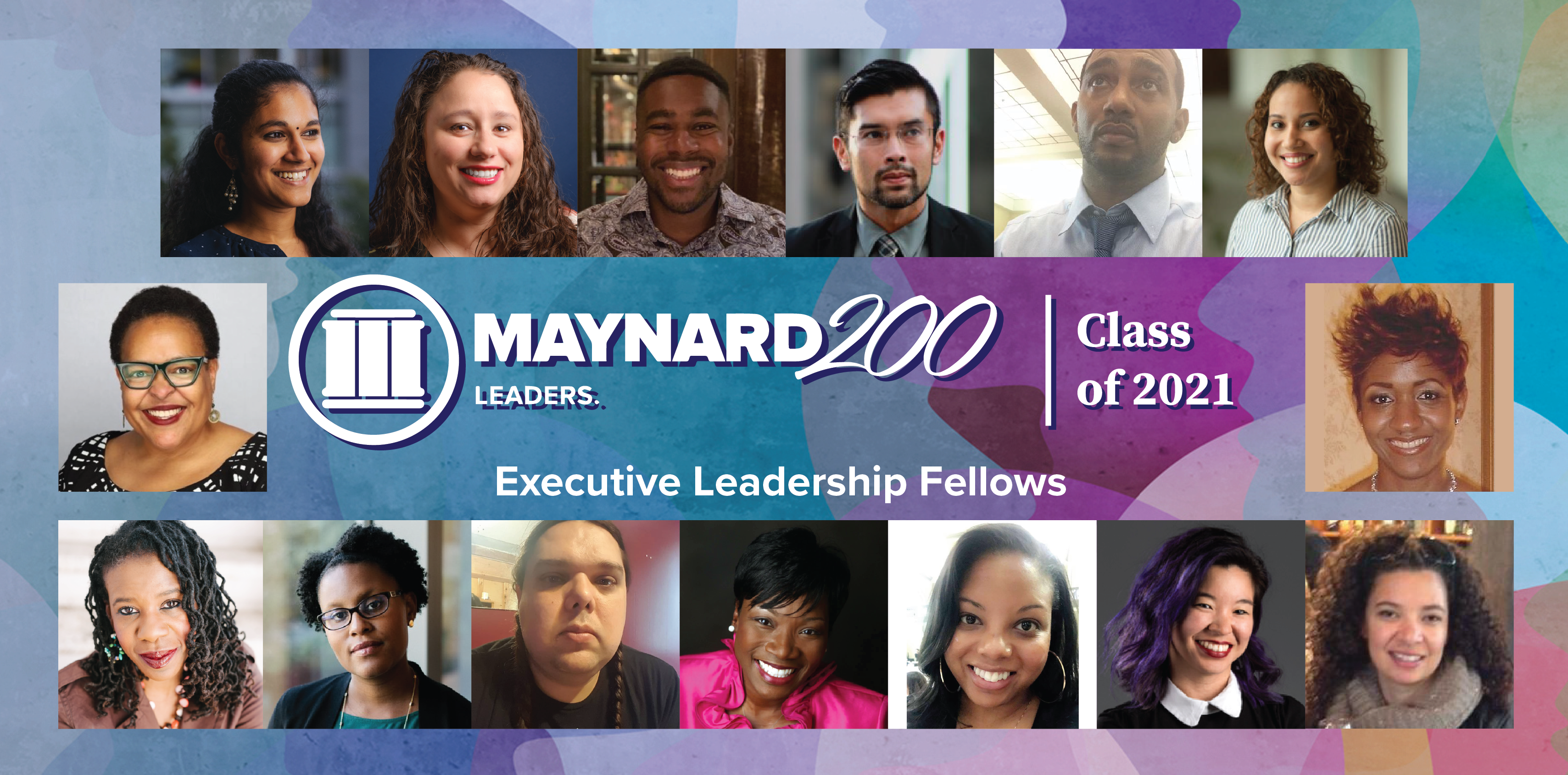
Participating in the Maynard 200 Fellowship – Executive Leadership track [L-R]:
Rajeswari Ramanathan, Michelle Faust Raghavan, Ross Terrell, Stephen Angeles, Gary Estwick, Samantha Guzman, Benét J. Wilson, Khalilah L. Liptrot, Lottie Joiner, Ashton R. Lattimore, Tripp J Crouse, Charmayne Brown, Tasha Stewart, Marian Liu, Anica Butler
EXECUTIVE LEADERSHIP TRACK
Stephen Angeles, supervising producer and news producer, ABS-CBN Global
Charmayne Brown, morning news anchor, WFXR News
Anica Butler, deputy managing editor, local news, The Boston Globe
Tripp J Crouse, news director, KNBA
Gary Estwick, news director, The Leaf-Chronicle (Gannett Newspapers)
Samantha Guzman, executive editor, Decibel – Austin PBS
Lottie Joiner, senior writer/editor, TheCrisisMagazine.com/NAACP
Ashton R. Lattimore, editor-in-chief, Prism
Khalilah L. Liptrot, senior editor, CBSN
Marian Liu, operations editor, The Washington Post
Michelle Faust Raghavan, equity initiative manager, Solutions Journalism Network
Rajeswari Ramanathan, senior video producer, AJ+/Al Jazeera Int’l
Tasha Stewart, senior manager of engagement, WCPO
Ross Terrell, managing editor, KUER NPR Utah
Benét J. Wilson, senior editor, The Points Guy
For more information about Maynard 200, contact:
Odette Alcazaren-Keeley – Director, Maynard 200-MIJE
okeeley@mije.org
I 650-455-3063
Visit: mije.org
###
ABOUT THE MAYNARD INSTITUTE FOR JOURNALISM EDUCATION
The Robert C. Maynard Institute for Journalism Education is the nation’s oldest organization dedicated to helping the news media accurately portray all segments of society, particularly those often overlooked, such as communities of color. The media play a pivotal role in shaping our perceptions of each other. The distorted coverage of communities of color influences public policy and the decisions we make in our personal lives.
Watch this space for more information on how to manage YOUR donor portal with BlueLena and FundraiseUp!
We’re partnering with the Kansas City Defender for Black Philanthropy Month! August is Black Philanthropy Month! Founded in…
The inaugural cohort of Fire Up Fellows represent the power and potential of diverse news in the State…
NEW APPLICATION DEADLINE: MARCH 5, 2021
Maynard 200 Application Form
Media Contact
Odette Alcazaren-Keeley
Director, Maynard 200-MIJE
okeeley@mije.org / 650-455-3063
EMERYVILLE, CA — The Maynard Institute, a nonprofit dedicated to making newsrooms look like America, has announced it will hold its signature Maynard 200 fellowship program in 2021. The fellowship provides cutting-edge training and year-long mentorship for leaders, storytellers and media entrepreneurs of diverse backgrounds, to prime them as candidates for higher roles in the workplace.
Mentorship is provided by distinguished media professionals and experts of varying backgrounds. By emboldening the next generation of leaders in media, the Maynard 200 is facilitating equity and belonging in the newsroom and beyond.
The program is tuition-free thanks to funding by Google News Initiative, Craig Newmark Philanthropies, The Wunderkinder Foundation and the McClatchy Foundation.
Candidates can apply for one of three tracks — Storytelling, Advanced Leadership and Media Entrepreneurship. Applications are now open, and will be accepted through March 5th.
“Our program’s mission, built on the reinvigoration of the diversity pipeline in media, is now sharpened by the triple crises of our time: the public health and economic devastation of the global pandemic, America’s racial reckoning and deep societal fractures laid bare again by the 2020 vote,” said Odette Alcazaren-Keeley, Maynard 200 director. “Responding to these seismic shifts, Maynard 200 continues to bolster the authentic voice, leadership power and change agency of professionals of color.”
“We are fortunate to have top executives, well-known journalists and news leaders, outstanding business strategists and leading academics as members of our program faculty and as mentors,” said Evelyn Hsu, co-executive director of the institute and chief architect of Maynard 200. “They are a generous and dedicated group that has made Maynard 200 a top training program.”
MIJE co-executive director Martin G. Reynolds said, “The fellows represent the future of our industry. Given where we are now as a nation, their perspectives, influence, passion, skill and creativity are essential as they seek to ascend to top leadership roles, create nuanced journalism and start new media enterprises that will help shape the journalistic landscape in the years to come. This program is as much about building up the person as it is about supporting the work they do. It is an honor to see them flourish.”
Reynolds will once again lead the fellows in Fault Lines ®, a core training session of the institute’s foundational framework of diversity, equity and belonging. It’s one of several marquee sessions in the program including Finding Your Authentic Voice and Being Heard, a discussion between public media powerhouses Tonya Mosley and Aarti Shahani.
And this year’s Maynard 200 faculty will be another high-caliber roster as in past years, comprised of esteemed experts across various disciplines. This includes the AP’s Global Investigations Editor Ron Nixon, who also co-founded the Ida B. Wells Society; renowned executive coach and career expert Caroline Ceniza-Levine, also a senior contributor to Forbes.com; and speaker coach Tom Nixon, who has mentored business top brass including from Coca Cola and VISA.
The Maynard 200 Fellowship will begin with a virtual training week, April 12-16. The second training week is scheduled November 8-12 and may be in-person, depending on public health protocols related to the COVID-19 pandemic. Some travel support will be available for the second training week if it is in person.
Fellows are required to attend both training weeks and to participate in the year-long mentorship and supplementary courses.
Since 2018, Maynard 200 has trained 49 media professionals representing African American, Latino, Asian American, Native American and Middle Eastern communities; mainstream and ethnic media organizations, and entrepreneurial ventures from various regions of the United States. Included are fellows who are now being promoted at The New York Times, Los Angeles Times, Mother Jones, CNN, theGrio, Associated Press, The Washington Informer, Mundo Hispano Digital Network, LinkedIn, Nieman Journalism Lab, ABS-CBN international — The Filipino Channel, Sing Tao Daily, the Indigenous Media Freedom Alliance and many others.
NEW APPLICATION DEADLINE: MARCH 5, 2021
Maynard 200 Application Form
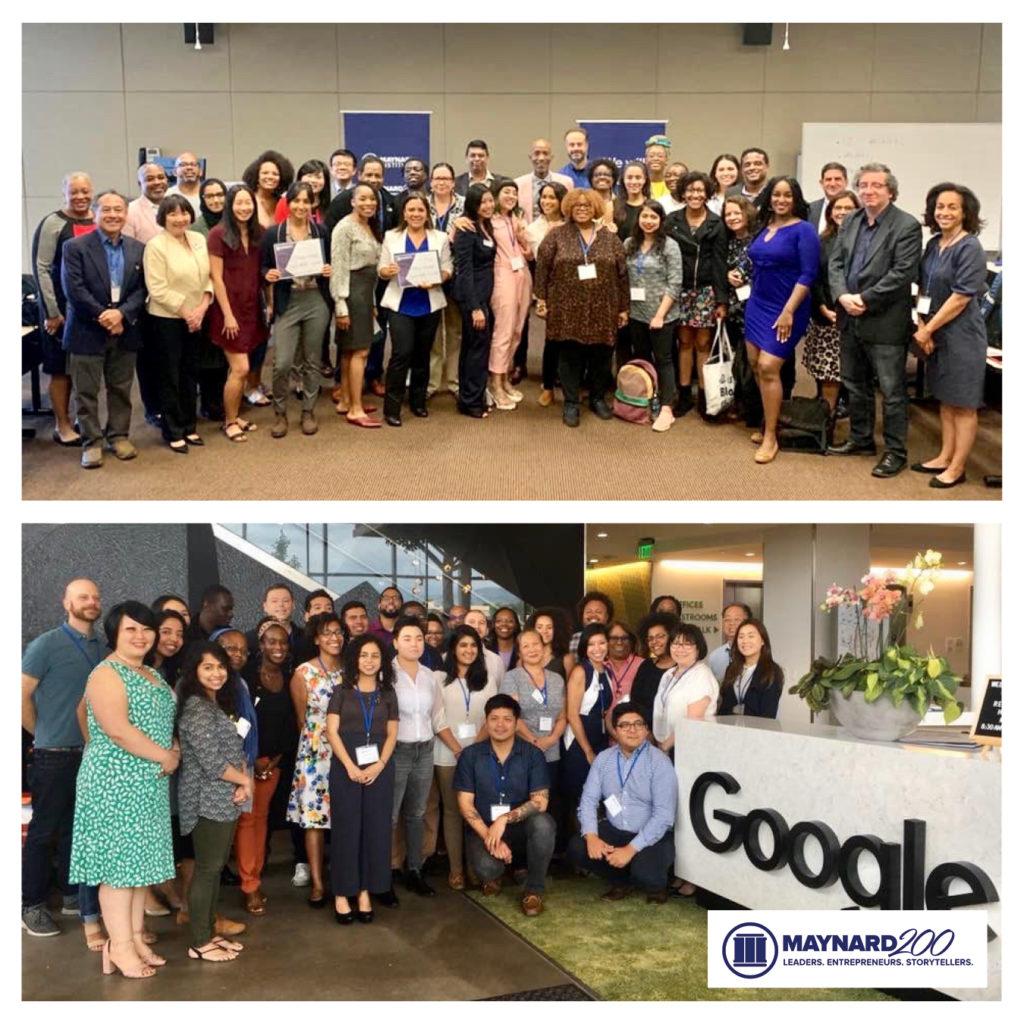
The Maynard 200 journalism fellowship program cohorts gather with some of their mentors, faculty, track executives-in-residence and the MIJE executive team. Top: The 2019 class at USC Annenberg School for Communication and Journalism in Los Angeles. Bottom: The 2018 class at the Google campus in Boulder, CO.
MAYNARD 200 ON PR WEB.
For more information, contact Odette Alcazaren-Keeley – Director, Maynard 200: okeeley@mije.org / 650.455.3063.
ABOUT THE MAYNARD INSTITUTE FOR JOURNALISM EDUCATION
The Robert C. Maynard Institute for Journalism Education is the nation’s oldest organization dedicated to helping the news media accurately portray all segments of society, particularly those often overlooked, such as communities of color. The media play a pivotal role in shaping our perceptions of each other. The distorted coverage of communities of color influences public policy and the decisions we make in our personal lives.
Watch this space for more information on how to manage YOUR donor portal with BlueLena and FundraiseUp!
We’re partnering with the Kansas City Defender for Black Philanthropy Month! August is Black Philanthropy Month! Founded in…
The inaugural cohort of Fire Up Fellows represent the power and potential of diverse news in the State…
The Maynard Institute seeks practitioners, consultants and firms that specialize in diversity, racial equity training, organizational transformation to help execute its Equity and Inclusion Transformation Program. An understanding of journalism and the media ecosystem is preferred but not required. Optimal areas of expertise include, DEI, racial equity, restorative and anti-racist practices, microaggressions, trauma, systemic racism and organizational psychology. Practitioners who work over a series of sessions are welcomed and preferred.
The Maynard Institute received funding from the John S. and James L. Knight foundation to pilot a series of newsroom embeds to take news organizations from a conversation about diversity, to institutions of belonging for BIPOC journalists and those of diverse backgrounds. Two pilot embeds (six months each) will be delivered in 2021.
Consultant sessions would be scheduled at various times throughout the embed. Depending on the particular area of expertise, a consultant might come to conduct one two-hour session with follow-up work, or a series of sessions over the six months combined with outside coaching and guidance to various teams within the news outlet.
Fifty years ago, the Kerner Commission excoriated the journalism industry for its lack of diversity. Decades later, the industry has failed to diversify its organizations and leadership to adequately represent the breadth of the communities it needs to serve. At the same time, more evidence has emerged on how critical diversity is to the survival of the media industry. As journalists of color speak freely about their experiences with racism in the newsroom, and audiences of color express deep distrust in journalism institutions, the industry has no choice but to make dramatic change.
The goal of these embeds is to dive deep into three key areas: the institution, the culture and the coverage. By the conclusion of the embed, a news organization will have goals, strategies and steps to move closer to becoming institutions of belonging.
Please send along information about you, your team and/or organization, area of expertise, process and rate sheet to Maynard Institute Executive Administrator, Alida Birnam, at abirnam@mije.org. If you have any questions, please contact Maynard Institute Co-Executive Director Martin G. Reynolds at mreynolds@mije.org.
The deadline for submissions is January 15, 2021.
The Robert C. Maynard Institute for Journalism is the oldest journalism training non-profit in the U.S. dedicated to helping America’s newsrooms reflect the diversity of the nation. 1400 65th St. Suite 200, Emeryville CA 94608 – 510-891-9202
Watch this space for more information on how to manage YOUR donor portal with BlueLena and FundraiseUp!
We’re partnering with the Kansas City Defender for Black Philanthropy Month! August is Black Philanthropy Month! Founded in…
The inaugural cohort of Fire Up Fellows represent the power and potential of diverse news in the State…

MIJE partnered with Solutions Journalism Network, which presented a webinar on April 3, on covering the COVID-19 pandemic. Fellows and alumni of the Maynard Institute’s Maynard 200 and Oakland Voices programs attended and shared their own coverage of the public health crisis.The session: ‘Solutions Journalism 101: Covering the Coronavirus Outbreak’ was designed for journalists with varying levels of familiarity with the solutions journalism framework, and want to learn to use it in covering the pandemic.
Speakers Sarah Gustavus, Mountain West Region manager and Michelle Faust Raghavan, West Coast Region manager, both from SJN, discussed the 4 pillars of this framework. Solutions journalism is defined as “rigorous, evidence-based reporting on responses to social problems.”
The session was organized and moderated by Odette Alcazaren-Keeley, Maynard 200 director, who opened the discussion with a global and national situationer on the outbreak. She quoted latest data at the time of the webinar, on COVID-19 infections, deaths and shelter-in-place orders, including from the Johns Hopkins University Center for Systems Science and Engineering, the CDC and the New York Times. This session is part of a series of webinars to be offered to Maynard Institute fellows, alumni and its broader media community to provide information, perspectives and resources amid the pandemic.
For more information regarding the Maynard 200 journalism fellowship and this webinar: contact: Odette Alcazaren-Keeley @ okeeley@mije.org
Watch this space for more information on how to manage YOUR donor portal with BlueLena and FundraiseUp!
We’re partnering with the Kansas City Defender for Black Philanthropy Month! August is Black Philanthropy Month! Founded in…
The inaugural cohort of Fire Up Fellows represent the power and potential of diverse news in the State…
PROGRAM UPDATE: POSTPONED
This press release is revised accordingly with MIJE statement on postponement of programs in light of coronavirus threats to public safety.
EMERYVILLE, CA — The Maynard Institute for Journalism Education and Northwestern University Medill School of Journalism, Media, Integrated Marketing Communications announce their partnership for this year’s Maynard 200 journalism fellowship program, aligned in their mission to galvanize diversity in media and to bolster careers of more journalists of color nationwide.
Schedules and Venue: TBD – Dependent on the recommendations of healthcare professionals in light of the coronavirus threats to public safety.
The fellowship aims to train 200 journalists of color in the United States by 2023.
It supports the next generation of storytellers, managers/leaders and media entrepreneurs of diverse backgrounds by providing relevant training courses, resources and mentorship for a year by distinguished media professionals and experts in various disciplines.
A majority of the estimated 35-member 2020 fellowship class will be recruited locally, and the rest will be chosen from a national pool of applicants.
Candidates can apply for one of three tracks — Storytelling, Advanced Leadership and Media Entrepreneurship.
Link to the Maynard 200 application portal.
Fellows are required to attend both sessions and to participate in the year-long mentorship and supplementary courses.
“We couldn’t be more excited to rekindle our partnership with Northwestern, and to be able to do so in San Francisco is all the more fortuitous,” said Martin G. Reynolds, Maynard Institute co-executive director. “We are committed to helping support the next generation of journalism entrepreneurs, leaders and storytellers, and we know this great institution shares a similar goal and passion in service of its students. We look forward to collaborating with Northwestern’s faculty to infuse Maynard 200 with their wisdom and expertise.”
“For more than two decades, the Maynard Institute held its path-breaking Management Training Center at Northwestern’s Kellogg School of Management,” said Evelyn Hsu, the institute’s co-executive director. “We are pleased to be partners with the university again and look forward to recruiting speakers from Northwestern’s renowned faculty.”
“Medill is deeply committed to increasing diversity in all levels of media, and we’re delighted to share our faculty and space with Maynard to prepare journalists from across the country,” Medill Dean Charles Whitaker said. “These journalists will go back to their communities with an enhanced understanding of how to share rich reporting and insights with their readers, viewers and listeners.”
Maynard 200 Director Odette Alcazaren-Keeley said this year’s program cements the renewed alliance of the two institutions.
“In its third year, we see Maynard 200 as a catalyst in transforming the media landscape, especially in amplifying the voice, skills, growth and authentic power of diverse journalists,” she said. “We are once again creating a dynamic, vibrant curriculum and faculty roster to address the current needs of diverse media professionals.
“Since 2018, we have had the expertise of distinguished speakers and mentors from The Washington Post, The New York Times, Google News Lab, The Wall Street Journal, Associated Press, Los Angeles Times, Impremedia, ProPublica, USC Annenberg School for Communication and Journalism, USC Marshall School of Business, NBC, CBS, Reveal and many other respected media and academic institutions. We look forward to having the knowledge and resources of Northwestern Medill’s respected faculty, as well as of its academic affiliates and network of experts.
“We’re continuing our mission to expand access to training for more journalists of color representing the general market, diverse and community media, and to spark a mini-movement of diversity in the industry, that gives real power to them.”
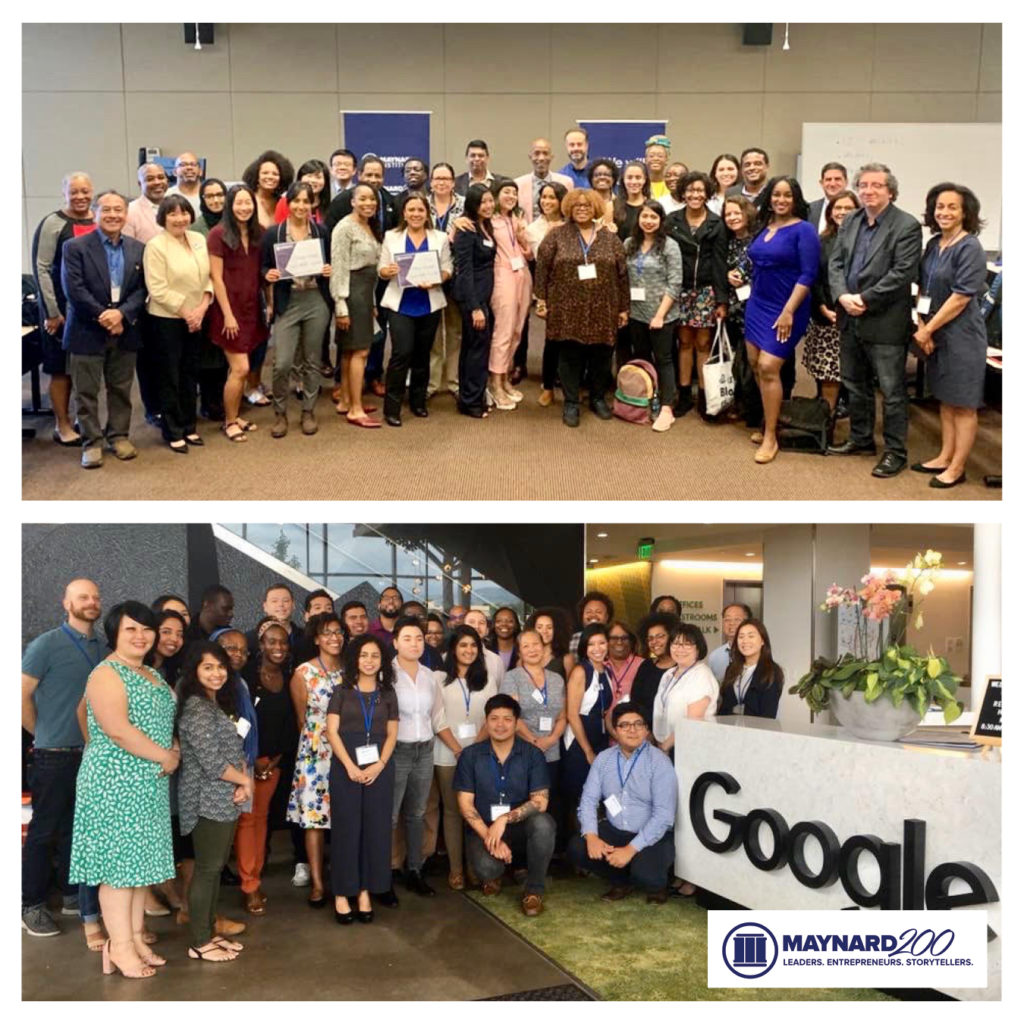
The Maynard 200 journalism fellowship program cohorts with some of their mentors, faculty, track executives-in-residence and MIJE executive team. Top: The 2019 class at USC Annenberg School for Communication and Journalism in Los Angeles, CA; Bottom: The 2018 class at the Google campus in Boulder, CO
Forty-nine Maynard 200 fellows representing mainstream and diverse media organizations and entrepreneurial ventures, as well as print, broadcast, online and multimedia portals, have participated to date from across the United States. They continue to express appreciation of the program.
“There is no experience like the experience of being a Maynard 200 fellow,” says Hélène Biandudi Hofer, a 2019 participant in the media entrepreneurship track. “From the support that you receive, the resources you’re given, the mentors that are there to help lead and guide you, the trainings, the workshops, webinars . . . and especially the family unit that is created with the other Maynard fellows and the Maynard leaders, it’s unlike any experience that I’ve had as a journalist and as a media entrepreneur.
“I feel that not only has my passion for journalism been enhanced . .what this program gifted me is how it has really changed how I look at this work, and empowered me to be more of a leader in news in our country.”
Hofer is host and producer of “Need to Know” on WXXI-TV in Rochester, N.Y., a veteran team member on CBS’ “48 Hours” and founder of HBH Enterprises LLC based in New York.
The 2020 Maynard 200 program is supported by Google News Initiative and Craig Newmark Philanthropies.
MAYNARD 200 APPLICATION PORTAL
UPDATE: Applications will continue to be accepted and processed. DEADLINE IS CURRENTLY LIFTED
For more information about Maynard 200:
contact director Odette Alcazaren-Keeley at okeeley@mije.org
ABOUT THE MAYNARD INSTITUTE FOR JOURNALISM EDUCATION
The Robert C. Maynard Institute for Journalism Education is the nation’s oldest organization dedicated to helping the news media accurately portray all segments of society, particularly those often overlooked, such as communities of color. The media play a pivotal role in shaping our perceptions of each other. The distorted coverage of communities of color influences public policy and the decisions we make in our personal lives.
Maynard seeks to help news media achieve both a diverse staff and provide the public with the most accurate and nuanced coverage possible.
Maynard breaks the cycle of inaccurate depictions by using a three-pronged approach: training media managers, journalists and correspondents from communities of color; creating content to demonstrate nuanced coverage; and keeping media accountable through its Watchdog program.
ABOUT NORTHWESTERN UNIVERSITY MEDILL SCHOOL OF JOURNALISM, MEDIA, INTEGRATED MARKETING COMMUNICATIONS
The Medill School of Journalism, Media, Integrated Marketing Communications prepares the best journalism and marketing students from around the world to lead the media into the future. The school was established almost 100 years ago, and more than 17,000 Medill graduates now engage in all types of industries and are among the nation’s most successful journalists and marketers. Medill, the only journalism school at a Top 10 university, offers undergraduate and graduate degrees in journalism and a graduate degree in integrated marketing communications. Visit medill.northwestern.edu

Watch this space for more information on how to manage YOUR donor portal with BlueLena and FundraiseUp!
We’re partnering with the Kansas City Defender for Black Philanthropy Month! August is Black Philanthropy Month! Founded in…
The inaugural cohort of Fire Up Fellows represent the power and potential of diverse news in the State…
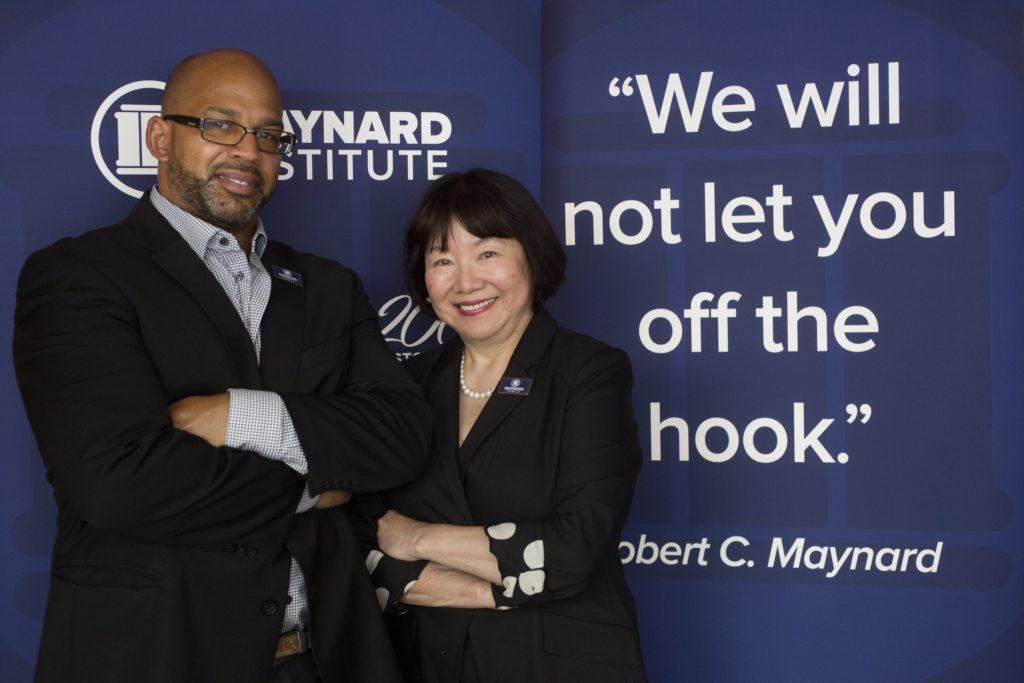
Co-executive directors, Martin Reynolds and Evelyn Hsu
EMERYVILLE, CA — August 5, 2019 — We have some very exciting news to report. The John S. and James L. Knight Foundation today announced $1.2 million in new funding for the Maynard Institute for us to develop an in-depth transformation program for news organizations to help them establish more equitable and inclusive workplaces.
This is a huge deal.
It represents an emerging shift in the funding priorities on the part of philanthropies as they begin to further show, with their dollars, how important diversity, equity and inclusion are to the health of our democracy and to the Fourth Estate.
A portion of this grant will also go to fund Maynard’s general operations and will help us add the staffing necessary to bring this initiative to fruition. Over the years Knight has been an important partner and supported many Maynard programs. But this is the first grant it has made that will include some general support, which is needed and greatly appreciated. This also represents an important and ongoing evolution on the part of foundations, which are beginning to understand the need to support basic operations of nonprofits that do work that may never earn enough revenue to sustain them. We applaud foundation grants that award general support.
The exciting investments in local news made by Knight, Facebook and Google over the past year or so are critical as the for-profit sector, in particular, begins to migrate from an ad-based revenue model, to one that looks to subscribers as key sustainers of news gathering.
But here’s the rub.
The vast majority of American news organizations, particularly at the local level, lack the diversity necessary to reach audiences of color. You would be surprised how little data outlets have on the audiences they could have if they approached coverage and business practices using Fault Lines as a framework.
In many cases, diverse communities have turned away from their local outlets, instead looking to so-called ethnic media to see themselves accurately reflected.
And while ethnic outlets often have deep relationships and are trusted by these communities, they often lack the resources to do the kind of deep-dive journalism that is necessary to hold power to account.
We seek to help news organizations transform from within. We’ll be selecting two news organizations to pilot this program over the next 18 months. Each “Equity and Inclusion Transformation Embed” will run six months.
One will be selected out of the Knight-Lenfest Newsroom Initiative (formerly known as Table Stakes), the other through a competitive national call-out. For-profit, independent and nonprofit news outlets will be eligible to apply. The application will be made public in late 2019.
For the Maynard Institute, this is about more than just diversity around the room, although that is vitally important. It’s about the need for journalists of color and those of diverse backgrounds to have a voice in what coverage looks like. To have the power and influence to help make real decisions about the strategy and direction of their news organizations, to have their whole selves reflected in the work they do and the roles they play.
The lens through which the world is seen cannot be viewed through one set of eyes. Our nation is diverse and the work we do, whether stories, sales, marketing, audience engagement or membership, must reflect that diversity.
Given the racial toxicity of our national discourse, the need for newsrooms to possess exceptional levels of cultural competency could not be more acute.
Issues that reach across the social fault lines of race, class, gender, generation, geography and sexual orientation are some of the most challenging to navigate in society, let alone our newsrooms.
This grant will empower us to develop a program to help news outlets go from a conversation about diversity, to becoming workplaces that are equitable and inclusive in service of the very diversity they seek.
Journalism is the truth serum of a democracy. But if the public distrusts the institutions that inform it, our society’s health is in peril. Diversity is the antidote to treat distrust. This work could not be more needed and more vital at this time in our nation’s history.
It won’t be easy.
We’ll be chronicling this journey as part of the grant, so keep an eye out for how the work is progressing. On behalf of the Board of Directors and alumni of the Maynard Institute, we deeply thank the Knight Foundation for its support.
We know Dori would raise a glass of red wine, offer a wry smile and then tell us, it’s time to get to work.
Martin G. Reynolds and Evelyn Hsu
Maynard Institute co-executive directors
–
Knight Foundation is a national foundation with strong local roots. We invest in journalism, in the arts, and in the success of cities where brothers John S. and James L. Knight once published newspapers. Our goal is to foster informed and engaged communities, which we believe are essential for a healthy democracy. For more, visit kf.org.
The Robert C. Maynard Institute for Journalism Education is the nation’s oldest organization dedicated to helping the news media accurately portray all segments of society, particularly those often overlooked, such as communities of color. The media plays a pivotal role in shaping our perceptions of each other. The distorted coverage of communities of color influences public policy and the decisions we make in our personal lives. Maynard seeks to help news media achieve both a diverse staff and provide the public with the most accurate and nuanced coverage possible. For more information visit mije.org
Watch this space for more information on how to manage YOUR donor portal with BlueLena and FundraiseUp!
We’re partnering with the Kansas City Defender for Black Philanthropy Month! August is Black Philanthropy Month! Founded in…
The inaugural cohort of Fire Up Fellows represent the power and potential of diverse news in the State…