News / Uncategorized
Learn about Supporting The Maynard Institute with Donor-Advised Funds!
You give when and how you can, and receive immediate tax deduction for your contributions of cash, stock…


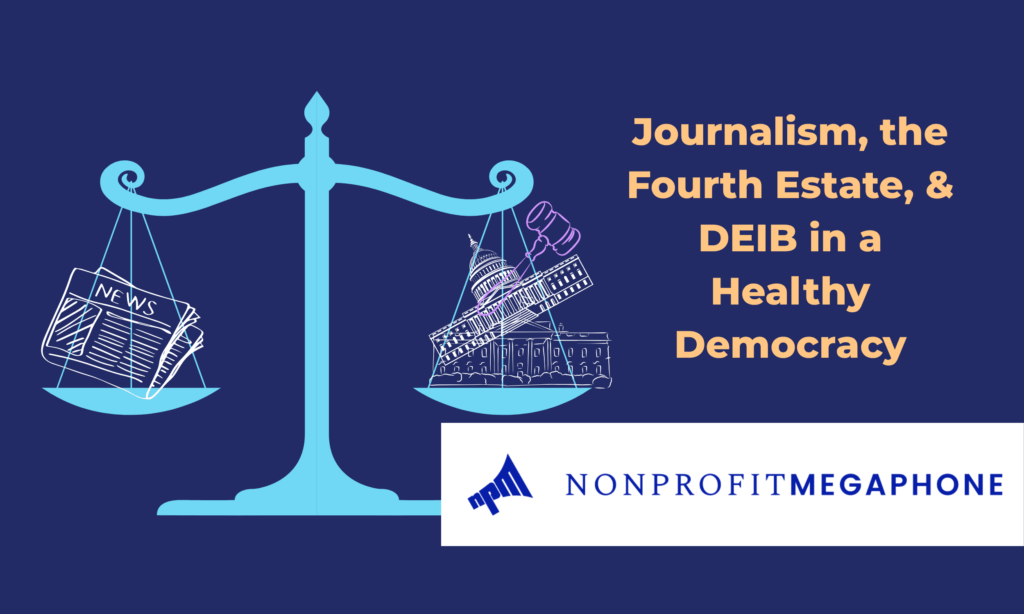
By Celeste Barker-Bright for NonProfit Megaphone. Contains promotional content for the Maynard Institute.
The term “Fourth Estate” isn’t exactly a household concept, but it should be — now more than ever.
The Fourth Estate refers to the news media. It’s been part of our democracy so long that it originally described the printing press before expanding to cover broadcast and digital journalism as well.
This term is most commonly invoked to describe the news media’s civic role as a watchdog over government, functioning alongside — and holding accountable — the three traditional branches of power.
In the U.S., this idea is closely tied to the First Amendment because it asserts that the press holds a stature comparable to the three constitutional branches of government, or the core democratic failsafes of checks and balances. That standing was earned, not granted: in the early years of our republic a bold, scrappy press played an influential role in denouncing colonial rule. Once the Bill of Rights protected press freedom in 1791, journalism became an assertive force in the young nation.
Importantly, the watchdog function isn’t a formal constitutional guarantee, but a role the press has claimed and sustained through practice. At the same time, few laws directly govern how American journalism is practiced; like so many other institutions in a capitalist society, the media is largely driven by market forces.
It also depends on a media-savvy public capable of judging accuracy, holding biased outlets accountable, and withdrawing their attention and advertising dollars in response. It thrives only when the public trusts it enough to sustain it, and that trust depends in large part on whether people feel seen and supported by it.
If the press’s core democratic function is to inform the public and hold power accountable, then who gets to do that reporting — and whose stories get told — determines how well democracy actually works. That means equitable and respectful media representation of minorities isn’t just a peripheral workplace concern; it directly answers the question of whether journalism can fulfill its constitutional purpose.
Healthy democracies require more than periodic voting. They depend on equality, meaning that every citizen has the right to be heard and be given equal consideration in shaping public policy. This in turn depends on equal access to social determinants of health, such as education, employment, housing, and freedom from discrimination. When the media doesn’t shine a light on unequal access, it’s much harder to address.
As one journalism professor from the Columbia Journalism Review put it, journalism is fundamentally about giving the public the truthful information needed to make rational, empathetic decisions in a democratic society — a mission that depends on having enough varied perspectives in the room to catch blind spots before they reach the public.
When newsrooms are homogeneous (primarily staffed and managed by one race, gender, or other demographic factor), they struggle to detect, much less report on, the barriers that keep some communities from that equal footing. A press that doesn’t understand, investigate, or report on those realities can’t support equality or, in turn, a true democracy. Diversity in the media helps to keep these obstacles to power and resources in check, addressing real democratic deficits.
Newsroom diversity isn’t just an equity issue — it’s a safeguard against journalism being weaponized. Diversity in media statistics from Columbia Journalism Review found that racial and ethnic minorities made up almost 40% of the US population but less than 17% of newsroom staff at print and online publications, and only 13% of newspaper leadership, as of 2017.
That imbalance has consequences. When editorial decision-making lacks diverse voices and perspectives, harmful or poorly vetted content can slip through with less scrutiny.
Greater representation in leadership roles, in particular, creates stronger accountability and stronger safeguards against exclusionary or poorly substantiated narratives making it into a published story.
Democracy is healthiest when citizens are exposed to a genuine range of perspectives rather than a narrow, filtered version of reality. Diversity, equity, inclusion, and belonging (DEIB) in media coverage are crucial to the health and functioning of a democracy because they ensure audiences have access to a wide range of perspectives, which strengthens civic engagement and helps hold power accountable across all parts of democratic society.
Journalism education plays a direct role here: students need to learn how to produce content that reflects society’s pluralism and reduces the risk of echo chambers by exposing audiences to differing opinions. Without that training, journalists are more likely to produce work — and news content — that lacks inclusivity.
Building diversity and inclusion in media outlets isn’t a one-time initiative — it’s an ongoing organizational commitment, but the payoff for both journalism quality and business sustainability is significant.
Hiring diverse staff is only the first step. Without belonging, even diverse and equitable workplaces can struggle with disengagement or high turnover when employees don’t truly feel included. Organizations should aim for a culture where diversity creates access and opportunity while belonging ensures people feel genuinely connected and empowered once they’re there.
The effects of representation in the media, along with genuine inclusion and belonging, show up directly in the newsroom’s output and its bottom line. When journalists reflect a broader range of lived experiences, coverage becomes more representative and less likely to overlook or misinterpret marginalized perspectives, while inclusive practices help journalists ask better questions, build trust with sources, and avoid harmful stereotypes.
That, in turn, translates into stronger reputations and ratings. Diverse teams also tend to perform better organizationally, bringing a wider range of ideas and problem-solving approaches that lead to better decision-making and more innovative content strategies.
In an industry facing declining trust and shrinking revenue, DEIB isn’t a distraction from journalism’s core mission — it’s a direct investment in the accuracy, credibility, and relevance that keep the Fourth Estate viable, and keep American democracy alive and well-informed.
The Maynard Institute inspires and powers the national, collaborative drive for DEIB in news media. Our culture-shiftantiracism training programs have helped create decades of news industry trailblazers, all of whom belong to the “Maynard Family”: a community of deep caring and intergenerational support for journalists of color. Programs by the Maynard Institute are open to all applicants, and the Maynard Institute is committed to addressing the underrepresentation of people of color and other historically disadvantaged groups in media-related professions.
The Maynard Institute’s Fault Lines® Culture Shift Program gives media professionals the tools to recognize and address biases that shape news coverage. Rooted in the Fault Lines® framework, our program helps organizations move far beyond performative DEI efforts.
Instead, we use intentional DEI practices — built on nearly 50 years of DEI training in media spaces — that are proven to create inclusive workplaces that connect with diverse communities.
Fill out our interest form and register to bring Maynard’s Fault Lines® training to your company today!
You give when and how you can, and receive immediate tax deduction for your contributions of cash, stock…
“She launched the Spanish-language website Brennan En Español, a monthly newsletter, and as she put it, was ‘dedicated…
“We started selecting this cohort in the spring, so it’s truly inspiring to see them come together for…