News / Uncategorized
Shayla Moon joins the Maynard Institute as Director of Coalition Building
The Maynard Institute is excited to announce that Shayla Moon is joining us as our inaugural Director of…


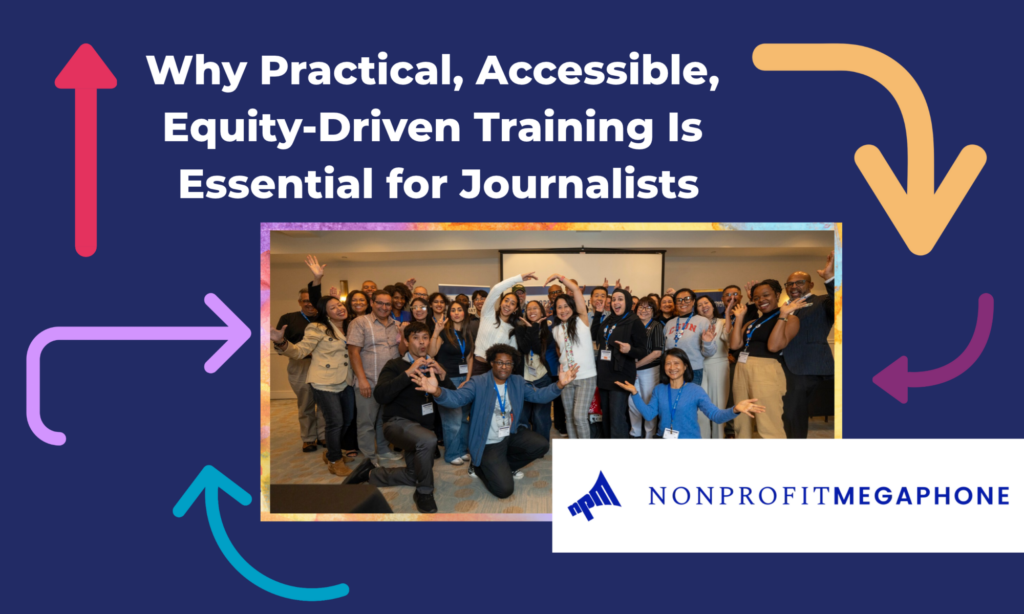
By Celeste Barker-Bright for Nonprofit Megaphone. This post is promotional content for the Maynard Institute.
Journalism has changed faster than the paths into it. The traditional route — a four-year degree followed by entry into local news and a climb through ever-larger newsrooms — has grown narrower and more expensive, just as changes in journalism today demand new skills. Specialized training programs are stepping in, and the strongest ones pair hands-on instruction with real access and a deliberate focus on equity.
Rising tuition and student loan debt can make traditional paths to a journalism career difficult to navigate. Nieman Reports has noted that graduate programs that once led to top jobs can cost so much that low-income students rule them out.
Meanwhile, closures and layoffs have weakened the ladder from small newsrooms to larger ones. Experienced mentors who once showed young reporters how to pull records or shape a big story have thinned out along with these opportunities.
Professional training programs like the Propel Regional Training that put skills into practice help close that mentorship gap. For example, in October 2025, a UNESCO and UN Women residency in Sarajevo combined workshops and mentoring sessions on fact-checking, responsible sourcing, and artificial intelligence (AI). Young journalists left with working tools to counter misinformation and a regional network of peers.
Research points in the same direction. A study of journalists in Italy found that a participatory, discussion-based training program improved attitudes toward inclusion. The program ran as a series of live online sessions, suggesting that well-designed online courses for journalism can offer flexibility for people who can’t relocate or step away from work. The authors cautioned that the study lacked a control group and called for longer-term follow-up.
Who gets trained shapes who gets trusted. Pew Research Center surveys show that the majority of Black Americans (as of 2023) and more than half of Hispanic Americans (as of 2020) say the news media doesn’t understand or reflect them. Programs that recruit from underrepresented groups and the communities they cover help close that gap.
Community-based models teach residents to report on their own neighborhoods, bringing in voices that mainstream coverage often misses. Some participants land paid positions. Cost is part of equity, too. Low-cost or free options let people join who couldn’t otherwise afford graduate school.
Still, Neiman Reports notes that short programs can leave graduates without a clear route to jobs. That is why ongoing support, including continuing education after the initial program ends, matters.
When weighing professional development options, look for:
For more than 50 years, the Maynard Institute has trained journalists and newsrooms. Alumni have become newsroom executives, reporters, editors, authors and journalism educators. Its programs for individuals train the next generation of news leaders and community-focused reporters and editors.
Good journalism depends on who gets the chance to learn the craft. Practical, affordable training built around equity gives aspiring and current journalists the skills to do the work well, along with a community to lean on as the industry evolves. The right program can change the course of a career and, with it, the accuracy and inclusiveness a newsroom can provide.
The Maynard Institute inspires and powers the national, collaborative drive for diversity, equity, inclusion and belonging (DEIB) in news media. Our culture-shift training programs have helped create decades of news industry trailblazers, all of whom belong to the “Maynard Family:” a community of deep caring and intergenerational support for journalists of many backgrounds.
All Maynard alumni are also invited to join the Maynard Communities of Practice, a peer-to-peer education and support network that continues online programming and offers continued mentorship and community. Programs are open to all applicants, and the Institute is committed to addressing the underrepresentation of historically marginalized groups in media-related professions.
The Maynard Institute’s professional development training programs have operated for nearly 50 years, with 2027 marking the Institute’s 50th anniversary. For nearly a decade before our co-founders established the Maynard Institute in 1977, they ran summer journalism training programs for minority journalists at Columbia University and the University of California at Berkeley.
Learn more about us, explore our training programs for individuals and get the support you need to thrive in the future of journalism today.
The Maynard Institute is excited to announce that Shayla Moon is joining us as our inaugural Director of…
The Maynard Institute is proud to announce that Doris Truong is transitioning from Deputy Director to Director of…
You give when and how you can, and receive immediate tax deduction for your contributions of cash, stock…