News / Blog
Meet our new Program Manager, Jasmine Barnes
Jasmine expands upon this relational work by amplifying and archiving everyday stories as a freelance journalist contributing to South…


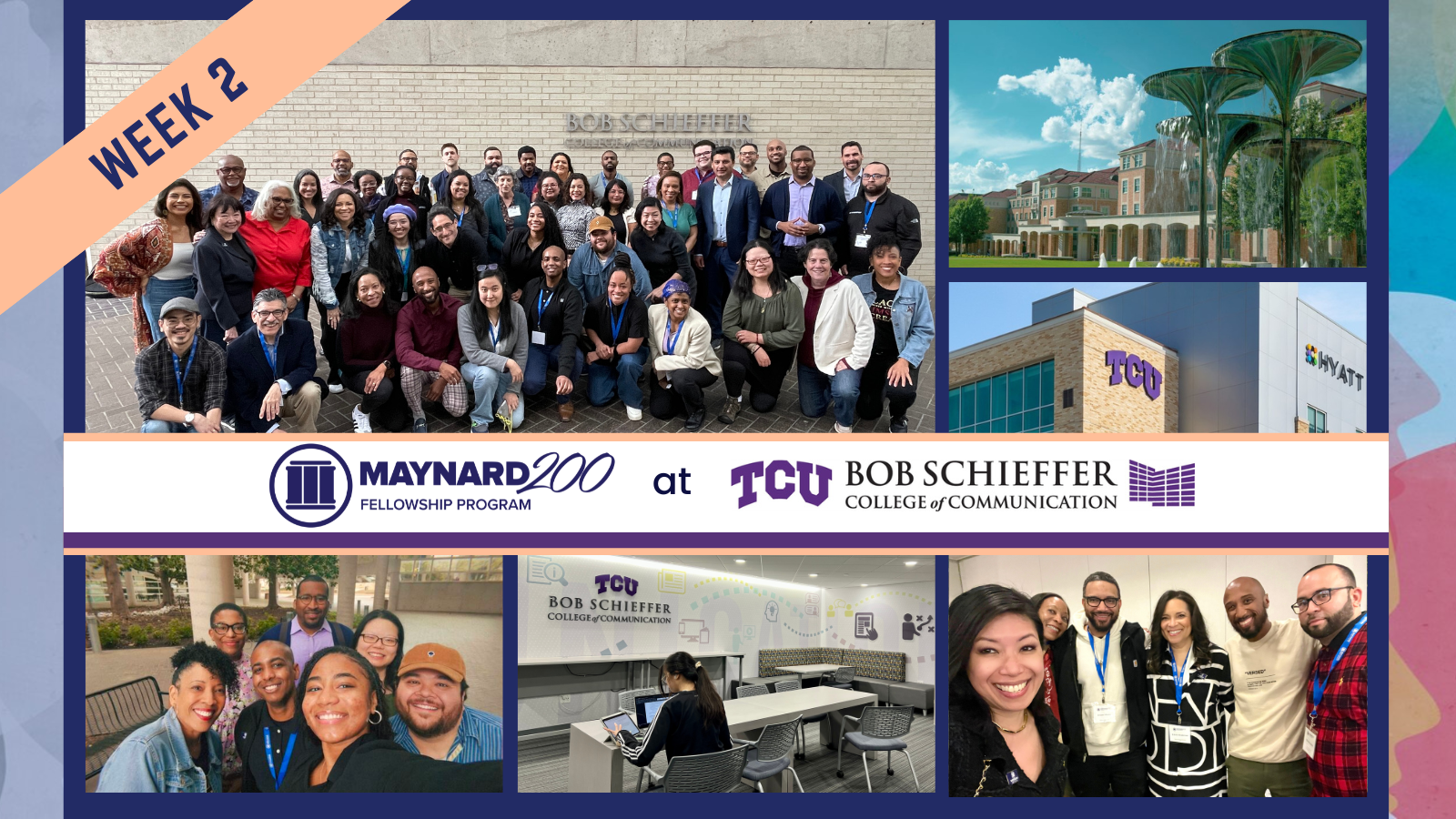
The 2024 Maynard 200 Fellowship is designed to sharpen skills, provide hands-on training as well as a one-to-one year-long mentorship, and build a community of peer support. This year’s curriculum has been updated with a hyperfocus on the critical role editors and managers play in today’s newsrooms. Hosted by the Bob Schieffer College of Communication at TCU, fellows benefit from two weeks of in-person training sessions and workshops led by industry leaders. This blog highlights just a few of the 2024 Maynard 200 Faculty who will be leading the fellows through their second week of training with presentations carefully crafted to build leadership skills and hone managerial instincts.
Faculty: Maria Carrillo
Maria is a consultant and coach after spending 36 years in seven newsrooms. She was enterprise editor at the Tampa Bay Times and Houston Chronicle, and, before that, managing editor at The Virginian-Pilot. She has edited dozens of award-winning projects, frequently lectures on narrative journalism and co-hosts a podcast about craft called WriteLane.
She is a board member of the Virginia Center for Investigative Journalism as well as the National Press Photographers Association and a juror for the Hillman Prizes.
Maria was born in Washington, D.C., two years after her parents left Cuba in exile. She now lives in St. Petersburg, Florida.
Faculty: P. Kim Bui
P. Kim Bui is a 2023-24 John S. Knight Journalism fellow. Recently, she was senior director of product and audience innovation at the Arizona Republic. A native Iowan, she’s focused her career on leading real-time news initiatives and creating new storytelling forms for digital, print and broadcast companies catering to local, national and global audiences.
Prior, she was editor-at-large for NowThis News and deputy managing editor for reported.ly, a distributed social journalism startup.
She was in the inaugural class of the Executive Program in News Innovation and Leadership from City University of New York’s Craig Newmark Graduate School of Journalism. She’s spoken on journalism and leadership worldwide and written about empathy in journalism for a number of research outlets. She writes a newsletter for emerging leaders: The Middles.
Faculty: Caroline Ceniza-Levine
Caroline Ceniza-Levine is a career expert, media personality, and founder of the Dream Career Club. Caroline is a Senior Contributor to Forbes.com, Top LinedIn Voice for Executive Coaching, Career Counseling, and Personal Development, and former career columnist for Money.com, Time.com, CNBC, and Portfolio. She has been a repeat guest expert on CBS, CNN, CNBC, and Fox Business and has been quoted in major media outlets, including BusinessWeek, Entrepreneur, Fast Company, Fortune, Inc, NPR, and The Wall Street Journal.
As an executive coach, Caroline has worked with professionals from Amazon, American Express, Condé Nast, Goldman Sachs, McKinsey, Tesla, and other leading firms. She designed and oversees the career program for the Columbia Business School Executive Program in Management and is the creator of the online courses “Behind the Scenes in the Hiring Process” and “Making FIRE Possible.”
Caroline is the author of “Jump Ship: 10 Steps to Starting a New Career.” A classically-trained pianist at Juilliard and Manhattan School of Music, Caroline performed stand-up comedy in NYC clubs for 10 years and is currently a producer and writer with FBC Films. A native New Yorker, Caroline divides her time among Florida, New York, and Costa Rica and blogs about her journey to the land of Pura Vida on Costa Rica FIRE.
Faculty: Virgil Smith
Virgil L. Smith is the founder and Principal of the Smith Edwards Group, LLC, a consulting firm he established in 2015 after a distinguished 24-year career at the Gannett Company. Prior to his retirement, Smith held various leadership roles, including President and Publisher at the Stockton Record and Asheville Citizen-Times as well as a corporate HR executive responsible for talent development and diversity across broadcast, print, and digital operations.
Before joining Gannett, Smith spent two decades at the McClatchy Company, where he held executive positions such as Human Resources Director, Director of Consumer Marketing, and Chief Labor Negotiator.
Throughout his career, Smith has helped numerous professionals achieve their career and life goals. In addition to his work as a consultant and career coach, Smith is currently the President of the Board of Trustees for the Z. Smith Reynolds Foundation. He has served as a Trustee since 2005.
Smith authored the book “The Keys for Effective Leadership” and has been recognized for his contributions by numerous professional and community organizations.
His awards include the Ida B. Wells Award for Distinguished Leadership, the Lifetime Achievement Award from the Asheville Human Relations Council, and the Dr. Martin Luther King Jr. Legacy of Peace, Justice, and Community Award. Smith holds a Bachelor of Science and Master’s degree from the University of San Francisco and an Honorary Doctorate Degree from the University of North Carolina Asheville. He resides in Atlanta with his wife, Joann Smith, PhD.
Faculty: Marian Chia-Ming Liu
For the past two decades, Marian Liu has worked across newspapers and digital platforms, diving into what resonates with readers in the local, national, and global news cycle.
Her career has always been about reflecting the communities she represents – Asian, immigrant and female, covering everything from Korean Pop to health disparities across communities.
Currently, Marian Chia-Ming Liu is The Washington Post’s Projects Editor of Special Newsroom Initiatives and Partnerships, focused on developing innovative new ways to reach new readers. She’s managed several projects and section launches, including the new Style section covering news from the frontlines of culture; Well+Being, wellness stories on bodies of all shapes, sizes and colors, and the Pulitzer-winning series “The Attack: Before, During, and After.”
Before The Post, she was a writer, music critic, and editor at CNN in Hong Kong and several newspapers, including the Seattle Times, San Jose Mercury News, Source Magazine, and the South Florida Sun Sentinel, where she launched a hyperlocal entertainment site and app. Liu also directed the student multimedia convention projects for the Asian American Journalists Association and UNITY. She serves as National Vice PResident of Civic Engagement for AAJA and is developing an updated style guide for the AANHPI community.
Faculty: Ernesto Aguilar
Born in East Houston, Ernesto Aguilar’s life was transformed by public media. His career has traversed daily newspapers and alternative weeklies to public radio news and program director roles.
At KQED, he oversees radio broadcast content and DEI initiatives in the organization’s Content division. He is former co-chair of the KQED DEI Council.
In his spare time, he writes OIGO, a newsletter on public media and diverse audiences. Prior to KQED, Aguilar served stations as executive director of the National Federation of Community Broadcasters. He was also part of the founding committee of Public Media for All, an initiative aimed at organizing radio stations around actionable DEI outcomes.
A Robert C. Maynard Institute for Journalism Education Fellow, Sulzberger Executive LEadership Fellow, and Public Media CEO/COO Bootcamp graduate, Aguilar has a B.A. in journalism, with minors in sociology and Women’s Studies from the University of Houston.
Faculty: Katrice Hardy
Katrice is vice president and executive editor of The Dallas Morning News. Previously, she was executive editor of The Indianapolis Star and Midwest regional editor for USA Today Network. When Katrice joined the network in 2016, she was the executive editor of The Greenville News and then took on responsibilities as the South regional editor overseeing news organizations in South Carolina, North Carolina, Louisiana, Alabama, Mississippi and Virginia.
Previously, she had worked for 20 years at The Virginian-Pilot where she started as an intern and left as managing editor. Her IndyStar newsroom and its reporting partners The Marshall Project, AL.com, and Invisible Institute were awarded the 2021 Pulitzer Prize for National Reporting for “Mauled: When Police Dogs Are Weapons,” and the newsrooms where she has led have won multiple IRE and Editor and Publisher awards, and myriad state honors as well. She is a board member of the Marshall Project, a member of the National Association of Black Journalists, the Dallas Assembly and the International Women’s Forum.
Katrice believes strongly that a news organization’s role is to shine light on wonderful people and organizations making a difference in local communities and to uncover the problems, ills, misuses and abuses to help make positive change.
Faculty: Sandra Clark
Sandra Clark, featured in Editor and Publisher’s “15 Over 50” Class of 2024, is CEO of StoryCorps and is a leading voice in journalism and beyond, challenging norms and practices that create barriers to building trust and meaningful, sustainable connections with communities. At StoryCorps, she leads the award-winning organization’s mission to help us believe in each other by recording and sharing stories from everyday people that illuminate the humanity and possibility in us all.
Prior to joining StoryCorps, Clark was Vice President for News and Civic Dialogue at WHYY in Philadelphia. Her innovative approaches to collaborating with grassroots information providers garnered national recognition. Previously, Clark served as Managing Editor at the Philadelphia Inquirer, leading the paper to a 2014 Pulitzer Prize for Criticism. She is a longtime visiting coach and mentor for the Maynard Institute.
Faculty: Andy Alford
Andy Alford is The Texas Tribune’s director of recruitment, training and career development. She also manages the Tribune’s fellowship program, which employs student fellows to work in all areas of the organization, including on teams in the newsroom, as well as the events, product development, and marketing and communication teams.
Andy came to the Tribune in 2022 after a long stretch at the Austin American-Statesman, where she rose from reporter to managing editor. Alford had a nearly 19-year tenure at the Statesman where she had various roles, including local editor, data journalist on the investigative team and community affairs reporter.
The Maynard 200 Fellowship program is made possible thanks to all members of the 2024 faculty and mentors and the second training week kicks off on July 15.
Our university host partners at TCU’s Bob Schieffer College of Communication have been instrumental in welcoming the Maynard 200 Fellowship, including Chair of the Journalism Department, Dr. Uche Onyebadi, and long-standing TCU faculty member, Associate Professor of Professional Practice and Director of Student Media Journalism, Jean Marie Brown has also been instrumental in welcoming the Maynard 200 Fellowship. The reception on July 18 will include an address by the Dean of TCU’s Bob Schieffer College of Communication, Dr. Kristie Bunton.
Also rejoining the fellows for week two of their Maynard 200 training are Executive-in-Residence Felecia Henderson and faculty members John X. Miller, Tom Huang, and Dickson Louie.
Read the bios for all week 2 faculty (PDF).
For more than 45 years, the Maynard Institute has fought to push back against the systemic lack of diversity in the news industry through training, collaborations and convenings. Founded by Robert C. Maynard, the Institute promotes diversity and antiracism in the news media through improved coverage, hiring and business practices. We are creating better representation in America’s newsrooms through our Maynard 200 fellowship program, which gives media professionals of color the tools to become skilled storytellers, empowered executives and inspired media entrepreneurs.
Maynard 200 is the cornerstone program advancing the Maynard Institute’s efforts to expand the diversity pipeline in news media and dismantle structural racism in its newsrooms. Since 2018, the Maynard Institute has trained media leaders, storytellers, editors, managers and entrepreneurs through the fellowship program. Maynard 200 is designed to sharpen skills, provide hands-on training as well as a one-to-one year-long mentorship, and build a community of peer support for diverse journalists. In 2024, the program returns with two weeks of in-person training rounds — specifically designed to support the success of newsroom editors and managers. Hosted by the Bob Schieffer College of Communication at TCU in Fort Worth, Texas, the program will convene in March and July of 2024.
Maynard 200 is made possible thanks to the support of our generous funders Craig Newmark Philanthropies, The Hearthland Foundation and McClatchy.
For more information about the Maynard 200 Fellowship, please reach out to:
Maynard 200 Director, Odette Alcazaren-Keeley at okeeley@mije.org.
Jasmine expands upon this relational work by amplifying and archiving everyday stories as a freelance journalist contributing to South…
A recap of our most recent Regional Training at Texas Christian University Bob Schieffer College of Communication in…
We want to hear from you! The Maynard Institute’s annual community survey helps us to better understand the needs of our alumni and to shape our programs, training offerings, and events. We strive to foster an inclusive sense of ownership and empowerment within our community through this survey practice. Take the survey and join us in shaping the future of the Maynard Institute.
When we launched our first community survey in 2022, we learned that certain communities of our alumni were less engaged than others. For example, a lower percentage of survey respondents were Asian American journalists than we had expected. We used this feedback to prioritize reconnecting with the community in a few ways.
First, as part of the Vision 25 Belonging in the News virtual discussion series, coordinated in partnership with Online News Association and Open News, we featured editor-in-chief of Teen Vogue, Versha Sharma. From 2015 to 2021, Sharma was managing editor at NowThis, where she shared in a 2018 Edward R. Murrow Award for a documentary on Hurricane Maria’s effects on Puerto Rico. Teen Vogue, a web-only Condé Nast publication, pivoted to become a strong voice on social justice issues in recent years and we invited Sharma to share her experience as the first South Asian American woman to helm Teen Vogue.
Second, we hosted a networking happy hour at the 2022 Asian American Journalists Association conference featuring Jeff Yang and Phil Yu, guest speakers and co-authors of the book RISE: A Pop History of Asian America from the Nineties to Now. The sold out, outdoor reception was a joyous celebration and for many attendees, it was the first in-person networking gathering since the pandemic began in 2020. The success of the event proved that our extended Maynard Family is eager for opportunities to connect with each other.
Third, the Maynard Institute’s local community journalism program Oakland Voices hosted a meetup featuring special guest, Thi Bui. Thi Bui was born in Vietnam and came to the United States in 1978 as part of the “boat people” wave of refugees fleeing Southeast Asia at the end of the Vietnam War. Her debut graphic memoir, The Best We Could Do (Abrams ComicArts, 2017) has been selected for an American Book Award, a Common Book for UCLA and other colleges and universities, an all-city read by Seattle and San Francisco public libraries, a National Book Critics Circle finalist in autobiography, and an Eisner Award finalist in reality-based comics. In a lively and frank discussion, Bui shared the challenges of getting a fine arts degree with professors who did not have the cultural competency to value storytelling that centered her Asian American identity.
These programming efforts were not only successful events, they helped increase the engagement among Asian American journalists in our community survey the following year.
How will your survey input help guide our programming in the future? We can’t wait to find out! Take the survey today.
Since 1977, the Maynard Institute has fought to push back against the systemic lack of diversity in the news industry through training, collaborations and convenings. Founded by Robert C. Maynard, the Institute promotes diversity and antiracism in the news media through improved coverage, hiring and business practices. We are creating better representation in U.S. newsrooms through our programs , which gives media professionals of color the tools to become skilled storytellers, empowered executives and inspired entrepreneurs.
Jasmine expands upon this relational work by amplifying and archiving everyday stories as a freelance journalist contributing to South…
A recap of our most recent Regional Training at Texas Christian University Bob Schieffer College of Communication in…
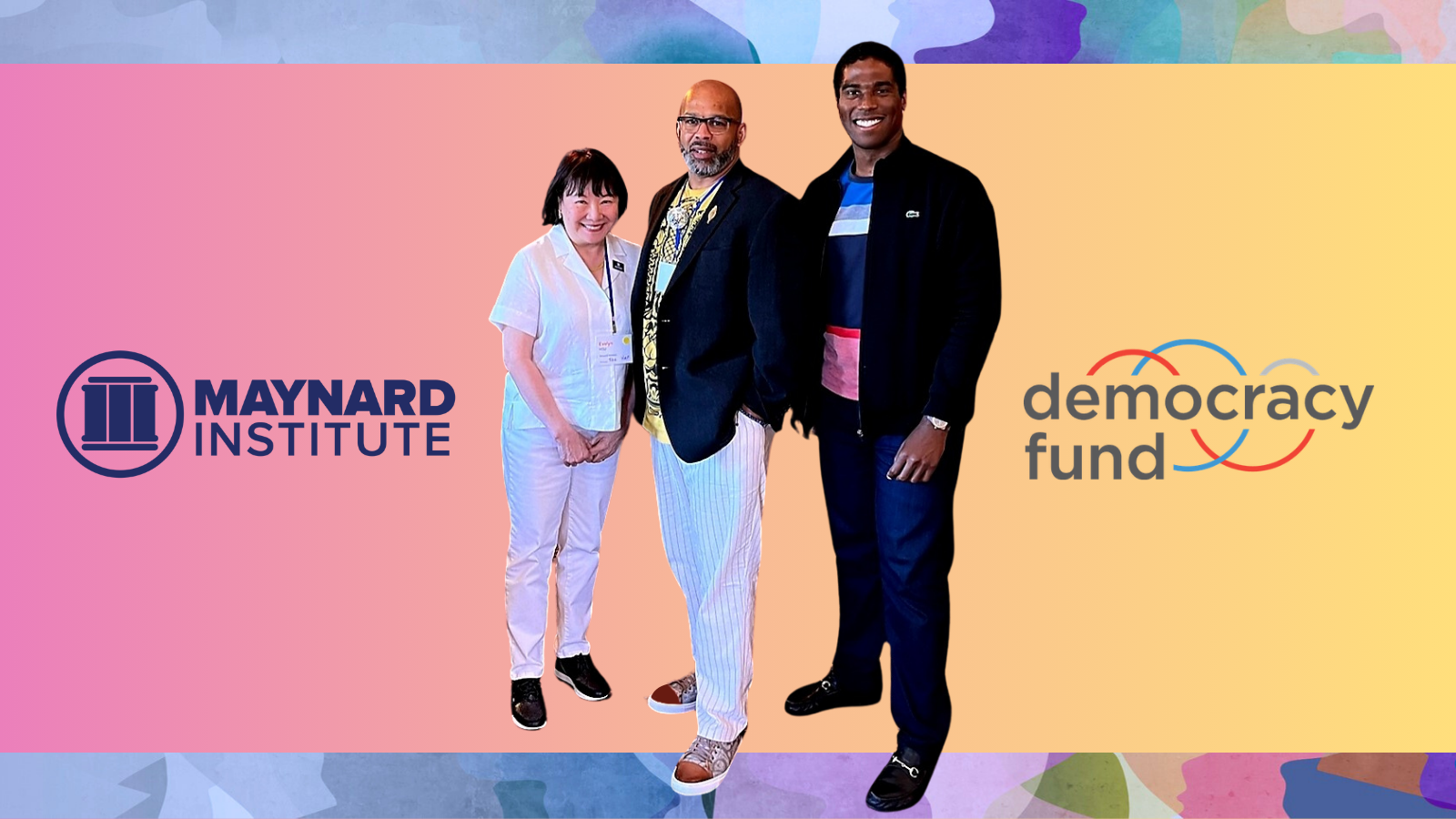
The Democracy Fund held its annual grantee convening in Detroit on May 6-8, 2024. The convening serves to connect leaders across fields in a collaborative and inclusive environment to build a vision for the future. On the second day of the convening, the Maynard Institute’s Co-Executive Director Martin G. Reynolds was surprised to be honored with a speech by Paul Waters, Director of the Digital Democracy Initiative.
Each year, Waters surprises someone in attendance whose commitment to upholding democracy through the advancement of journalism makes them a lynchpin of the community. Previous honorees have included Tracie Powell of the Pivot Fund, Geneva Overholser, former editor of the Des Moines Register, and Maynard Institute Co-Executive Director Evelyn Hsu.
On the convening’s second day at the historic Gem Theater, Waters honored Reynolds, saying, “I would like to recognize someone who has lived out the command to love your enemies. Someone who recognizes that forgiveness does not mean ignoring what has been done or putting a false label on an evil act. Rather, forgiveness means that the evil act no longer remains as a barrier to the relationship.”
Waters related Reynolds’ accomplishments as Editor-In-Chief of the Oakland Tribune, Co-Founder of Oakland Voices, and Co-Executive Director of the Maynard Institute. His many years of experience, infectiously positive attitude, and tireless dedication to building community place him firmly in the path of his Oakland Tribune predecessors, Bob, Nancy, and Dori Maynard and the intrepid Chauncey Bailey.
Waters continued, calling Reynolds “an emissary for an America that does not yet exist,” in reference to his work implementing the Maynard Institute’s Fault Lines training program.
“Instead of sowing hate and division, Martin has taught and trained newsrooms to span the Fault Lines of race, gender, sexual orientation, generation, geography, and class, as they apply to journalists, newsroom collaboration, and coverage,” Waters said.
Read the full remarks by Waters below.
Speech by Paul Waters honoring Martin G. Reynolds
Tuesday, May 7, 2024
Ye have heard it said of old that thou shall love thy neighbor and hate thine enemy. But I say unto you, love your enemies. Bless them that curse you. Do good to them that hate you, and pray for them that despitefully use you, that ye may be the children of your Father which is in heaven.
Good Morning and welcome to day two of our stakeholder gathering.
Starting all the way back in the Spring of 2017, I have been lucky to be able to lift up some of the values and practices required to successfully push for reform in spite of overwhelming odds and challenging circumstances. Given the exceptional group of folks Angelica has assembled, I could pick almost anyone as a role model for demonstrating what Martin Luther King called the Strength to Love.
In our very first meeting in Washington, DC, we honored Tracie Powell as a transformed nonconformist, someone fighting to improve journalism in ways that are always costly and never altogether comfortable, but with an enduring humble and loving spirit. Even while recognizing that change will not come overnight, Tracie continues to work with the faith that it is on the horizon.
In our second gathering, we saluted Geneva Overholser as a leader who had taken the desire to be first in recognition and importance – that drum major instinct – and recast it to be first in love, first in moral excellence, and first in generosity.
In our 2018 gathering in St. Petersburg, Florida, we recognized Evelyn Hsu…A leader who for over a quarter century has dedicated her personal and professional life to creating opportunities for journalists and communities of color. Since that time, I have come to revere Evelyn’s work to further the legacy and piece together the dreams of Robert and particularly Dori Maynard, following her tragic and sudden death.
In Austin, TX, we commended Dr. Michelle Ferrier as someone who has truly hewn a stone of hope out of a mountain of despair. Neither glamor nor glory await a canary in a coal mine and few have emerged from their mountain so dedicated to lifting up others.
In our last gathering in 2019, in Santa Fe, New Mexico, (shout out Lea!) we celebrated Dr. Jessica Mahone and Estizer Smith, Esq. Their lives are a testament to Justice Sonya Sotomayor’s declaration that there are uses to adversity, that don’t reveal themselves until tested. Whether it’s serious illness, financial hardship, or the simple constraint of parents who speak limited English, difficulty can tap unsuspected strengths.
From the Chocolate City, to the Sunshine City, to the Motor City, turn to your neighbor and say: We’ve been at this for a minute.
And so now, with the very brief time I have remaining I would like to recognize someone who has lived out the command to love your enemies. Someone who recognizes that forgiveness does not mean ignoring what has been done or putting a false label on an evil act. Rather, forgiveness means that the evil act no longer remains as a barrier to the relationship.
All Gop: 1:08 – 2:08
Who’s that knocking on your door?
Who’s that peering through your window?
Who’s that got you on the floor?
Bop City baby, Bop City baby
This is Bop City’s version of hip hop / neo soul
I’m the mad hatter in control
My zodiac sign Leo
Occupation – journalist, lyrical pro
Some say son you need to grow up
You can’t rely on the fact that one day you might blow up
I could hunker down pull my bootstraps up
Become Johnny journalism make my way on up through the ladder
And all the bad dress writers scatter
Sitting in endless meetings having to relieve my bladder
I could do it – run a newspaper or few, but putting down the mic ain’t the thing Ima’ bout to do
Huah
Win a Grammy and a Pulitzer
Wanna be the lyrical CNN Wolf Blitzer
Sittin’ in the Bay Wolf drinking a spritzer with Bu and D sippen in the town baby rippen
Who’s that knocking on your door?
Who’s that peering through your window?
Who’s that got you on the floor?
Bop City baby, Bop City baby
Who’s that? Our soul brother, Martin Reynolds aka MC Hoflow, is thankfully not the sole brother at this gathering.
Martin grew up in Berkeley and worked his way up the ladder at the Oakland Tribune from a 1995 Chips Quinn Scholarship to Editor-in-Chief from 2008 to 2011.
A journalist, lyricist, and father, Martin is the co-founder of Oakland Voices and the co-Executive Director of the Maynard Institute for Journalism Education.
Martin has engaged newsrooms across the country as an emissary for an America that does not yet exist. Instead of sowing hate and division, Martin has taught and trained newsrooms to span the faultiness of race, gender, sexual orientation, generation, geography, and class, as they apply to journalists, newsroom collaboration, and coverage.
Martin, continue to work with the faith that one day we shall win freedom, but not only for ourselves. Your work to appeal to the heart and conscious will win our enemies in the process, and our victory will be a double victory.
Thank you, thank you, thank you for being a part of this community.
Democracy Fund is an independent foundation that works to ensure the American political system operates with equity, adapting to new challenges in the 21st century and safeguarding democracy for all Americans. “Committed to building an inclusive and multiracial democracy in the United States,” the Digital Democracy Initiative is grounded in creating “equitable digital civic infrastructure” to guarantee that civil and human rights protections extend to the digital realm.
The work of the Maynard Institute would not be possible without generous support from the Democracy Fund and our additional funders.
Our blog readers are invited to check out the track with lyrics by Reynolds referenced in the speech above. Listen to All Gop by Bop City Pacific on Spotify.
Jasmine expands upon this relational work by amplifying and archiving everyday stories as a freelance journalist contributing to South…
A recap of our most recent Regional Training at Texas Christian University Bob Schieffer College of Communication in…
Martin G. Reynolds is the Co-Executive Director of the Maynard Institute. He was honored with a speech and rap at the Democracy Fund Grantee Convening in Detroit.
As we count the days until the Maynard 200 Fellowship reconvenes at TCU Bob Schieffer College of Communications in July, we’re celebrating the achievements of the Maynard Institute fellows, faculty and alums as they continue to create impact in their roles. Join us in celebrating all they have already accomplished in the last few months.
We celebrate the newest addition to The 19th team, Fernanda Santos, who joined as the new managing editor.
Congrats to former news editor Carolyn Copeland on her new role at Prism as managing editor.
Dorany Pineda started a new beat covering water, climate, and the environment in Latino communities across the U.S.
Jacob Simas, was recently promoted to Community Journalism Director at Cityside, which launched a new publication, Richmondside.
Rachel James Terry, director of Jackson State University’s Public Relations, was recognized with an award for Outstanding Professional of the Year by the Public Relations Association of Mississippi. She was also welcomed by ForbesBLK, “a platform and community that amplifies the voices of Black entrepreneurs, professionals, leaders, and creators.”
Aallyah Wright and the Capital B team won a Silver Anthem Community Voice Award for Human and Civil Rights News and Journalism for Wright’s work on a 2023 story on Black voter and candidate suppression: “In 2023, Aallyah Wright, Capital B’s rural issues reporter, set out to tell a shocking story that uncovered years of racist harassment and intimidation targeting Patrick Braxton, a Black mayor in rural Alabama, who was blocked from taking office in his majority Black town by its majority-white council (none of whom were elected themselves).”
Eleanore Catolico joined the Journalism and Women Symposium 2024 class of Health Journalism Fellows, and is working on a solution-based long-form story examining efforts to increase the number of people of color participating in clinical trials for Alzheimer’s drugs.
Luella Brien, founder of Four Points Media was awarded another prestigious fellowship and became a member of the inaugural Emerging News Leadership cohort at CUNY.
Helina Selemon, health and science reporter for the Blacklight investigative unit at New York Amsterdam News, was selected to be a Society of Environmental Journalists diversity fellow.
2024 Maynard 200 Fellow Allison Jing Yang was selected for yet another prestigious fellowship with The Ford Foundation! One of 26 members of the Ford Global Fellowship cohort, Jing Yang told the Ford Foundation she “believes that journalism needs to take new approaches to engaging and informing readers. She believes that games and new mediums can change how people think about issues of inequality and challenge stereotypes and biases.”
Natasha Alford published her memoir American Negra and began her multi-city book tour! The examination of identity and the American dream is fresh off the presses, and Alford has made appearances on CNN, ABC, and Good Morning America to discuss the genesis of her memoir and her experiences as an Afro-Latina of African American and Puerto Rican origin.
Ashton Lattimore, Editor-in-Chief at Prism Reports, published “All We Were Promised,” her debut novel and a work of historical fiction set in 1837 Philadelphia, in which a housemaid and an abolitionist plot to help an enslaved girl escape after she’s brought to the city, then a powder keg of tension between pro-slavery rioters and abolitionists. Though only two weeks into publication, the book is receiving excellent reviews on platforms like Goodreads.
Ngoc Nguyen began crowdfunding for her forthcoming podcast “The First Wave,” about the first 120,000 Vietnamese refugees to reach American shores after the fall of Saigon.
Meena Thiruvengadam traveled to Antarctica, her 7th continent. She also made it into not one but two Lonely Planet guidebooks.
Bourree Lam and Julia Carpenter published The Wall Street Journal’s first guide book in 20 years, the New Rules of Money.
William Sanchez II is keeping everyone on their toes by hinting at the release of his new podcast.
Alicia Ramirez, founder of Riverside Record, spoke at the informational hearing of the senate committee on judiciary about the importance of journalism in the digital age and to call on state legislators to make sure small local news publishers are at the table for any potential legislative solution to the local new crisis. (Jan) The Riverside Record was also included in a roundup of Local Journalism Worth Reading by the New York Times.
Amanda Barrett served as a coach with the Media Transformation Challenge Program and shared “I am so blessed to serve as a coach and witness their growth and development.”
Brandon T. Harden, editor at Bloomberg Business, moderated a panel on the Commodification of Black Creativity, Safe Spaces, and Ownership for the Black Professional Community at Bloomberg.
Maynard 200 alum Jahna Berry celebrated four years as COO of Mother Jones.
In May, Annie Guo VanDan will celebrate 18 years as president of Asian Avenue Magazine.
Corinne Chin celebrates two years as Director of News Talent/Recruitment with the Associated Press.
Dalila-Johari Paul celebrated one year of being National Editor with Capital B News. Capital B News “is a local-national nonprofit news organization that centers Black voices, audience needs and experiences, and partners with the communities we serve.”
Emily Elena Dugdale celebrates 1 year with the Fuller Project. Dugdale is a seasoned investigative journalist covering criminal justice. As a member of the Fuller Project Team, Dugdale has been investigating allegations of serial rape against a Colorado cardiologist, digging into court records and investigating the possibility that dating apps used by the serial attacker to find victims knew of his dangerous behavior.
Maria Bastidas celebrated one year of her Latina Leads program. Bastidas said, “Over the past year, we’ve had the privilege of serving over 300 young Latinas through our Leadership Workshops, equipping them with essential skills, boosting their self-esteem, and providing them with tools to confront bullying and prepare to create inspiring social media content, videos, and sketches.”
Tierra Hayes was voted employee of the month at the Chattanooga Times Free Press for the second time. Hayes just celebrated one year as the Digital and Engagement Editor at the Chattanooga Times Free Press, and is already making waves and hiring new team members.
Aaron Glantz will be joining the Stanford Center for Advanced Study in the Behavioral Sciences as a fellow. The Center for Advanced Study in the Behavioral Sciences is an interdisciplinary research lab at Stanford University and fellows conduct research in a variety of fields including anthropology, archaeology, business, communication, economics, geography, history, language and literature, law, medicine, political science, psychology, and sociology.
Maynard Institute Board Member Kevin Merida, former Executive Editor of the LA Times, and Ron Nixon, Maynard200 Faculty member, cofounder of the Ida B. Wells Society, and VP of investigative, enterprise, grants and partnerships with the Associated Press, celebrated Oscar wins!
Kevin Merida shouted out former colleagues on Twitter after “The Last Repair Shop” won for Best Documentary Short. The film followed the team that repairs instruments for the Los Angeles Unified School District music classes, and was distributed by The Los Angeles Times Studios and Searchlight. This Oscar win marked a first for the LA Times.
Ron Nixon congratulated the team and quoted “20 Days In Mariupol” director Mstyslav Chernov, who used his acceptance speech to draw attention to the “humanitarian catastrophe” in his native Ukraine, and said he wished he had never had to make the film.
Nixon had led some of the original coverage of Russia’s attacks on the Ukrainian city, and guided the film as VP of investigations with the Associated Press. The feature-length documentary was a joint venture between the Associated Press and PBS Frontline.
The Maynard Institute for Journalism Education is proud of all members of our Maynard Family. We’re excited to move forward into 2024 with optimism and passion for diversity and belonging in journalism, and can’t wait to see what our Fellowship graduates and Fault Lines training recipients will do next to build inclusive and equitable news ecosystems in the new year.
Our work is made possible by individual donors, The California Endowment, Craig Newmark Philanthropies, Democracy Fund, Ford Foundation, The Hearthland Foundation, Inasmuch Foundation, Knight Foundation, Jacob and Valeria Langeloth Foundation, The Reva and David Logan Foundation, and the MacArthur Foundation.
Since 1977, the Maynard Institute has fought to push back against the systemic lack of diversity in the news industry through training, collaborations and convenings. Founded by Robert C. Maynard, the Institute promotes diversity and antiracism in the news media through improved coverage, hiring and business practices. We are creating better representation in U.S. newsrooms through our programs , which gives media professionals of color the tools to become skilled storytellers, empowered executives and inspired entrepreneurs.
Contact Community Engagement Coordinator, Amani Hamed, at ahamed(at)mije(dot)org to be featured in our next Maynard Family Update.
Jasmine expands upon this relational work by amplifying and archiving everyday stories as a freelance journalist contributing to South…
A recap of our most recent Regional Training at Texas Christian University Bob Schieffer College of Communication in…
Remembering our friend and colleague Michael Days.

Do you live in Oakland and have a story to tell? The Maynard Institute for Journalism Education is now accepting applications for Oakland Voices, a six-month program designed to empower Oakland residents through newswriting, photography, and community storytelling. The 2024 program is hybrid model, with both in-person meetings and virtual instruction via Zoom, plus a planned in-person graduation celebration. Correspondents will receive a $1,500 stipend for participation and completing assignments. No previous media experience required.
Applications are due by Sunday, April 14, at 11:59 PM PDT. Apply using this online form (Google account required). Select applicants will be invited for an interview. Interviews begin April 8.
Many of our correspondents join Oakland Voices because they want to reshape common misperceptions of their communities, portraying them instead as dynamic places where real people struggle, succeed, and thrive. Our team members also join the program because they have a passion for telling stories — with the camera, and with the pen. Oakland Voices allows correspondents to explore both their sense of mission and their love for storytelling, while also acquiring skills they can take into their personal and professional lives.
Oakland Voices correspondents are trained in digital media storytelling — writing blogs and online pieces, taking photos, shooting video, and using social media to discuss issues that matter most in their communities. Correspondents also learn journalism ethics and editorial decision-making, interview basics, and story craft. They use those tools to report on a wide range of issues highlighting the triumphs and challenges of life in Oakland, including community heroes and heroines, health and wealth disparities, and more.
Online applications must by submitted by Sunday, April 14, 2023, at 11:59 PM PDT. Applicants must be an Oakland resident over 18 years old with access to a stable internet connection via computer or mobile device in order to participate in virtual meetings. Students in their senior year of high school are eligible and unhoused residents, low-income, and community members of color are encouraged to apply. A Google account is necessary to access the online application form. Visit the Oakland Voices website to learn more about the program requirements and submit your application using this online form (Google account required).
Maynard Institute programs are open to all. The Institute is committed to addressing the under-representation of people of color and other historically disadvantaged groups in media-related professions. For questions about sponsoring an Oakland Voices correspondent or donating to the program, contact us to learn more.
Intensives
Bi-Weekly Learning Sessions
Note: Attendance is optional May 9, August 10 and October 12.
Founded in 2010, Oakland Voices emerged from a partnership between the Oakland Tribune and The Maynard Institute for Journalism Education. Oakland Voices connects correspondents with more than a dozen media professionals to teach correspondents. Participants work individually and in teams, creating content for the Oakland Voices website. This content may also be published by program partners such as The Oaklandside or KALW Public Radio. The collaborative, applied learning approach means correspondents quickly become aware of their power and responsibility as storytellers, and as members of the media.
Rasheed Shabazz and Momo Chang serve as Co-directors of the Oakland Voices program. Martin Reynolds co-founded Oakland Voices and is co-executive director of the Maynard Institute. Evelyn Hsu is co-executive director of the Maynard Institute and contributes the training curriculum of the program.
Multiple cohorts of Oakland residents have completed the Oakland Voices program. Check out a summary listing of all the correspondents by project years since 2010.
Jasmine expands upon this relational work by amplifying and archiving everyday stories as a freelance journalist contributing to South…
A recap of our most recent Regional Training at Texas Christian University Bob Schieffer College of Communication in…
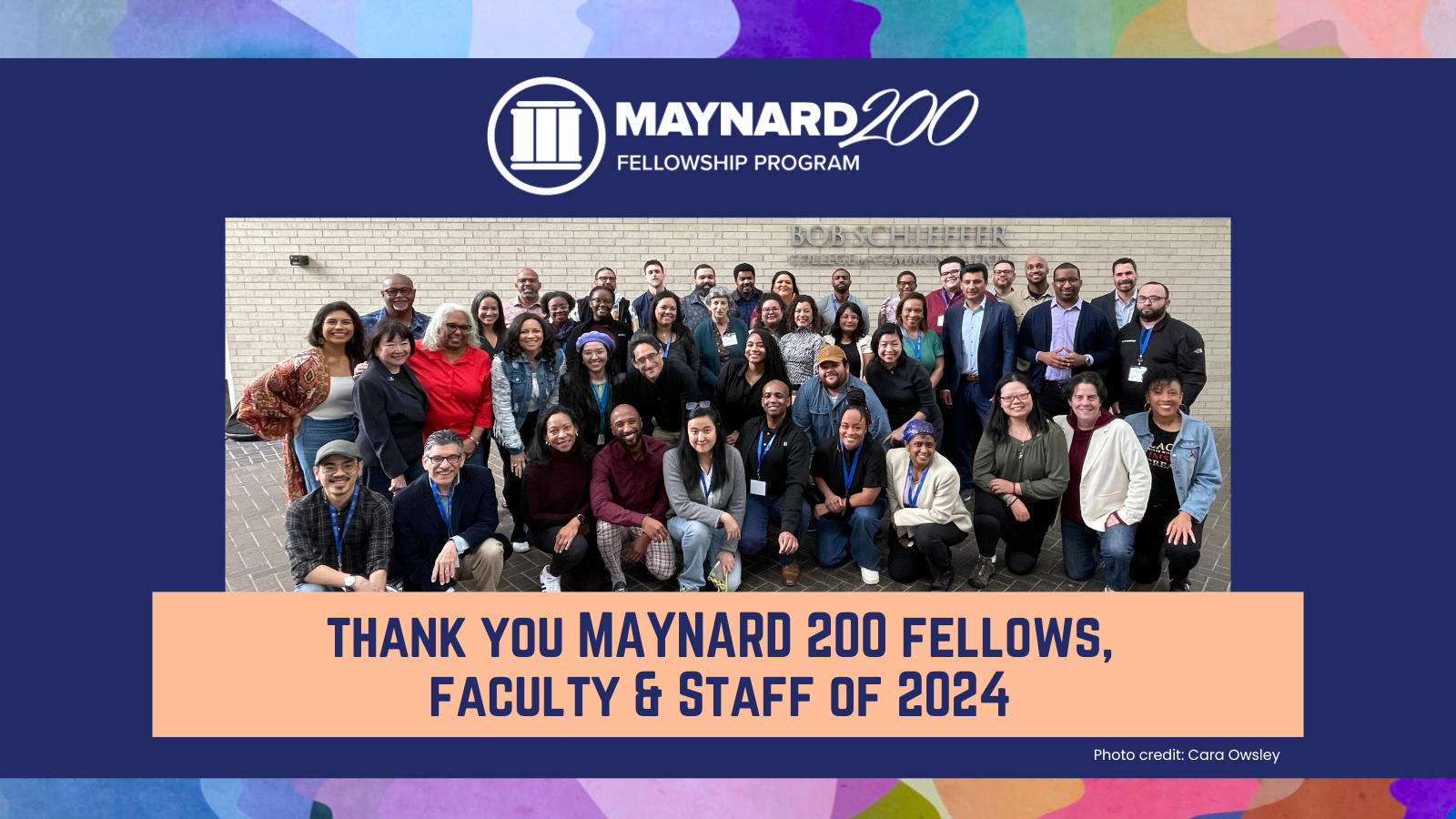
The first training week of the 2024 in-person Maynard 200 Fellowship Program hosted by TCU Bob Schieffer College of Communication, concluded with a call-to-action. This year’s cohort of 32 editors and managers from diverse backgrounds were encouraged by the Maynard Institute’s Board Chair John X. Miller to take their top three lessons from Maynard 200 workshops and apply them in their newsrooms. Fellows explored benefits of new editing toolkits, management frameworks and thought-provoking discussions with long-time leaders in the industry, while furthering the values of diversity, equity, inclusion and belonging in journalism. This blog highlights key takeaways from faculty on editing, storytelling and community building, as well as testimonials from fellows who described their Maynard experience as transformational.
In the week’s concluding session, Maynard 200 Director Odette Alcazaren-Keeley lauded the fellows for their courageous conversations, including sharing direct experiences with barriers to a sense of their belonging in newsroom culture.
“We listened to each other with empathy and insight, which has been key to the success of our shared learning,” said Alcazaren-Keeley.
“Your voices on these issues are crucial as fellows…the totality of who you are is powerful. Continue to challenge ideas, challenge us, each other and yourselves. Know that alongside our Maynard 200 alumni, you represent the future of media. You have us now, as your newest community on the frontlines of this mini-movement especially amid ongoing upheaval, to dismantle systemic racism in our field.”
The Maynard Institute’s Director of Cultural Competency, Felecia D. Henderson serves as this year’s Maynard 200 Executive-in-Residence. Henderson and Alcazaren-Keeley worked together in crafting a high-impact, hands-on curriculum for the fellows that they could apply in their roles as editors and managers. Henderson said the 2024 curriculum is specifically aligned with what newsroom leaders are looking for in a professional development program because “frontline editors and managers are often thrust into crucial positions with little to no training.”
In addition to learning practical skills, another unique benefit of the Maynard 200 Fellowship professional development program is the opportunity fellows have to bond with a community of their peers. Some fellows shared heartfelt testimonials about their experiences in post-training surveys (shared below with permission).
The ability to meet so many curious, intelligent, and gracious journalists was a gift. I absolutely left the training both renewed and transformed.
Teri Henderson, Baltimore Beat, Arts & Culture Editor
The Maynard 200 fellowship offers key support to front-line managers. With editing, coaching and management training, fellows can walk away with new tools and language to better engage with their reporters and the newsroom.
Sabrina Bodon, The Sacramento Bee, Equity Lab Editor
The program was transformational. I feel inspired, energized, and more confident.
Carmen Castro-Pagan, Bloomberg Industry Group, Team Lead (Editor)
The Maynard faculty were incredibly helpful during the first week of training. Many of the techniques they shared throughout the week came with real world examples that made it easier to translate their guidance to our own work. Kristopher Hooks, The Boston Globe, Money, Power, Inequality Editor
This was the first time in my career where someone distilled the basics of editing – what to look for and what techniques to use. I finally have an editor toolbox that I can use everyday.
Fahmida Y Rashid, Dark Reading, Informa Tech, Managing Editor, Features
The first week of the Maynard 200 fellowship was extremely rewarding. It was refreshing and insightful to collaborate with such an esteemed group of journalists who are committed to their work! While all of the sessions were extraordinary, I found the editing sessions to be most beneficial. I walked away feeling empowered to utilize editing tips I learned.
Erica McIntosh, WNPR, CT Public, Sr. Regional Editor, Southern CT
I did not realize how much of this I was missing and needing until I went through this past week, and knowing there’s a community of folks I can reach out to is/will be invaluable.
Kai Teoh, Dallas Morning News, Data & Interactives Editor
Political journalism really struggles with diversity, so, on some basic level, I just feel energized being around talented journalists of color who are making it work in the bigger ecosystem of our profession. It was therapeutic to be around so many news nerds.
Darius Dixon, POLITICO; Deputy Managing Editor, Policy
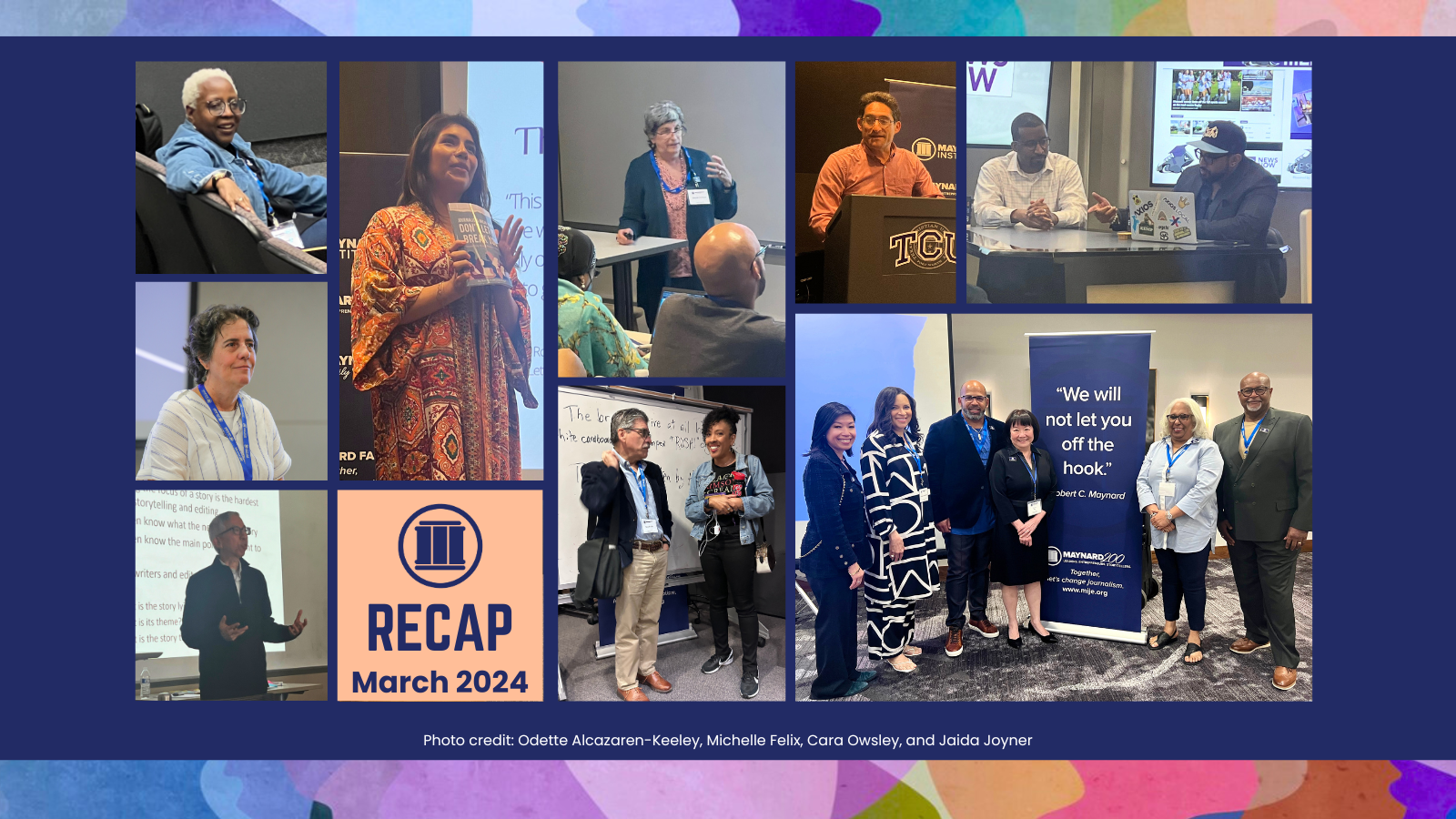
Maynard 200 faculty and staff pictured (clockwise from top left): Michelle Johnson, Leslie Rangel, Merrill Perlman, Aaron Glantz, Delano Massey (seen on far right coaching fellow Matthew Vann), John X. Miller, Jean Marie Brown, Evelyn Hsu, Martin G. Reynolds, Felecia D. Henderson, Odette Alcazaren-Keeley, Cara Owsley, Steve Padilla, Tom Huang and Maria Carrillo.
“Fine-Tuning Your Story Pitch” and “Mounting and Managing the Big Project” with Aaron Glantz
Aaron Glantz is California Bureau Chief and Senior Editor at The Fuller Project, the global newsroom focused on women. A two-time Peabody Award winner and finalist for the Pulitzer Prize, he is a seasoned manager of complex projects, who delivers excellence simultaneously across mediums and newsrooms so that stories land with maximum velocity. His work has sparked new laws, dozens of Congressional hearings, and investigations by the FBI, DEA, Pentagon inspector general, and the United Nations Special Rapporteur for extrajudicial, summary, or arbitrary execution. A former foreign correspondent who worked as an unembedded journalist in Iraq, Glantz is the author of four books, among them 2019’s Homewreckers, which tracks hedge fund profiteering off the 2008 financial crisis.
Glantz presented two sessions “Fine-Tuning Your Story Pitch” and “Mounting and Managing the Big Project.” During his session on best practices for managing a big project, Glantz explained, “It’s really important that your big project be aligned with your newsroom’s mission.”
He advised fellows to become advocates for the big project. “Nobody advocates for your story as well as you do. You know your story. You know the stakeholders, you’re building relationships,” Glantz said.
“Some of you are at local outlets, you want to have a local story that’s going to speak to these greater, bigger themes. And when you really have a winner is when you can have a story that can hit in multiple metros at the same time…It’s so hard to cut through the fog, your reporting will cut through more if the stakes are high, if people can say this is an issue on my block, in my neighborhood, in my community.”
“AI: What You Need to Know” with Michelle Johnson
Michelle Johnson is an Emerita Associate Professor of the Practice in Journalism, Boston University. She retired from BU in 2022, where she taught a variety of courses focused on online journalism and multimedia storytelling. Johnson is a former editor for the Boston Globe and boston.com. She is currently an Expert in Residence with BU’s Spark! program, an experiential learning and innovation lab based in the Center for Computing and Data Science.
For more than 20 years, Johnson conducted multimedia training workshops for student and professional journalists for a variety of organizations, including the Online News Association, the Maynard Institute, the National Association of Black Journalists, the National Association of Hispanic Journalists, and the Association of LGBTQ Journalists.
Johnson hopes her presentation emboldens fellows with an understanding of “the potential and pitfalls of AI, and that this will prepare them to take part in conversations that will shape policies in their newsrooms and organizations going forward.”
“Improving Collaboration between Reporters and Photographers” with Cara Owsley
Cara Owsley is a national award-winning visual journalist/director of photography at The Cincinnati Enquirer. In 2018 The Cincinnati Enquirer won a Pulitzer Prize in the local reporting category. The story “Seven Days of Heroin” was recognized by the Pulitzer board “for a riveting and insightful narrative and video documenting seven days of greater Cincinnati’s heroin epidemic, revealing how the deadly addiction has ravaged families and communities.” Cara was a photojournalist and photo editor for the project.
Before working for The Enquirer, Cara was a staff photojournalist at The Times-Picayune in New Orleans, The Sun Herald in Biloxi, Mississippi, and The Repository in Canton, Ohio. She has been in the industry for 28 years. Cara found her love of photojournalism while attending Western Kentucky University where she earned her Bachelor of Arts degree in photojournalism.
Owsley stressed in her talk that the key ingredient in improving the collaborative work of reporters and photographers is communication. She explained: “involve the photo staff in the beginning stages, not after interviews…Work as a team and support each other.”
“Holistic Resilience and Finding Work-Life Harmony in Turbulent Times” with Leslie Rangel
Leslie Rangel is an Emmy-nominated and United Nations-recognized journalist, morning news anchor and author. Her journalism is community-focused at the intersection of equity and social injustice. She’s a 2023 recipient of the The Chauncey Bailey Journalist of Color Investigative Reporting Fellowship. She’s spent 12+ years working in newsrooms and is a certified yoga, mindset, meditation and life coach. Rangle is also the founder and CEO of The News Yogi Coaching, on a mission to cultivate soul centered spaces and conversations that allow high-achieving marginalized folks to feel seen and see themselves. She provides mental wellness and holistic leadership coaching to high-achieving humans, particularly those who are often the firsts in their family from a non-dominant culture.
Rangel’s keynote fittingly capped an insightful week, and she started by leading fellows and faculty in a grounding meditation. This pause was impactful, amid relentless demands of the news cycle, ongoing turbulence across media spaces, and also the globe.
She exhorted this next generation of news leaders to: “Remember to be a human first, journalist second. Normalize living sustainably in our industry and actually take action to rest. Remember, it’s okay to ask for help. It’s okay to admit you’re not okay. It’s okay to prioritize yourself.”
“Finding the Heart of the Story” with Tom Huang
Tom Huang is Assistant Managing Editor for Journalism Initiatives at The Dallas Morning News, where he edits enterprise stories, oversees the newsroom’s internship program and leads the newsroom’s community-funded journalism initiative, which seeks philanthropic support of public service journalism.
Huang walked fellows through the 5 focusing questions that editors can ask to help guide reporters to find the heart of the story and become better storytellers. He says he “starts with questions that spark a writer’s imagination… I push the writer to think harder about the story’s theme…and try fresh approaches to storytelling,
According to Huang, these questions that he uses as an editor were developed by David Von Drehle and Chip Scanlan:
“Coaching for Story” with Maria Carrillo
Maria Carrillo is a consultant and coach after spending 36 years in seven newsrooms. She was enterprise editor at the Tampa Bay Times and Houston Chronicle and, before that, managing editor at The Virginian-Pilot. She has edited dozens of award-winning projects, frequently lectures on narrative journalism and co-hosts a podcast (WriteLane) about craft.
Carrillo stressed that building trust and relationships based on mutual respect to each other’s expertise, is foundational in the effective partnership between editors and writers. Her session aimed to “grow editors’ confidence as coaches, and give them tools to help guide writers to tell better stories.”
“Editing for Tone” with Merrill Perlman
Merrill Perlman spent 25 years at The New York Times in jobs ranging from copy editor to director of copy desks, in charge of all 150-plus copy editors at The Times. Now, she coaches writers and editors in self-editing, grammar, language and clarity, where her clients have included the Poynter Institute, Honolulu Civil Beat, The Philadelphia Inquirer, The Weather Channel, FoxNews, The Monterey Bay Aquarium Research Institute and the U.N., as well as communications companies, corporations, law firms and foundations. She’s a freelance editor who has worked for such places as Center for Public Integrity, Investigative Reporting Workshop, ProPublica, Rosetta Books and Amazon Kindle Singles.
According to Perlman, it is imperative for “editors to make sure that each sentence and word is in service of the story. They also need to watch out for unintended bias in adjectives and labels.”
“Editing Techniques” with Steve Padilla
Steve Padilla is editor of Column One, the front-page showcase for storytelling at the Los Angeles Times. He joined the Times in 1987 as a night police reporter but soon moved on to editing. He helped guide the Times’ Pulitzer-winning coverage of a botched bank robbery in North Hollywood in 1997.
In his 36 years with the Times, he has edited a wide variety of subjects—national politics, higher education, California state news and religion among them. Before his current assignment, Padilla was enterprise editor on the foreign-national desk. He also served as director of Metpro, the Times’ training program designed to bring diversity to newsrooms.
Padilla summed up his talk with the hope that the fellows will remember that “when editing or coaching writers, positive direction, rather than negative, often produces good results—they’re longer lasting and the process is more fun, too.”
“Name it, Claim it and Aim it: Leveraging Your Strengths” with Jean Marie Brown
Jean Marie Brown is an associate professor of professional practice in the Department of Journalism at TCU’s Bob Schieffer College of Communication. In addition to serving as a full-time faculty member, she is also director of student media.
A former newspaper executive, Jean Marie spent most of her professional career working for Knight Ridder and later, for McClatchy newspapers. She held management positions at The Fort
Worth Star- Telegram and The Charlotte Observer. Her management career included time as a deputy features editor, city editor, assistant managing editor and managing editor. She directed local news coverage for the Arlington and Northeast edition of the Star-Telegram. Her strengths as an editor were line editing, story idea generation and staff development.
The Gallup Strengths Assessment and 1:1 coaching sessions with fellows by Prof. Jean Marie Brown has been a pillar in the Maynard 200 curriculum since its pilot. In this pivotal process, she explains how we as leaders can name, claim and aim our strengths in order to leverage them – in work and relationships.
Brown encouraged fellows “to lean in and own who you are, make other people accept who you are…and to celebrate yourself for the things that you do really well.” She stressed that it is critical “to bring our authentic selves to our newsrooms.” She added “that in understanding our strengths and of our team members, you are able to recognize what you do best, and you let other people do what they do best.”
Fault Lines® with Professor Jean Marie Brown and Martin G. Reynolds
One of the Maynard Institute’s mainstay professional development offerings is a series of trainings for newsrooms based on the Fault Lines® methodology. Designed by founder and namesake Robert C. Maynard, the Fault Lines® framework helps newsrooms address bias along lines of race, gender, sexual orientation, generation, geography, class and more, as they apply to journalists, news coverage, newsroom collaborations and community engagement. This keynote session was co-led by Professor Jean Marie Brown and the Maynard Institute’s Co-Executive Director, Martin G. Reynolds.
Prior to joining the Maynard Institute leadership, Reynolds was senior editor for community engagement and training for Bay Area News Group and served as editor-in-chief of The Oakland Tribune between 2008-2011. His career with Bay Area News Group spanned 18 years. Reynolds was also a lead editor on the Chauncey Bailey Project, formed in 2007 to investigate the slaying of the former Oakland Post editor and Tribune reporter.
Reynolds is also co-founder of Oakland Voices, a hyperlocal storytelling project that trains residents to serve as community correspondents that first launched in 2010 as partnership between the Oakland Tribune and the Maynard Institute. He was named as Digital First Media’s Innovator of the Year for his work on Oakland Voices.
In his opening remarks at the 2024 Maynard 200 Fellowship session, Reynolds spoke about the challenging and vital role the 2024 Maynard 200 fellows play in their newsrooms.
“Here you are. Frontline editors, navigating it all. You have among the most challenging jobs in all of journalism. Sitting at the nexus of the community, the organization and the storytellers.”
He added, “This program is about equipping you with the skills, but perhaps even more importantly…this is about community so that you have what you need to be supported, to be seen, to be cared for as you move through this journey.”
Fellows benefited from hands-on breakout sessions that were customized to tactical coaching workshops relevant to editors across three primary platforms:
Delano Massey, a Maynard Institute alum, has been serving as a Maynard 200 mentor for the last 2 years. In 2024, Massey served as the coach for the broadcasting breakout coaching sessions. He shared his multi-layered experience in this space, including the importance of creating and leveraging influence. He is currently managing editor for Local at Axios, overseeing operations across 30 markets. He was also the former supervising producer of the Race & Equality Team at CNN. His impact extends from major outlets like CNN and the Associated Press to local platforms like News 5 Cleveland, WKYT, and the Lexington-Herald Leader.
Coaches also held one-on-one office hours with fellows.
Fellows and faculty alike expressed an eagerness to reconvene in a few months for the July weeklong training sessions. In addition to the generous university partner host TCU Bob Schieffer College of Communication, the 2024 Maynard 200 Fellowship would not be possible without the support of Craig Newmark Philanthropies, the Hearthland Foundation, McClatchy and individual donors.

This program is about strengthening newsroom leaders for a sustainable future in media. The cohort of 2024 marks a special milestone. When the fellowship program launched in 2018, the Maynard Institute set the goal to provide professional development to two hundred journalism professionals and the 2024 fellows have exceeded that goal.
During the March training, the Maynard Institute’s Co-Executive Director Evelyn Hsu shared the pivotal history that is part of the fellowship surpassing its mission, through the lens of the vision and legacy of the institute’s nine founders.
The next round of sessions in July will conclude with a special celebration to honor this achievement while acknowledging the marathon continues.
For more than 45 years, the Maynard Institute has fought to push back against the systemic lack of diversity in the news industry through training, collaborations and convenings. Founded by Robert C. Maynard, the Institute promotes diversity and antiracism in the news media through improved coverage, hiring and business practices. We are creating better representation in America’s newsrooms through our Maynard 200 fellowship program, which gives media professionals of color the tools to become skilled storytellers, empowered executives and inspired media entrepreneurs.
Maynard 200 is the cornerstone fellowship program advancing the Maynard Institute’s efforts to expand the diversity pipeline in news media and dismantle structural racism in its newsrooms. It is designed for and serves the next generation of media leaders, storytellers, editors and entrepreneurs, in order to advance their career growth and leadership power in newsrooms and organizations. The professional development program provides customized training courses, resources and 1:1 mentorship by industry professionals, to fellows who have represented a wide spectrum of racial, gender and geographic backgrounds.
For more information about the Maynard 200 Fellowship, please reach out to:
Maynard 200 Director, Odette Alcazaren-Keeley at okeeley@mije.org.
Jasmine expands upon this relational work by amplifying and archiving everyday stories as a freelance journalist contributing to South…
A recap of our most recent Regional Training at Texas Christian University Bob Schieffer College of Communication in…
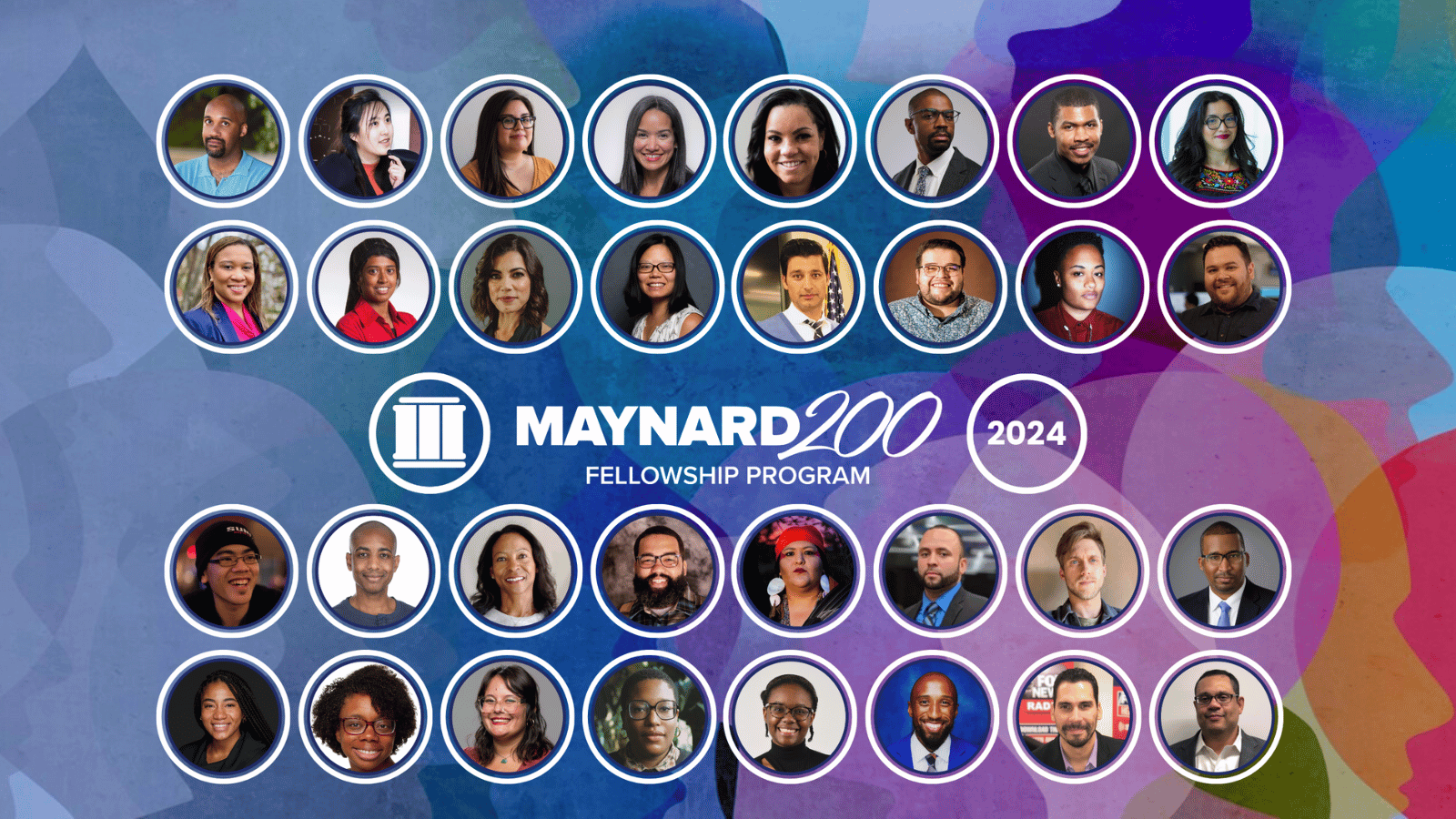
The 2024 Maynard 200 Fellows (clockwise from top left): Aaron Foley, Allison Jing Yang, Blanca Méndez, Carmen Castro-Pagán, Carolyn Copeland, Daarel Burnette II, Darius Dixon, Erica McIntosh, Estefania Mitre, Fahmida Rashid, Fernanda Santos, Heather J. Chin, Iftikhar Hussain, Jacob Sanchez, Jamilah King, Joshua Barajas, Juan Michael Porter II, Kai Teoh, Kim Johnson Flodin, Kris Hooks, Luella Brien, Martin Garcia, Mason Bryan, Matthew Vann, Maya Valentine, Pamela De La Fuente, Sabrina Bodon, Teri Henderson, Tierra Hayes, Torrance Latham, William Sanchez II and Zeke Minaya.
OAKLAND, CA (February 29, 2024): The Robert C. Maynard Institute for Journalism Education, a nonprofit dedicated to expanding diversity in the news media and dismantling structural racism in newsrooms, announced today the recipients of its 2024 Maynard 200 Fellowship. Since the program’s inception in 2018, the Maynard Institute has trained and mentored journalists, editors, managers, executives and media entrepreneurs of diverse backgrounds. With its latest class of 32 fellows, the Maynard Institute will surpass its mission of cultivating 200 media leaders dedicated to advancing diversity, equity, inclusion and belonging in journalism.
The tuition-free program includes two weeks of in-person training rounds as well as supplementary sessions, office hours and ongoing support throughout the year. Maynard 200 returns to the Bob Schieffer College of Communication at TCU in Fort Worth, Texas for two weeks of customized workshops, hands-on coaching and peer networking sessions in March and July. The in-person training weeks are followed by a year-long, one-on-one mentorship phase, wherein each Fellow is paired with an industry expert for dedicated coaching.
In 2024, the institute’s cornerstone training program Maynard 200 Fellowship will focus on the professional advancement and year-long mentorship for frontline editors and mid-level managers. The customized curriculum addresses the challenges editors and managers struggle with daily in their newsrooms, especially those who have recently transitioned to higher leadership roles. This year’s program is made possible thanks to the generous support of Craig Newmark Philanthropies, The Hearthland Foundation, McClatchy and individual donors.
“Maynard 200 has served as a lifeline to many BIPOC journalists, especially those navigating upheavals in the industry. Our graduates leave the program with a renewed fire in their roles and growth. They are emboldened to shift cultures in their newsrooms to create spaces of equity and belonging, knowing they have the support of the Maynard Family as their enduring community,” said Odette Alcazaren-Keeley, Maynard 200 Director.
“This year’s Maynard 200 Fellows are another outstanding class of 32 media leaders, representing diverse racial, gender, age, and geographic backgrounds. Alongside legacy media peers, the powerful voice of journalists affiliated with ethnic, community-powered and niche media make this cohort unique. Their collective impact will help us craft future Maynard programs that are adaptive to the challenges of the field,” Alcazaren-Keeley added.
“We are excited about the curriculum we have designed, which will be led by subject matter experts in the industry,” said Felecia D. Henderson, the Maynard Institute’s cultural competency director and Maynard 200’s new executive-in-residence. “The fellows will graduate the program as more confident and proficient newsroom leaders.”
“This year we will surpass our goal of training 200 storytellers, managers, entrepreneurs and executives. It is exciting and inspiring to see the good work that has emerged from our training and to see the contributions our graduates are making to the profession,” said Maynard Institute co-executive director Evelyn Hsu, the architect of the program.
Meet the Maynard 200 Fellows of 2024:
Read the bios for the 2024 Maynard 200 Fellows (PDF).
Interested in learning more about the 32 media leaders joining the fellowship in 2024?
For more than 45 years, the Maynard Institute has fought to push back against the systemic lack of diversity in the news industry through training, collaborations and convenings. Founded by Robert C. Maynard, the Institute promotes diversity and antiracism in the news media through improved coverage, hiring and business practices. We are creating better representation in America’s newsrooms through our Maynard 200 fellowship program, which gives media professionals of color the tools to become skilled storytellers, empowered executives and inspired media entrepreneurs.
Maynard 200 is the cornerstone fellowship program advancing the Maynard Institute’s efforts to expand the diversity pipeline in news media and dismantle structural racism in its newsrooms. It is designed for and serves the next generation of media leaders, storytellers, editors and entrepreneurs, in order to advance their career growth and leadership power in newsrooms and organizations. The professional development program provides customized training courses, resources and 1:1 mentorship by industry professionals, to fellows who have represented a wide spectrum of racial, gender and geographic backgrounds.
For more information about the Maynard 200 Fellowship, please reach out to:
Maynard 200 Director, Odette Alcazaren-Keeley at okeeley@mije.org.
Jasmine expands upon this relational work by amplifying and archiving everyday stories as a freelance journalist contributing to South…
A recap of our most recent Regional Training at Texas Christian University Bob Schieffer College of Communication in…
The 2024 Maynard 200 Fellowship is designed to sharpen skills, provide hands-on training as well as a one-to-one year-long mentorship, and build a community of peer support. This year’s curriculum has been updated with a hyperfocus on the critical role editors and managers play in today’s newsrooms. Hosted by the Bob Schieffer College of Communication at TCU, fellows benefit from two weeks of in-person training sessions and workshops led by industry leaders. This blog highlights just a few of the 2024 Maynard 200 Faculty.
Faculty: Merrill Perlman
Merrill Perlman is a consultant who works with news organizations, private companies and foundations, journalism organizations and writers and editors, helping them to communicate with clarity. She spent 25 years at The New York Times in jobs ranging from copy editor to director of copy desks, in charge of all 150-plus copy editors at The Times. She is also a freelance editor of books, long-form journalism and other informational content.
Before going to The Times, she was a copy editor and assistant business editor at The Des Moines Register. Before that, she was a reporter and copy editor at The Southern Illinoisan newspaper. She has a bachelor of journalism degree from the University of Missouri and a master of arts in mass communication from Drake University.
Faculty: Tom Huang
Tom Huang is Assistant Managing Editor for Journalism Initiatives at The Dallas Morning News, where he edits enterprise stories, helps with newsroom training and internships and leads the newsroom’s community-funded journalism initiative, which seeks philanthropic support of public service journalism. Since 2020, he has helped launch The News’ Education Lab, which has expanded education reporting with the support of local foundations; Arts Access, a partnership with KERA that covers arts and culture through a DEI lens; and the Dallas Media Collaborative, an alliance of news outlets and universities focused on solutions-based reporting on affordable housing.
As an adjunct faculty member of The Poynter Institute, he organizes seminars for professional journalists on writing, reporting and editing. For the past six years, he has served as a coach in the Poynter Table Stakes program, which helps newsrooms make the transition to sustainable digital publishing.
Faculty: Joanne Griffin
Joanne Griffin is a strategist, innovator and transformation professional with a lengthy career in finance and technology. Her career has spanned more than twenty years in various industries, including senior leadership positions at LinkedIn, Nielsen and EY.
She is currently the CEO of AdaptIQ where she leads innovation initiatives focused on transformation and adaptability for global enterprises. A solutions-builder at heart with a deep appreciation of the power of community to solve complex challenges, she is co-founder and COO of IrelandTogether.ie, a non-profit organisation creating opportunity for entrepreneurs by creating serendipitous collisions.
An enduring love affair with technology dates back to the arrival of the Commodore VIC-20 in the early 1980s. She has judged the European Automation Awards category for SSON since 2017, and is ranked as one of the Top 50 Thought Leaders in RPA. As a tech zealot with an innovative mindset, she believes that technologists have a responsibility to be ethical, collaborative and transparent in the design of products and business models. She advises a small number of high-potential start-ups who are aligned with those values.
Faculty: Maria Carrillo
Maria is a consultant and coach after spending 36 years in seven newsrooms. She was enterprise editor at the Tampa Bay Times and Houston Chronicle and, before that, managing editor at The Virginian-Pilot. She has edited dozens of award-winning projects, frequently lectures on narrative journalism and co-hosts a podcast (WriteLane) about craft.
She is a board member of the Virginia Center for Investigative Journalism and the National Press Photographers Association and a juror for the Hillman Prizes. Maria was born in Washington, D.C., two years after her parents left Cuba in exile. She now lives in St. Petersburg, Fla.
Faculty: Aaron Glantz
Aaron served as Executive-in-Residence for the Maynard 200 Fellowship’s Investigative Storytelling Track. He is California bureau chief and a senior editor at The Fuller Project, the global newsroom dedicated to groundbreaking reporting that catalyzes positive change for women.
Aaron is a two-time Peabody Award winner and Pulitzer Prize finalist, who produces journalism with impact. His work has sparked dozens of Congressional hearings and investigations by the FBI, DEA, Pentagon inspector general, and the United Nations Special Rapporteur for extrajudicial, summary, or arbitrary execution. One project prompted the second largest redlining settlement in Justice Department history, against Warren Buffett’s mortgage companies.
As senior investigations editor for NPR’s California Newsroom, he built an investigative collaboration for 17 public radio stations in partnership with NPR national. Their work led to the enactment of two state laws and propelled more than $2 billion in additional funds for affordable homeownership, climate mitigation, and compensation for fire victims.
Aaron is author of three books: How America Lost Iraq (Penguin); The War Comes Home: Washington’s Battle Against America’s Veterans (UC Press); and Homewreckers: How a Gang of Wall Street Kingpins, Hedge Fund Magnates, Crooked Banks, and Vulture Capitalists Sucked Millions Out of Their Homes and Demolished the American Dream (HarperCollins).
An alumnus of the John S. Knight Journalism Fellow at Stanford University, Aaron has been a DART Ochberg Fellow at Columbia University and a visiting professor at the UC Berkeley Graduate School of Journalism.
The Maynard 200 Fellowship program is made possible thanks to all members of the 2024 faculty and mentors and the first training week kicks off on March 11. Our university host partners at TCU’s Bob Schieffer College of Communication including long-standing TCU faculty member, Associate Professor of Professional Practice and Director of Student Media Journalism, Jean Marie Brown has also been instrumental in welcoming the Maynard 200 Fellowship. Brown is an expert in the Maynard Institute’s Fault Lines training methodology that promotes diversity, equity and inclusion (DEI) in newsrooms. Under Brown’s tutelage, the Fault Lines® methodology has also been applied to in-depth community reporting by students at TCU 360, the official, student-produced journalism of the Journalism Department in the Bob Schieffer College of Communication.
In addition to the sessions mentioned above, the Fellowship’s training sessions will also explore:
Maynard 200 is the cornerstone program advancing the Maynard Institute’s efforts to expand the diversity pipeline in news media and dismantle structural racism in its newsrooms. Since 2018, the Maynard Institute has trained media leaders, storytellers, editors, managers and entrepreneurs through the fellowship program. Maynard 200 is designed to sharpen skills, provide hands-on training as well as a one-to-one year-long mentorship, and build a community of peer support for diverse journalists. In 2024, the program returns with two weeks of in-person training rounds — specifically designed to support the success of newsroom editors and managers. Hosted by the Bob Schieffer College of Communication at TCU in Fort Worth, Texas, the program will convene in March and July of 2024.
Maynard 200 is made possible thanks to the support of our generous funders Craig Newmark Philanthropies, The Hearthland Foundation and McClatchy.
For more information about the Maynard 200 Fellowship, please reach out to:
Maynard 200 Director, Odette Alcazaren-Keeley at okeeley@mije.org.
Jasmine expands upon this relational work by amplifying and archiving everyday stories as a freelance journalist contributing to South…
A recap of our most recent Regional Training at Texas Christian University Bob Schieffer College of Communication in…
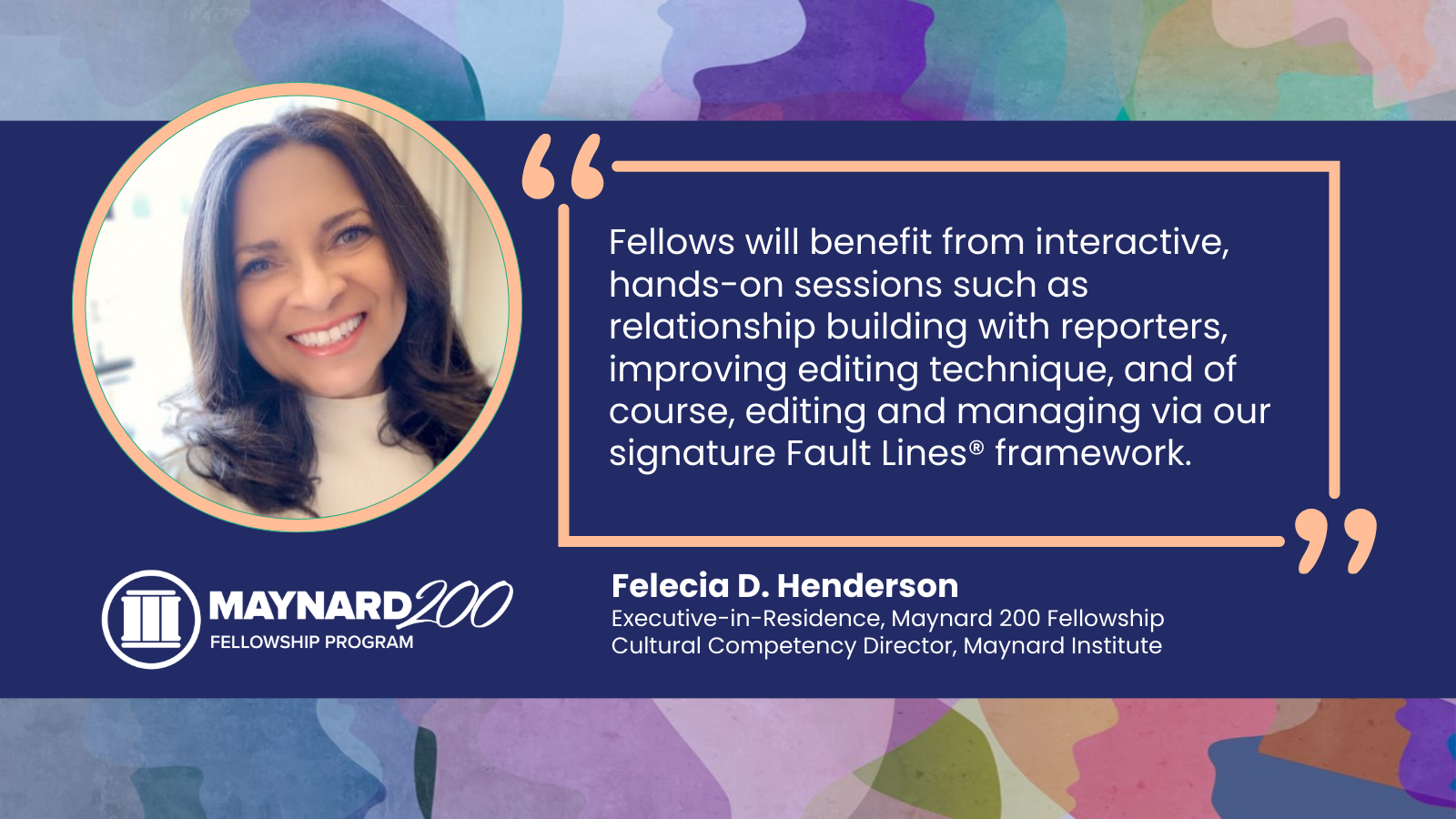
Fellows will benefit from interactive, hands-on sessions such as relationship building with reporters, improving editing technique, and of course, editing and managing via our signature Fault Lines framework.
Are you a newsroom editor or manager interested in growing your skills while building a diverse network of peers? The Maynard 200 Fellowship professional development program is for you. Led by the Maynard Institute’s Cultural Competency Director, Felecia D. Henderson, this year’s curriculum has been updated with a hyperfocus on the critical role editors and managers play in today’s newsrooms.
“There are not enough words to express how excited I am for this new iteration of Maynard 200,” says Felecia D. Henderson, who spent many years as a newsroom editor and manager. “We are responding to what we’ve heard from many news leaders who say training for middle managers is much needed. The 15 fellows selected will benefit from interactive, hands-on sessions such as relationship building with reporters, improving editing technique, and of course, editing and managing via our signature Fault Lines® framework. The goal is to produce more confident and effective editors and newsroom leaders.”
In 2024, the Maynard 200 Fellowship will focus on the professional development training and year-long mentorship for frontline editors and managers. The customized curriculum addresses the challenges editors and managers struggle with daily in a newsroom, especially those who have recently transitioned to higher leadership roles.
Dates: March 11- 15, 2024
Dates: July 15 – 19, 2024
The program will also provide nuanced frameworks and cultural competency for fellows seeking guidance in covering the ongoing war and humanitarian crises in the Middle East; as well as political coverage for the consequential 2024 U.S. presidential elections.
Since 2020, Henderson has trained nearly 250 print and broadcast news organizations on Diversity, Equity, Inclusion and Belonging issues using Maynard’s signature Fault Lines® program. She also oversees the cultural competency curriculum for colleges and universities, and is a newsroom organizational change coach and consultant.
Prior to joining the institute, Henderson was Assistant Managing Editor at The Detroit News where she was a member of the senior management team responsible for newsroom operations. In 2009, she successfully co-facilitated the largest newsroom change initiative to transition the organization to a digital news, four-day single copy, two-day home delivery model.
She began her journalism career at her hometown newspaper, The Courier-Journal in Louisville, KY, graduated from the Maynard Institute’s Editing Program for Minority Journalists at the University of Arizona, and held editing roles at the Detroit Free Press and Cincinnati Post.
Henderson is a founding member of the National Association of Black Journalists’ Visual Task Force. Locally, she was elected president and vice president-print of the Detroit NABJ. She currently serves an ex-officio member on the board of directors.
Henderson earned a bachelor’s degree in Radio-TV/Journalism from Murray State University, which named her a Distinguished Alumna in 2019, and a Master of Organization Development from Bowling Green State University. She holds certification in Diversity and Inclusion from Cornell University and is a certified Emotional Intelligence practitioner from RocheMartin, an international leadership development organization.
Maynard 200 is the cornerstone program advancing the Maynard Institute’s efforts to expand the diversity pipeline in news media and dismantle structural racism in its newsrooms. Since 2018, the Maynard Institute has trained media leaders, storytellers, editors, managers and entrepreneurs through the fellowship program. Maynard 200 is designed to sharpen skills, provide hands-on training as well as a one-to-one year-long mentorship, and build a community of peer support for diverse journalists. In 2024, the program returns with two weeks of in-person training rounds — specifically designed to support the success of newsroom editors and managers. Hosted by the Bob Schieffer College of Communication at TCU in Fort Worth, Texas, the program will convene in March and July of 2024.
Maynard 200 is made possible thanks to the support of our generous funders Craig Newmark Philanthropies, The Hearthland Foundation and McClatchy.
For more information about the Maynard 200 Fellowship, please reach out to:
Maynard 200 Director, Odette Alcazaren-Keeley at okeeley@mije.org.
Jasmine expands upon this relational work by amplifying and archiving everyday stories as a freelance journalist contributing to South…
A recap of our most recent Regional Training at Texas Christian University Bob Schieffer College of Communication in…
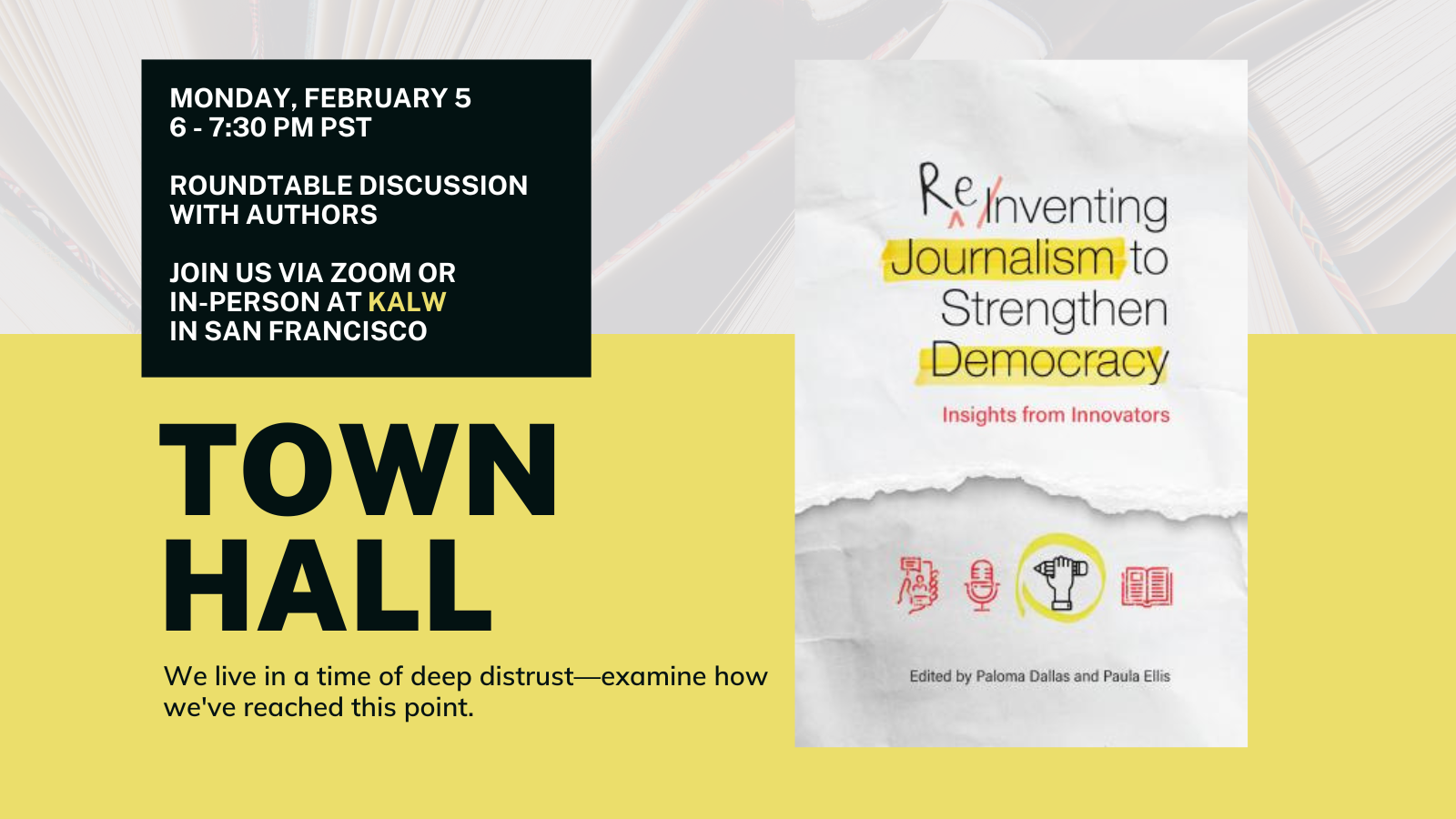
In 2023, the Kettering Foundation published a volume of essays on growing distrust of news media and opportunties for new practices to engage a diverse audience. Journalists from newspapers, public radio, civic media groups, and new media collectives contributed essays with their perspectives on how reinventing journalism as we know it can strengthen democracy. On February 5, 2024, KALW Public Media will host a free Town Hall, co-sponsored by the Society of Professional Journalists and the Kettering Foundation, featuring some of the authors, including Maynard Institute Co-Executive Director, Martin G. Reynolds. This blog includes an excerpt from his essay, titled “Dismantling Systemic Racism in News.”
From the publisher: During summer 2020, the killings of George Floyd and Breonna Taylor sent shockwaves across America. Newsrooms and the journalists in them also felt the shock. Martin Reynolds, former managing editor and editor in chief of the Oakland Tribune and co-executive director of the Robert C. Maynard Institute for Journalism Education, was one of them. Even though Reynolds saw himself “in Floyd, in Taylor, and in the faces of countless other people of color who had been slain by police,” his initial instinct was to maintain his objectivity and to frame these events through the lens of a media professional and not a Black man with a Black son. Reynolds examines this experience and suggests some ways the dismantling of systemic racism in newsrooms might begin.
The following is an excerpt from Reinventing Journalism to Strengthen Democracy: Insights from Innovators, published by the Kettering Foundation in 2023 and edited by Paloma Dallas and Paula Ellis. With persmission, we are sharing an edited excerpt from the essay, “Dismantling Systemic Racism in News,” written by Maynard Institute for Journalism Education’s co-executive director Martin Reynolds.
It feels difficult at this moment to return to the summer of George Floyd’s killing. I remember sitting in my car, rewatching the video on my phone, listening to accounts of protests. Hearing about Breonna Taylor and the list of other Black men and women and people of color killed by police was overwhelming.
I was enraged.
I was distraught.
I was scared.
I was ready to fight back.
How best to do that?
I decided I would never allow a police officer to press the life out of me. Trust in following police commands had been broken in a way I hadn’t before experienced. There was something about that time that felt profoundly different from other instances of police violence that I had helped cover or witnessed during my journalism career.
This time, tears of rage streamed down my face as I sat in my car.
Something snapped me out of a state of the journalistic objectivity that had guided my view of these stories and tragedies throughout my years as a journalist. This felt different and I could no longer separate my own Blackness and humanity from Floyd and from Taylor, slain in her own apartment by police following a no-knock warrant that was not issued for her.
For those reading this who aren’t journalists and who must be bewildered at how such separation from tragedy can be navigated, I must explain that I, among so many of my colleagues, was schooled in the objective approach to journalism.
I was taught that you kept your views on these issues from entering the coverage of a story, agreeing to a certain kind of internal invisibility. You are the witness, not the participant. You are the storyteller, not a character in the story.
I was instructed that who you are and what you have experienced have no place in the framing of a piece. You articulate what happened, with context of course. But often straight news stories about an incident weren’t the place for nuance and deep historical context. In the world of daily newspaper journalism where I was forging a career, you had to keep it moving.
“You can always do a folo (the journalistic term for a next-day story),” one of my former editors would say as she pounded out succinct edits on deadline.
News always happened the next day, so you moved on to the next homicide, fire, robbery, or carjacking. Or, perhaps the bit of context you did insert was removed or challenged by an editor or cut by the copy desk for space or because an editor thought it wasn’t appropriate.
I realize now that the invisibility extended beyond the role of journalist to a deeper place. I had to embrace the invisibility to survive, to find my place, to belong. But it wasn’t a true belonging.
Early in my career, I felt I had to compress elements of my identity and learn to turn away from the experiences that shaped my perception of the world. It wasn’t something that anyone necessarily said. It was more subtle and yet profound.
As that summer of violence and protest was unfolding, my initial instinct was to maintain my objectivity and to frame my view of these horrible events through the lens of a media professional and not a Black man with his own Black son.
Countless cases of Black and Brown people slain by police over the years hadn’t shaken that training, even though I felt pain each time it happened. The blatant racism on the part of police was something I had experienced many times, particularly as a young man, and I always felt as though it eroded my belief in democratic institutions.
The conflict of being a taxpayer and feeling under threat is a paradox I was never surprised by. I was taught that you kept your views on these issues from entering the coverage of a story, agreeing to a certain kind of internal invisibility.
And as news outlets scrambled to cover Floyd’s killing, something clearly snapped within them. The people who had so often been invisible were demanding to be seen. The reckoning in the streets, where we heard calls for racial justice, were echoed in newsrooms.
And there is a damn good reason for that. Fairly recently, newspapers, including the Orlando Sentinel, Los Angeles Times, Kansas City Star, Baltimore Sun, and the Philadelphia Inquirer, have, in various ways, admitted and apologized for their histories of racist coverage and the inflaming of racial tensions.
In a compelling Poynter Institute series, Mark I. Pinsky, author and former staff writer for the Orlando Sentinel wrote:
In recent years, a handful of the region’s newspapers have stepped forward to accept responsibility for biased reporting and editorials, shouldering their share of the burden of racist Southern history. They are acknowledging—belatedly—what their forebearers did and did not do in covering racism, White supremacy, terror and segregation over the past 150 years. Some newspapers, including the Sentinel, had especially grievous sins to confess.
The Inquirer’s look into its history, which was done by Pulitzer Prize-winning journalist Wesley Lowery, also apologized for the harm it had caused to Black journalists who worked for the paper, in addition to the Black community.
“The journalistic examination of the Inquirer by Wesley Lowery published this week [February 2022] puts our failings in brutal relief,” wrote Elizabeth H. Hughes, the paper’s publisher. “The reporting shows not only that we have not done right—it reveals, starkly, that we have done wrong. Black voices in the story—inside and outside the newsroom—articulate forcefully the harm we have inflicted over decades.”
As I reflect on this, now that some time has passed since the summer of Floyd and Taylor (which was followed by an insurrection fomented by a sitting president), I will say that my faith in democratic institutions does not have the luxury of being eroded by individuals not worthy of serving in them.
Looking at how representatives in the Trump administration, Congress, and even the spouse of a Supreme Court justice have behaved and perpetuated lies they know to be untrue has in some strange way evolved my view of the importance of these flawed but vital institutions.
Either the institutions themselves must be dismantled and rebuilt from the ground up or individuals with honor and integrity must stand up and lean against the pillars of these institutions and offer support to their cracking foundations.
I must admit that I am not sure which of these makes the most sense, or if either makes any sense.
The questions for me remain, What will be the true impact of these apologies? You can’t change an institution if the majority of the people inside it are unable, unwilling, or don’t know how, to unwind decades of socialized racism and bias. It is that racism and bias that have left so many feeling invisible, like they don’t belong in the very profession they have worked so hard to join.
I have to admit I never expected to “belong” in my newsroom. I was taught to endure, by journalists of color who were older and wiser. There wasn’t anything close to the refreshing expectation of “cultural competence” on the part of the institution that some younger millennials and Gen Zs have now come to call for.
I am glad they are, but that was not the reality I stepped into. The preparation I received was in the form of encouragement to sustain; to expect the arrows, the lack of cultural humility, blatant ignorance, and tone deafness; and to push through it in service of my career and
the need for more journalists of color in the newsroom.
We were prepared by journalists of color who were boomers and who were shaped by the experiences of their times and who were steeped in the civil rights movement. I was taught to understand that, in many ways, my presence was a form of protest.
Jasmine expands upon this relational work by amplifying and archiving everyday stories as a freelance journalist contributing to South…
The prize is awarded to the best journalism in the country that advances the understanding of stories and…