News / Blog
Newsrooms rethink source protection and journalist safety in immigration coverage
*This article references Maynard Institute programming and interviews Maynard Institute training participants and faculty, including Brenda Verano, who…


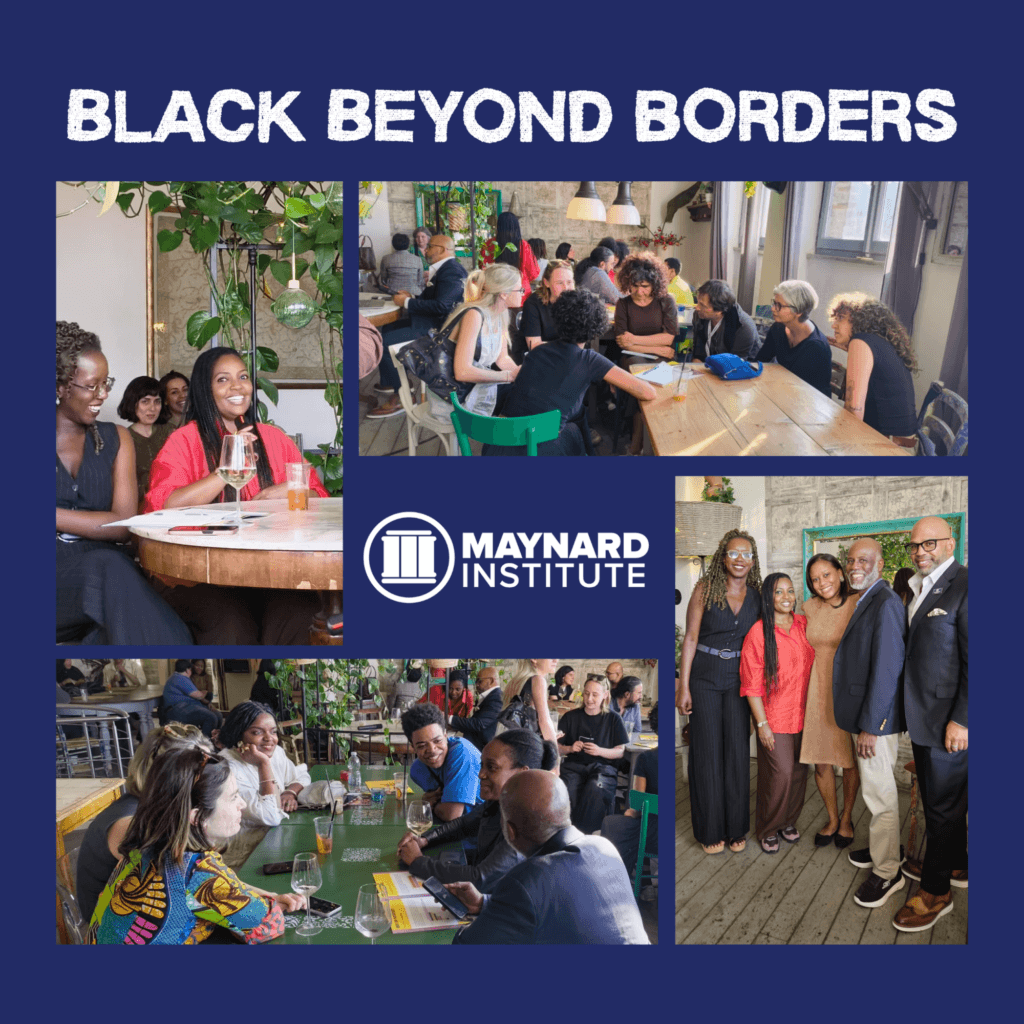
At the International Journalism Festival, Black journalists and allies created a space rooted in Black diasporic experience — and opened a wider conversation about belonging, solidarity and journalism’s global blind spots.
By Martin G. Reynolds
PERUGIA, Italy — Journalism gatherings often claim to wrestle with the future of the field. But too often, the people most practiced at seeing power clearly — Black journalists, Black media leaders and other journalists of color — remain peripheral to the rooms where that future is being imagined.
That tension was at the heart of Black Beyond Borders: A Global Town Hall on Journalism, Identity, and Resistance, convened by URL Media and the Robert C. Maynard Institute for Journalism Education during the International Journalism Festival in Perugia, Italy April 15-18.
At a moment when Black journalists, Black media and Black communities are facing intensifying attacks on multiple fronts, Black Beyond Borders created something both urgent and restorative: a space for candor, connection and collective imagination across the African diaspora.
The town hall brought together journalists, media leaders, scholars and others from across countries and cultures to ask a set of questions that felt both immediate and enduring: What does it mean to be a Black journalist in this moment? How are race, identity, belonging and truth being challenged or weaponized globally? And what becomes possible when we build stronger relationships, sharper analysis and deeper solidarity across borders?
The gathering was rooted in Black diasporic experience, but it was not insular. The room included colleagues from across journalism and philanthropy, as well as people who did not identify as part of the Black diaspora. The design was intentional: center Black journalists and Black experience, while welcoming a broader mix of voices committed to understanding, connection and the possibility of something more for all of us.
The roots of the idea trace back to last year’s festival, when Sara Lomax of WURD Radio and URL Media, film festival curator Karen McMullen, and I joined a panel titled “Am I Black Enough For You,” moderated by Coda Story founder Natalya Antelava. The conversation raised important questions about Black American identity and experience, but it also prompted audience concerns about framing, power and racial dynamics. As Lomax later put it, the critique was blunt — and fair.
In the months that followed, conversations continued with Press Forward Canada Executive Director Vicky Mochama, URL Media and others about how to create a more intentional space at this year’s festival. A larger gathering for Black women journalism leaders required more time and funding, and a proposed follow-up panel was not selected. Meanwhile, conversations in the Black Perugia Dinner WhatsApp Group made clear that other pitches from Black journalists had also been declined.
Taken together, those absences raised a larger question: How can journalism conferences, convenings and festivals claim to wrestle with the future of journalism while still too often treating Black expertise and experience as peripheral?
What began as a smaller idea evolved into a broader side event, developed with Mochama, URL Media and the Maynard Institute, centering Black voices from across the diaspora.
Held at Il Birraio in Perugia, Black Beyond Borders was intentionally designed not as a traditional panel, but as a town hall. Though unable to attend, Lomax offered a reflection I read at the start of the event, grounding the gathering in urgency and shared purpose.
The setting mattered.
Perugia, with its tight streets and sweeping views of Umbria’s rolling green hills, surrounds your senses with history. Nestled between Rome and Florence in the landlocked but lushly adorned landscape of Central Italy, the city is Umbria’s capital. It is a vivacious hill town of universities and artists, home to the Eurochocolate Festival, with stunning architecture and centuries-old travertine limestone underfoot. Its uneven cobblestones require an easeful pace — the kind reflected in a mother and daughter strolling arm in arm down Corso Vannucci, the wide pedestrian street at the heart of the city.
The evening opened with a scene-setting exchange featuring Garry Pierre-Pierre, director of partnerships at URL Media and founder of The Haitian Times; Seada Nourhussen, editor-in-chief of OneWorld Magazine in Amsterdam; and Mochama of Press Forward Canada — each bringing perspectives shaped by distinct national and professional realities.
From there, the conversation opened to the room.
Attendees sipped wine and compared notes across regions. They reflected on how anti-Blackness and exclusion take shape in different media systems and explored what stronger alliances might look like editorially, relationally and economically.
Many spoke from the experience of being the only person of color in their newsroom or institution, navigating both hypervisibility and isolation. Nourhussen, for example, spoke from the experience of being the only top Black editor in the Netherlands. Her presence underscored both the power of representation and the isolation that can come with being the only one.
The openness of the town hall, the range of voices in the room, and the willingness to move between personal experience and structural critique created something more expansive: a space not only for conversation, but for recognition, alignment and possibility.
It also became clear that frustrations about exclusion from the festival were not limited to Black journalists. Others shared similar experiences of rejected pitches, reinforcing the need for spaces where those who are structurally sidelined can come together honestly, without flattening their realities.
One attendee, a journalist from outside the United States, put it plainly: he and others in his circle had also been frustrated by pitches and perspectives that had not found a place in the formal festival program. But, he said, it was the Black journalists from the United States who decided to do something about it.
I found that observation deeply affirming, especially in a moment when Black people and other communities of color in the U.S. are facing renewed attacks through policy, politics and public rhetoric. To hear global colleagues say that the Black struggle in the United States continues to inspire marginalized people fighting for visibility in their own countries was both humbling and energizing.
It reminded me that the struggle our ancestors carried — and the one we continue to carry — has never stopped at national borders. The fight to be seen, heard and fully recognized matters not only for us, but for others searching for language, courage and strategy in their own struggles for visibility.
What emerged was not a single narrative, but a layered exchange about shared struggle, difference and possibility — and a living example of the Maynard Institute’s commitment to reaching across Fault Lines® of race, class, gender, generation, geography and other elements of identity. That commitment traces back to Robert C. Maynard, one of the Institute’s nine founders, who believed journalism could connect people across difference.
The idea of connection across difference was not abstract. It was voiced directly by the people in the room.
“Black people are too sparse in media, which means our experiences often have to be tied to a diasporic understanding to carry weight,” Nourhussen said. “At the same time, Black American media professionals can deepen their understanding of global Blackness by working with European, African and Latin American colleagues. That’s where BBB can become a global Black media network.”
Mochama connected the moment to a longer history.
“Mary Ann Shadd Cary, the first woman editor of a newspaper in North America, was a Black American who founded her paper in Canada,” she said. “Our experiences are connected, even if our realities vary. The scale of our ambitions is matched only by the depth of our challenges, but we can take them on together.”
Pierre-Pierre offered this perspective after the event about the energy in the room.
“It sparked a much-needed conversation for journalists who often find themselves as the only person of color in their spaces, navigating isolation,” he said. “We easily could have continued for another hour.”
Among those in the room was Jaldeep Katwala, director of the Sir Lenny Henry Centre for Media Diversity at Birmingham City University in the United Kingdom.
“The power of this gathering was that it happened both despite and because of the International Journalism Festival,” Katwala said. “It was a conversation that deserved a larger stage. I found my people at this event.”
That sense of finding one another — across geography, identity and experience — lingered with me. While Black Beyond Borders was shaped in part by what didn’t happen, it ultimately became something that likely could not have taken shape within the confines of the festival’s regular format.
Even the music spoke to that sense of connection. Curated by Nadia Campbell-Mitchell, Maynard’s development director, sounds of the Black diaspora floated through the venue, past distressed-style chairs and a spiral staircase that led to a lower level where other groups were holding conversations of their own.
Our gathering became an opportunity to build something more connected and more responsive to the realities people were carrying with them into the room — across countries, across systems and across different experiences of exclusion and belonging.
This was one of the most uplifting experiences of my professional life. What happened that night felt like the continuation of something that began modestly — a dinner last year, then a WhatsApp group — and is now evolving into something more intentional and ambitious.
As people joined the Black Beyond Borders community that night, it began to take shape as a growing network rooted in Black experience and sustained by solidarity.
Nourhussen mentioned that after coming to the festival numerous times, she would often see clusters of attendees of color gathered together, frustrated by what she described as a lack of inclusion and a sense that who they were was not fully seen or represented.
Not this time, Nourhussen said. When she passed people on the street who had attended our town hall, she was greeted with smiles and thank-yous for a space to connect, to tell their own stories and to be seen.
That is belonging beyond borders.
We are now exploring what it might look like to take Black Beyond Borders to other countries and communities, not as a one-time gathering, but as an evolving network of journalists in conversation across borders. So if this speaks to you, reach out. Let’s have a conversation.
Because what Perugia made clear is that when we gather with intention, we don’t just respond to the moment; we expand what becomes possible. We show what happens when Black people hold space for ourselves and, in doing so, open space for us all.
Martin G. Reynolds is co-executive director of the Robert C. Maynard Institute for Journalism Education. A former editor-in-chief of The Oakland Tribune, he co-founded Oakland Voices and was among the editorial leaders of the Chauncey Bailey Project. He is also a professional lyricist whose work includes a live album recorded in Havana, Cuba, with Mingus Amungus.
The Robert C. Maynard Institute for Journalism Education works to advance diversity, equity, and belonging in news media through training, leadership development, and innovative programs that support journalists of color and strengthen inclusive storytelling across the industry.
*This article references Maynard Institute programming and interviews Maynard Institute training participants and faculty, including Brenda Verano, who…
Co‑executive director of the Maynard Institute Martin G. Reynolds, while teaching about theFault Lines® framework, tasked us to…
Jasmine expands upon this relational work by amplifying and archiving everyday stories as a freelance journalist contributing to South…