News / Blog
Give Where the Whole Country Benefits: Journalism Nonprofits on Giving Tuesday
Strong journalism depends on journalists who have the tools, opportunities and support to thrive. This Giving Tuesday, partner…



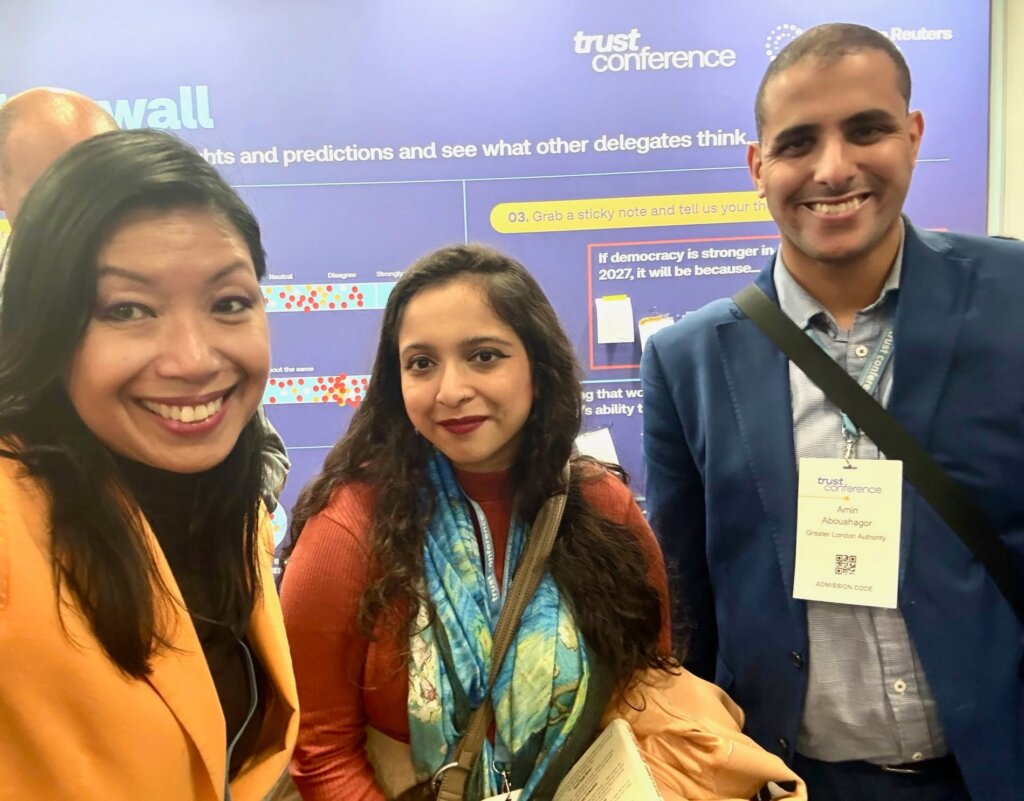
Earlier this month, Maynard Institute Programs Director Odette Alcazaren-Keeley flew to London for the Thomson Reuters Foundation Trust Conference, the Foundation’s flagship annual event that “brings together an international audience of civil society, media, the private sector and government leaders who are working to strengthen democracy, protect civic space and shape responsible business practices.”
“It was a privilege to have served as a delegate representing the Maynard Institute at this year’s Trust Conference held on November 4–5 in London,” Alcazaren-Keeley wrote in an email to Maynard Institute staff. “Attendants enjoyed a powerful convening of diverse international expertise, frameworks and perspectives on pivotal geopolitical issues.”
Alcazaren-Keeley also reflected on the timing of the conference, receiving news while in London on U.S. midterm election results that brought in sweeping wins for Democrats in offices long held by Republicans.
“It was striking to be across the Atlantic, engaging in conversations with leaders spanning disciplines and continents, especially about the impact of the historic ‘blue tsunami’ from the midterm elections sweeping across the U.S. just the night before,” Alcazaren-Keeley wrote.
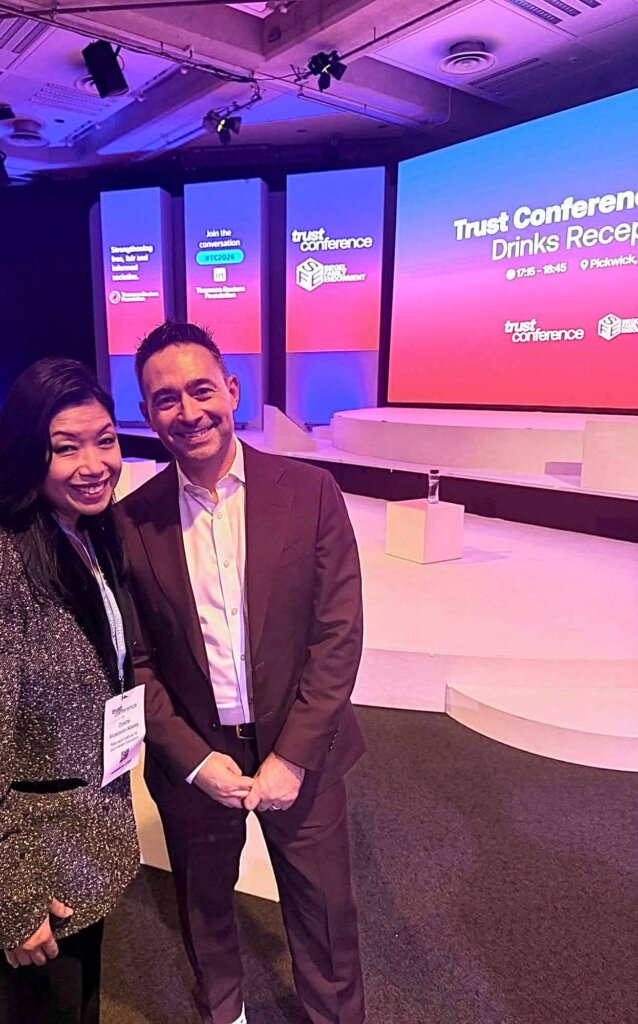
The conference’s speakers included independent journalists, human rights advocates, economists and philanthropists. Editors and CEOs joined press freedom advocates and AI evangelists, skeptics and ethicists.
Day one of the two-day event began with an examination of “the new world disorder” and consequences for democratic societies, a discussion between Věra Jourová, Former Vice President of the European Commission for Values and Transparency Democracy 27, and Joseph Liow, Dean and Wang Gungwu Professor in East Asian Affairs, Lee Kuan Yew School of Public Policy, NUS.
James Clayton, Tech Editor for the Bureau of Investigative Journalism led a presentation on AI extremism and content farming by scrutinizing a far-right “music artist” with a large presence on Spotify created entirely through AI, and is being exploited to create polarizing and hateful content online.
Further discussions on “information integrity” and “trust, democracy and impunity” shaped a view of a lawless internet information landscape in which accountability and trust have been eroded by the availability of disinformation and the exploitation of emotion and political discourse.
At the same time as governmental institutions and news organizations have been stripped of public trust, journalists and civil society organizations have struggled to maintain balance amid legal challenges and loss of funding. Through a practice called “lawfare,” political forces employ litigation, regulatory complaints, and smear campaigns, strangling funding and producing a chilling effect with regards to nonprofit advocacy organizations and groups.
“The chilling impacts of lawfare attacks further exacerbate the shrinking civic space problem,” Kay Guinane wrote in a 2021 report on lawfare and the suppression of civil society in 2021.
Further breakout sessions on the first day of the conference discussed cyber resilience and legal armor, led by journalists in exile like Natalia Belikova of Press Club Belarus and human rights and digital security advocates. Belikova has been in exile from Belarus on and off since 2010, and hasn’t been back to her home country since 2019 due to the authoritarian rule of Belarusian President Alexander Lukashenko, whose administration is responsible for an increase in the arrests of journalists.
Speaking to the Washington Post in August of this year, Belikova shed light on the administration’s hostility towards the free press, which has pushed many Belarusian journalists to leave home.
“Belarusian independent media are mostly working in exile because independent press is outlawed inside the country, and the state maintains very strict control over the information space, so they qualify any dissent as extremism or terrorism,” Belikova said.
Belikova’s presence as well as the presence of Ahmed Shihab-Eldin, highlighted the true risks to holding power to account, and what the world risks collectively by jailing or silencing journalists covering authoritarian regimes, civil unrest, war, genocide, occupation and invasion.

Shihab-Eldin, an American of Palestinian descent who also holds Kuwaiti citizenship was arrested in Kuwait and held for six weeks after filming “a US F-15 fighter jet falling from the sky and crashing near Kuwait City, as well as photos that he said showed an American pilot who had ejected and landed in the al-Jahra area,” according to the BBC. Shihab-Eldin believed the jet activity was connected to the U.S. military action in Iran, and was charged with “spreading false information, harming national security, and misusing a mobile phone.” He was later stripped of his Kuwaiti citizenship.
Day one closed with a keynote address from Thomson Reuters CEO Antonio Zapulla.
Dr. Nathan Cooper, Chief of Staff at Kaleidoscope and an attendee of the Trust Conference reflected on the impact of Zappulla’s words on LinkedIn, writing: “The near-flawless opening keynote set the tone in one line: ‘We managed to wipe out 50 years of democratic progress.’
“Then the uncomfortable truths kept coming one after another… ‘Information is now “the new currency of power,”’ ‘Manipulation is getting cheaper. Detection is getting harder.’ An AI-generated rapper with over a million Spotify streams I actually had never heard of until today, pushing far-right messages, whose creators were only found because they slipped up. A 24-year-old in the audience calling community ‘the biggest casualty of the modern age.’”
However, if the first day of the conference appeared bleak as it took stock of assaults on democracy, press freedom and human rights, day two was determined and sharply concentrated on tactics for fighting back.
Laurent Richard, CEO of Forbidden Stories, led a session on “Exposing the machinery of digital repression.”
Maria Ressa, Filipina journalist and Co-Founder and CEO of Rappler, discussed her new book with Allesandra Galloni, Editor-In-Chief of Reuters. The book, “The Fight Back: A Citizen’s Guide to Standing Up to Dictators,” comes after Ressa has faced years of prosecution under Philippines former President Rodrigo Duterte, who now faces trial at the International Criminal Court.
Alcazaren-Keeley, a longtime broadcast journalist in Manila, shared her excitement at seeing Ressa speak on fighting authoritarianism and defending democracy.
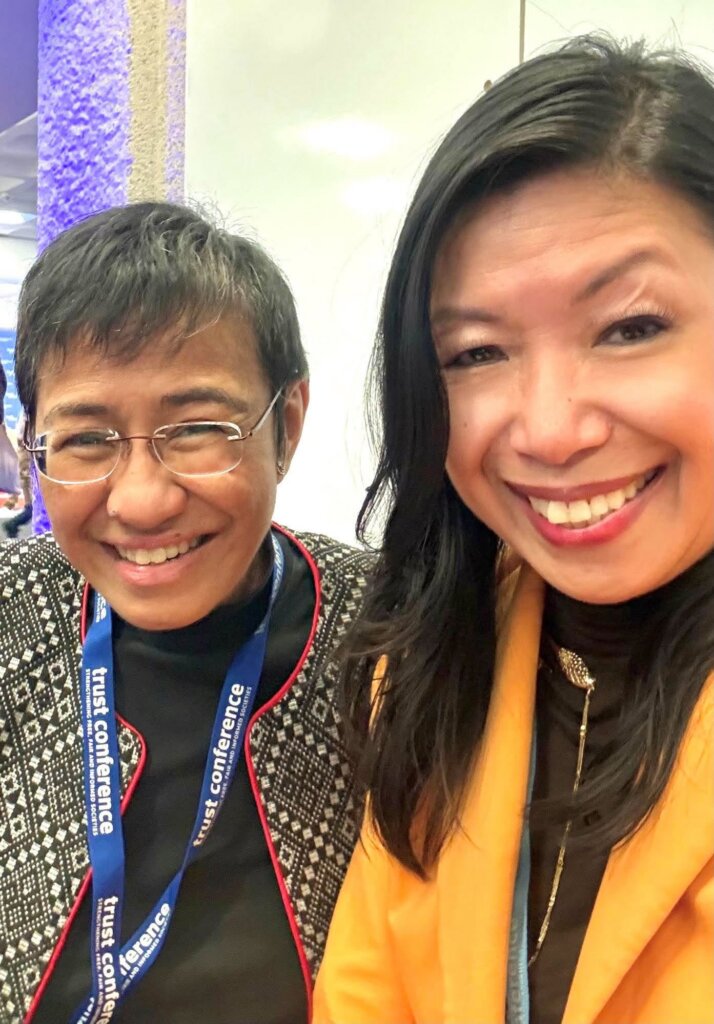
“I remain inspired to have met and shared our Maynard mission with fellow delegates and international thought leaders, among them our homeland’s own fearless journalism warrior, Nobel Peace Prize laureate from the Philippines Maria Ressa,” Alcazaren-Keeley wrote. “Maria provides in her latest book her action plan for citizens to ‘Fight Back’ against this modern wave of authoritarianism, including at its tactical core – the erosion of information integrity. Her manifesto galvanizes citizens of the world with actionable steps to ‘defend democracy, reclaim human agency from predatory technology, and rebuild a shared reality anchored in truth.’”
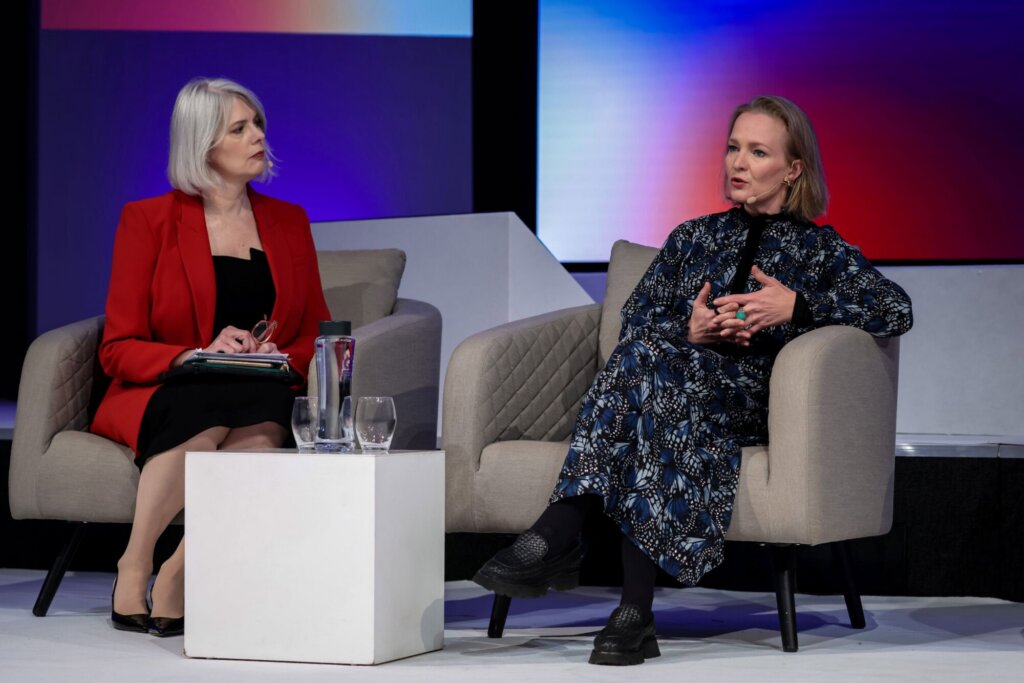
AI continued to dominate many of the sessions and conversations, though discussions centered not on the inevitability or supremacy of AI in journalism technology, but on the need for ethical guardrails and regulations as AI continues to spread.

“Maynard Institute programs seek to embolden media professionals representing a wide spectrum of diversity, in order to lead news spaces with courage, strengthen a culture of belonging and defend human agency in this accelerating AI race,” Alcazaren-Keeley said.
From sessions entitled “Protecting the Real Value of Journalism: What AI Can – and Can’t – Replace” to “Cohesion or conflict? AI’s impact on the social fabric,” it would appear presenters and speakers shared Alcazaren-Keeley’s concerns and desire for ethical use of AI as a tool for knowledge growth, rather than an extractive system prioritizing profit over human rights.
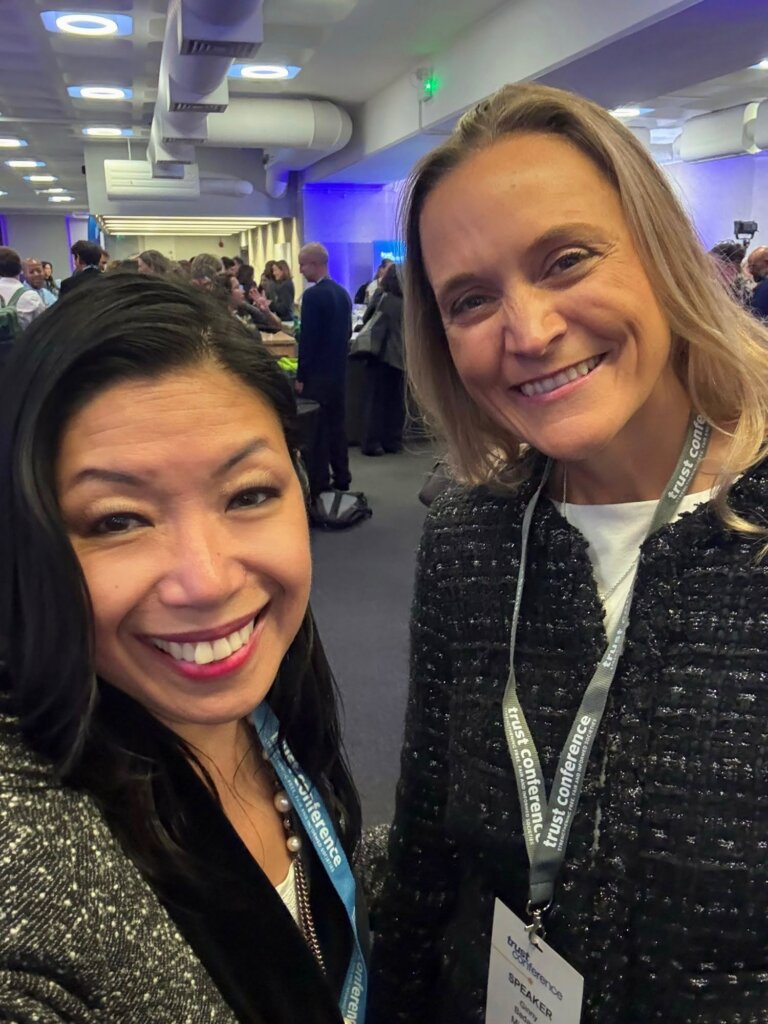
“Our Maynard mission to advance the next generation of journalists with professional proficiency, confidence and resilience – through adaptive training and community-building experiences – resonated with fellow global leaders at the intersection of public trust, journalism and democracy who gathered at this year’s Trust Conference,” Alcazaren-Keeley shared with Maynard Institute staff.
“We are driven by renewed urgency especially in this era of mounting lawfare against journalists and imperiled information integrity. Being in conversation and community with fellow journalists and advocates underscored the strength of an international community committed to truth.
“Their expert frameworks and diverse voices will sharpen Maynard’s curriculum approach and deepen its impact in the field for years to come.”


Strong journalism depends on journalists who have the tools, opportunities and support to thrive. This Giving Tuesday, partner…
Over 2.5 days in Pasadena in late October, the cohort worked with experts in audience, community and product.…
Communities depend on healthy newsrooms and well-supported journalists to access reliable information, stay informed and participate in civic…