News / Blog

Vision25: 5 ways to get involved in the movement for racial equity in newsrooms


The Online News Association, the Maynard Institute for Journalism Education and OpenNews are committed to dismantling systemic racism in the journalism industry and transforming news organizations into institutions of belonging.
The past few months, we have worked behind the scenes scheming (the good kind) and strategizing new efforts through our Vision25 collaboration. We’ve convened newsroom leaders, spoken to funders and even brought together many of the people who were newly minted in their news organizations to address diversity, equity and belonging.
The conversations have been robust, revealing and troubling. In April, we’ll share some of what we’ve learned, including how the concept of belonging emerged as the aspiration we are pushing to see operationalized across the news industry.
Meanwhile, we’d like to share with you five opportunities to participate in Vision25 this month—through a fellowship, an event, a coalition, and resources to ensure information equity. And there is more to come.
5 ways to participate now
Maynard 200 Fellowship Program: Apply by March 5
The Maynard 200 Fellowship is the Maynard Institute’s signature professional development program for media professionals of color. The fellowship provides cutting-edge training and year-long mentorship for leaders, storytellers and media entrepreneurs of diverse backgrounds guided by the expertise of a distinguished faculty across relevant disciplines. The program supports and emboldens the next generation of leaders, creators and founders of new media ventures. Diverse media executives advance belonging in their newsrooms, thereby advancing the goals of Vision25.
Apply to the Maynard 200 Fellowship by March 5
Maynard 200 Application Form
Maynard Institute’s Belonging in News series
The third episode of Belonging in the News is coming up on Wednesday, March 10 at 3 p.m. EST / 12 p.m. PST. Martin G. Reynolds, event moderator and co-executive director of the Maynard Institute, will discuss institutions of belonging with Pulitzer Prize-winning journalist, author and correspondent for CBS News, Wesley Lowery. In addition to discussing his experience investigating police shootings for The Washington Post’s “Fatal Force” project, we will discuss his own journey to find belonging as a journalist.
Register to join the conversation
OpenNews is launching the DEI Coalition For Anti-Racist, Equitable, And Just Newsrooms
Over 100 community volunteers have worked to create a digital community space dedicated to learning and taking concrete actions to create newsrooms and workplaces that are anti-racist, equitable and just. The space will serve as a place to work in solidarity across all levels of experience, on challenges members face in moving DEI forward in their newsrooms, and collectively creating strategies and resources to tackle those challenges. The development of this space has embodied the values of belonging that Vision25 is all about: OpenNews has intentionally designed the space with community leaders and members as a collaborative process. You can sign up to receive a notification when the community space, hosted on Slack, opens later this March.
Get notified when the DEI coalition community space opens soon
The Online News Association’s resource database for information access equity
The #ONAinfoequity database provides resources for journalists to engage communities that are historically under- or misrepresented in the media and ensure equitable access to information. Free Press’ Vanessa Maria Graber and ONA Board member Anita Li led over a dozen journalists to collaborate on this project through an ONA Community Circle. It’s a one-stop shop with guidance for identifying gaps in information access, making the case for community engagement to newsroom leadership and discovering ways to improve existing efforts.
Explore and share the #ONAinfoequity database
Support Vision25
Vision25 is a commitment by our three organizations to advance racial equity in journalism. But, to make this a reality, we need to do this together as an industry. If you’re interested in exploring funding or supporting this work, please email Irving Washington at irving@journalists.org to set up a conversation about our plans and how you can help.
Recent updates
-
- News / Inclusion in News
Town Hall and Book Excerpt: Dismantling Systemic Racism in News
Read an excerpt of the essay written by the Maynard Institute's Co-Executive Director, Martin G. Reynolds, for the…
- News / Inclusion in News
ASU Shaufler Prize in Journalism Call for Submissions
The prize is awarded to the best journalism in the country that advances the understanding of stories and…
Simplified Summary
Five opportunities to connect with us.
Converse & Convene

Charlene Carruthers, author and strategist, was a panelist at MIJE’s Converse & Convene dinner.
WASHINGTON, DC – With trust in the media still recovering from an all-time low in 2016, the Robert C. Maynard Institute for Journalism Education convened a group of journalists and other stakeholders Oct. 29 for a candid conversation about their roles in a democracy.
“We are all in our silos, and we cannot afford to be,” said Martin G. Reynolds, co-executive director of the Maynard Institute. “These three constituencies are vital to our society as those seeking media justice work to address inaccurate portrayals, net neutrality and media consolidation, while movement or issue activists seek to change our society through organizing and public protest — and all this as journalists seek to tell the stories of humanity and hold truth to power.”
A group of more than two-dozen attended the Oct. 29 “Converse & Convene” dinner, the first of two gatherings sponsored by a grant from the Nathan Cummings Foundation. Attendees included a diverse set of reporters, editors, educators, funders, activists and organizers. The event was fittingly held inside the Fourth Estate Room at the National Press Club and was facilitated by Keith Woods, NPR’s vice president of newsroom training and diversity.

Converse and Convene dinner attendees.
The dinner’s aim was to facilitate a dialogue surrounding a shared goal of more inclusive journalism, contextualized and informed by the people who are often excluded from the conversation. Its intent was also to build relationships and foster communication between groups that oftentimes must collaborate to tell stories no one else will.
Trust and confidence in mass media has risen 13 points from a dismal low of 32 percent two years ago, but it’s still 27 points below its high-water mark from 1976, according to annual Gallup polls.
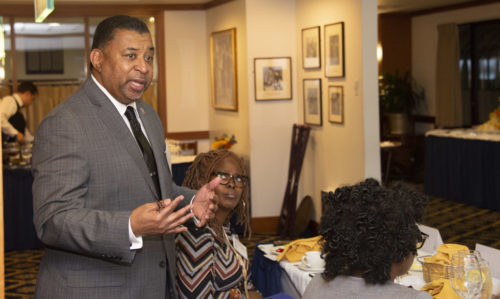
Monte Young, Newsday
The role of journalism and journalists has changed over the last four decades. The traditional mold of journalists still exists, but present-day reporters are being undermined by an administration that dismisses critical coverage as “fake news” and casts them as “the enemy of the people.”
Even those who claim to be objective are under attack. President Donald Trump and the White House blame the fourth estate for an especially violent week in America that saw 11 people murdered in a synagogue, two African-Americans killed by a white supremacist and more than a dozen high-profile Democrats and donors targeted by a serial mail bomber who appears to be a fervent Trump supporter.
The blame game continues despite the fact that CNN has been sent suspicious packages in recent days and five people were gunned down at the Capital Gazette newsroom in Annapolis, Maryland, earlier this summer.
Dinner participants acknowledged the tension between each of their roles, and most agreed that a firewall should separate them. Veterans emphasized that the role of reporters is simply to tell the truth, a mission that sometimes upsets activists who struggle to have their stories shared or have their own ideas about how a story should look.
Reporters and editors made clear that while the end result may not always be ideal, they’re constantly fighting behind the scenes to produce under-covered stories and include language that’s often stripped away by copy editors who aren’t comfortable working through stories involving race and culture.
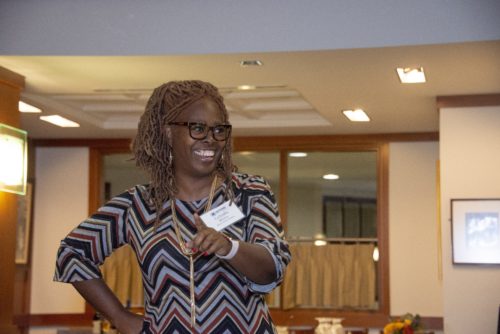
LaTosha Brown, Black Voters Matter
A split emerged when it came to bias among reporters. More experienced journalists upheld objectivity as a basic tenet of journalism, while others made the case for having bias and owning it — like the owners of television networks, TV stations and newspapers. As one millennial put it, having to choose between activism and journalism for her is like having to say whether she’s black or a woman: the two can’t be separated.
Activists said they want journalists to see how an imbalance in the foundation of journalism impacts their work, and they challenged the notion that there are only two sides to any story. LaTosha Brown, co-founder of Black Voters Matter, said people of color are often marginalized because stories have always been slanted in favor of the majority.
Brown took issue with the perceived value of a story and highlighted what she called the “sins of sensationalism,” the misconception that black readers only want to see sensational stories. She acknowledged that African-American reporters sometimes don’t want to be pigeonholed into covering the so-called “black” story but asked: “If you don’t take our stories, who’s gonna take our stories?”
“I’m not saying that there’s not other journalists that will, but there is a particular kind of framework and nuance and culture competency that you can capture,” she explained.
Editors noted that newsrooms respond to metrics. So one idea for activists to have a larger impact in media coverage is to promote the stories that do get told. High engagement and social media reach are data reporters and editors can point to when the higher-ups are wary of pursuing a particular story.
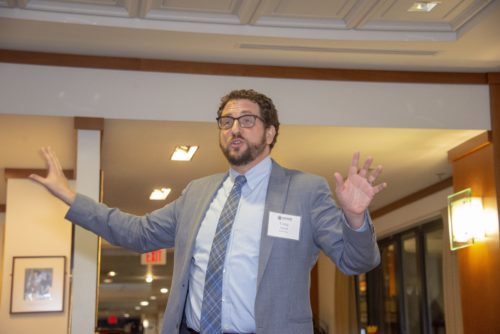
Craig Aaron, Free Press
It’s also important that each constituency understands — and learns — what the others do, attendees said. Like journalists, organizers are also trained. They learn how to agitate and interact with systems to transform them but don’t necessarily seek media attention for their work.
“We are oftentimes taught as organizers to not organize for media attention and to be wary of journalists and that our work is not for the sake of being visible or for the sake of the sensational story or anything,” said Charlene Carruthers, an author and strategist. “It’s to drive forth a strategy to achieve a desired change.”
Critics said TV networks’ exclusion of journalists and freelancers who don’t get booked because they don’t work at mainstream publications like The New York Times or Washington Post limits exposure to and muzzles reporters at smaller organizations who are subject-matter experts on local issues and topics they cover. They also lamented that TV networks are dominated by commentary instead of news reporting.
Participants presented a lack of funding as another challenge to storytelling. It’s tough to organize without money, they said, and hard to generate exposure without the proper resources in newsrooms to dig into issues.
The solution to any of these problems is unclear, but attendees believe a step in the right direction is more collaboration with one another and more conversations with the communities they serve. The idea that all three constituencies are working for their respective communities is the common cause that unites them.
Said Woods: “If we have a common interest in the people and principles we serve, then there’s something to be gained from talking across these titles and understanding what we have to offer to one another and testing the boundaries of collaboration.”
Recent updates
- News / Blog
The Maynard Institute condemns arrests of Georgia Fort and Don Lemon for reporting on Cities Church in St. Paul, Minnesota
- News / Inclusion in News
Town Hall and Book Excerpt: Dismantling Systemic Racism in News
Read an excerpt of the essay written by the Maynard Institute's Co-Executive Director, Martin G. Reynolds, for the…
- News / Inclusion in News
ASU Shaufler Prize in Journalism Call for Submissions
The prize is awarded to the best journalism in the country that advances the understanding of stories and…
Simplified Summary
The Maynard Institute gathered a group of journalists to discuss their roles in a democracy.